


B2B ecommerce is the largest commercial market in the world, and most of the companies competing in it are doing SEO the wrong way.
Not because they’re ignoring it. Organic search generates 44.6% of all B2B revenue, more than double any other marketing channel. Most B2B marketing teams know SEO matters. The problem is they’re running a B2C playbook on a B2B site and wondering why it isn’t converting.
In this guide, I’ll break down what’s actually different about B2B ecommerce SEO, where most strategies fall short, and what to prioritize instead.
Audio summary
B2B Ecommerce SEO Opportunity CalculatorFind the pages, technical assets, and trust signals most likely to move qualified organic demand. Open tool
Business inputs
Adjust the inputs. Results update automatically.
High opportunity
Strong upside across product and category visibility.
Listen to the article summary
A short version to review the main ideas about B2B ecommerce SEO.
Free PDF
Download the B2B SEO playbook
Save the guide to review priorities, key pages, and signals that help Google and AI systems understand your B2B ecommerce site.
Download PDFB2B buyers don’t behave like B2C shoppers
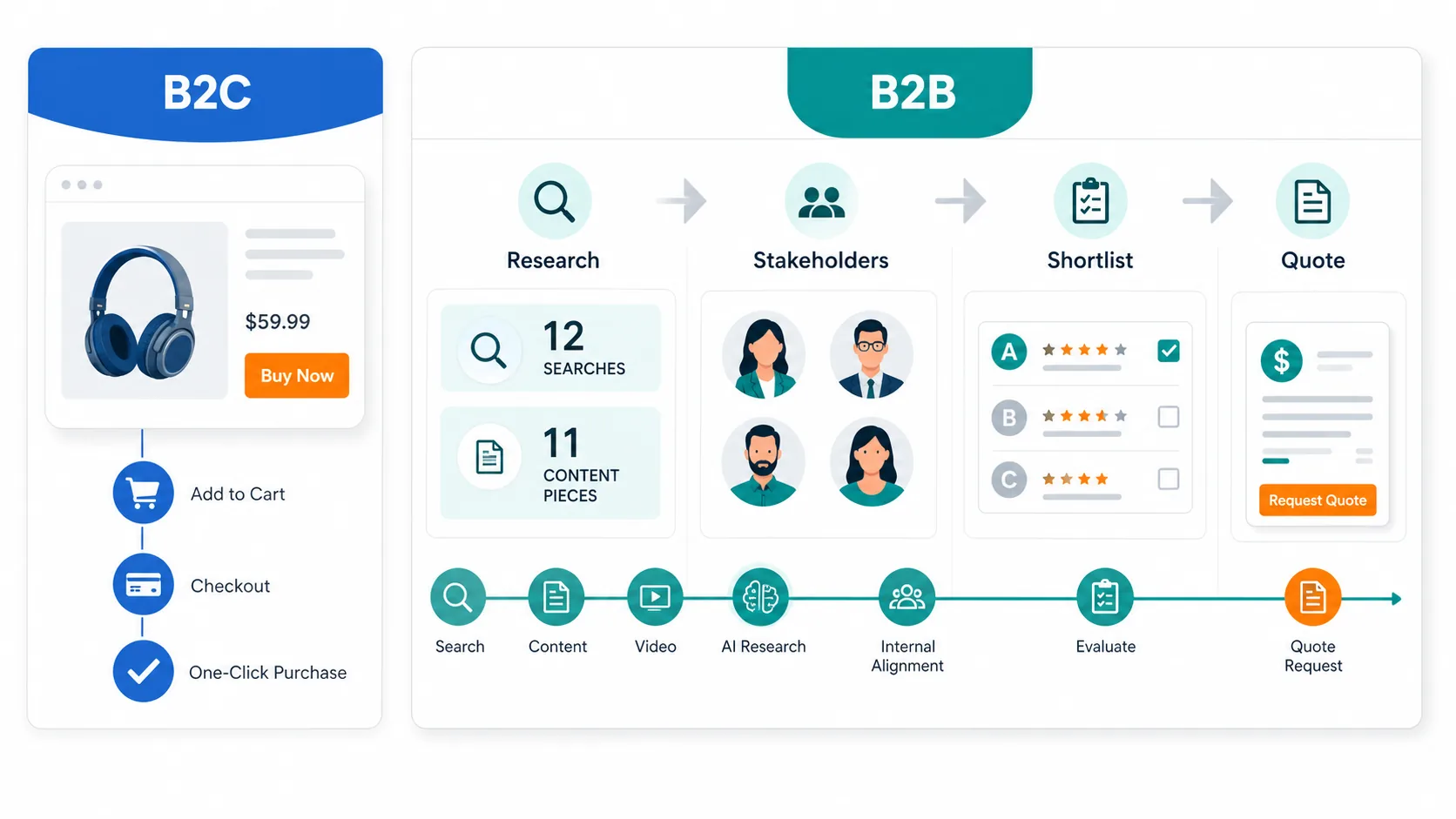
This sounds obvious. The implications aren’t.
The average B2B buyer reviews 11.4 pieces of content before they’re ready to contact a vendor. They don’t land on your product page and buy. They research for weeks, loop in multiple stakeholders, and arrive at the first conversation with you having already done most of the decision-making.
Here’s what that means for SEO specifically:
81% of B2B buyers already have a preferred vendor in mind before making first contact. Which vendors they’re even considering is largely determined by what they found during the research phase. If you weren’t visible then, you’re not on the shortlist.
B2B buyers conduct an average of 12 searches before engaging directly with a vendor’s website. That’s not one visit. It’s a multi-session process where your content needs to show up at multiple points in the funnel.
89% of B2B buyers use generative AI in at least one stage of their purchasing process. More on that later.
The practical implication: B2B ecommerce SEO doesn’t start at the product page. It starts much earlier, with content that answers the questions buyers have before they even know they need what you sell.
Why B2B ecommerce SEO is different from B2C
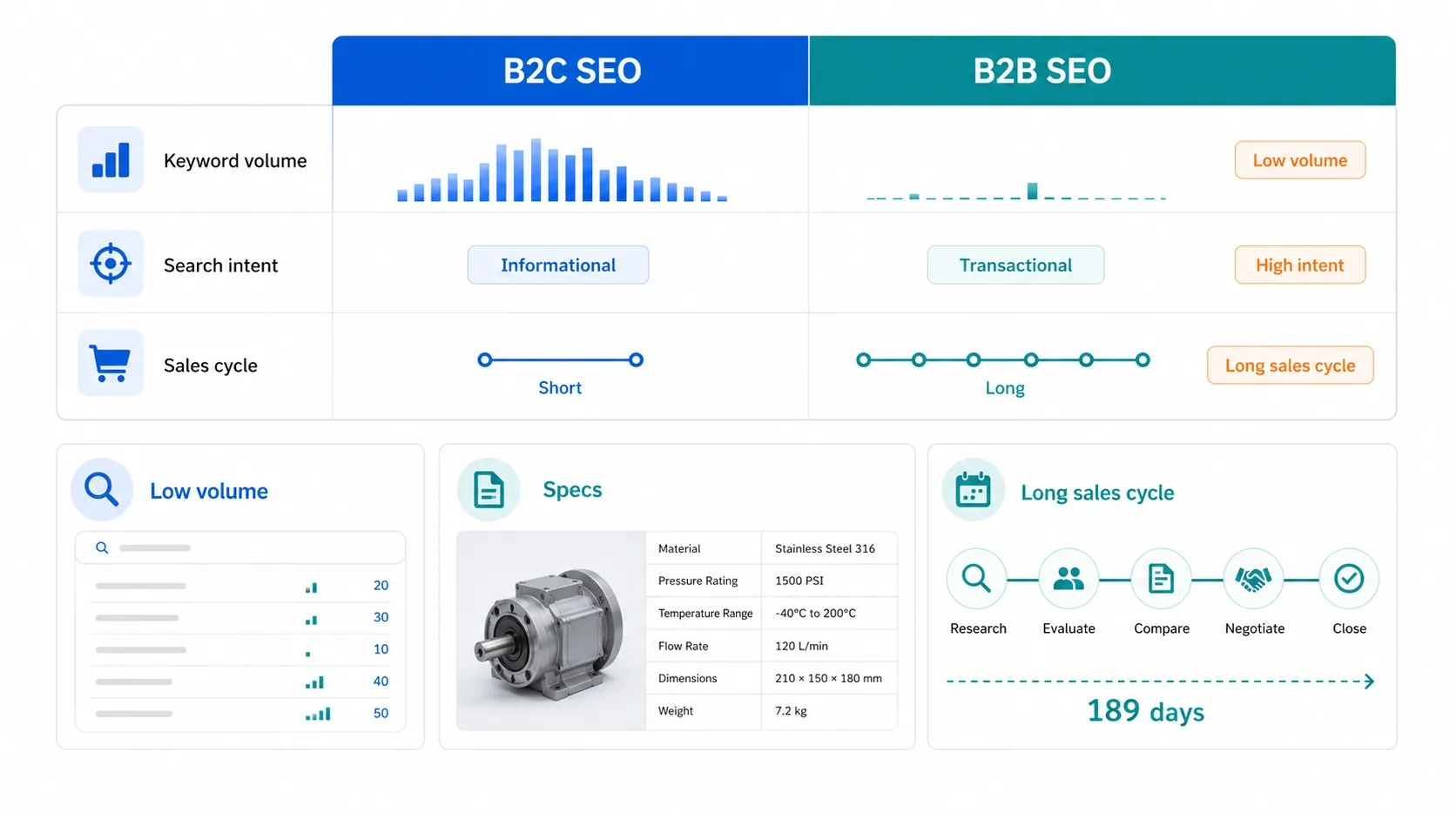
There’s no separate B2B algorithm. Google ranks B2B and B2C sites the same way. But in practice, almost every tactical decision looks different.
Keyword volumes are misleadingly low
In B2C, a keyword with 50 monthly searches usually isn’t worth building a page for. In B2B, it might be exactly the search a procurement manager at a €50M company runs when they’re ready to find a supplier.
While B2C sites typically go after keywords that thousands of people search for each month, in B2B you might target a keyword that gets 50 searches per month, or even 10.
Using volume as your primary filter in B2B keyword research is a mistake. Commercial intent and buyer profile matter more than how many people search the term.
Product pages need completely different content
Unlike B2C pages, which often focus on emotional appeal, B2B product pages need to highlight technical specifications, pricing structures, bulk discounts, and business account benefits.
A B2B buyer landing on a product page needs to know: does this fit my process, can you handle the volume I need, what are the pricing tiers, and does this integrate with my existing systems. A product sheet that reads like a consumer catalogue doesn’t convert in B2B.
The sales cycle demands content at every stage
The median time to close a B2B deal is 189.5 days when the journey begins with thought leadership content.
A strategy that only targets bottom-of-funnel terms captures a fraction of the potential. The bulk of the opportunity is in the buyer who’s still researching, weeks or months before they’re ready to talk to anyone.
Keyword research for B2B ecommerce
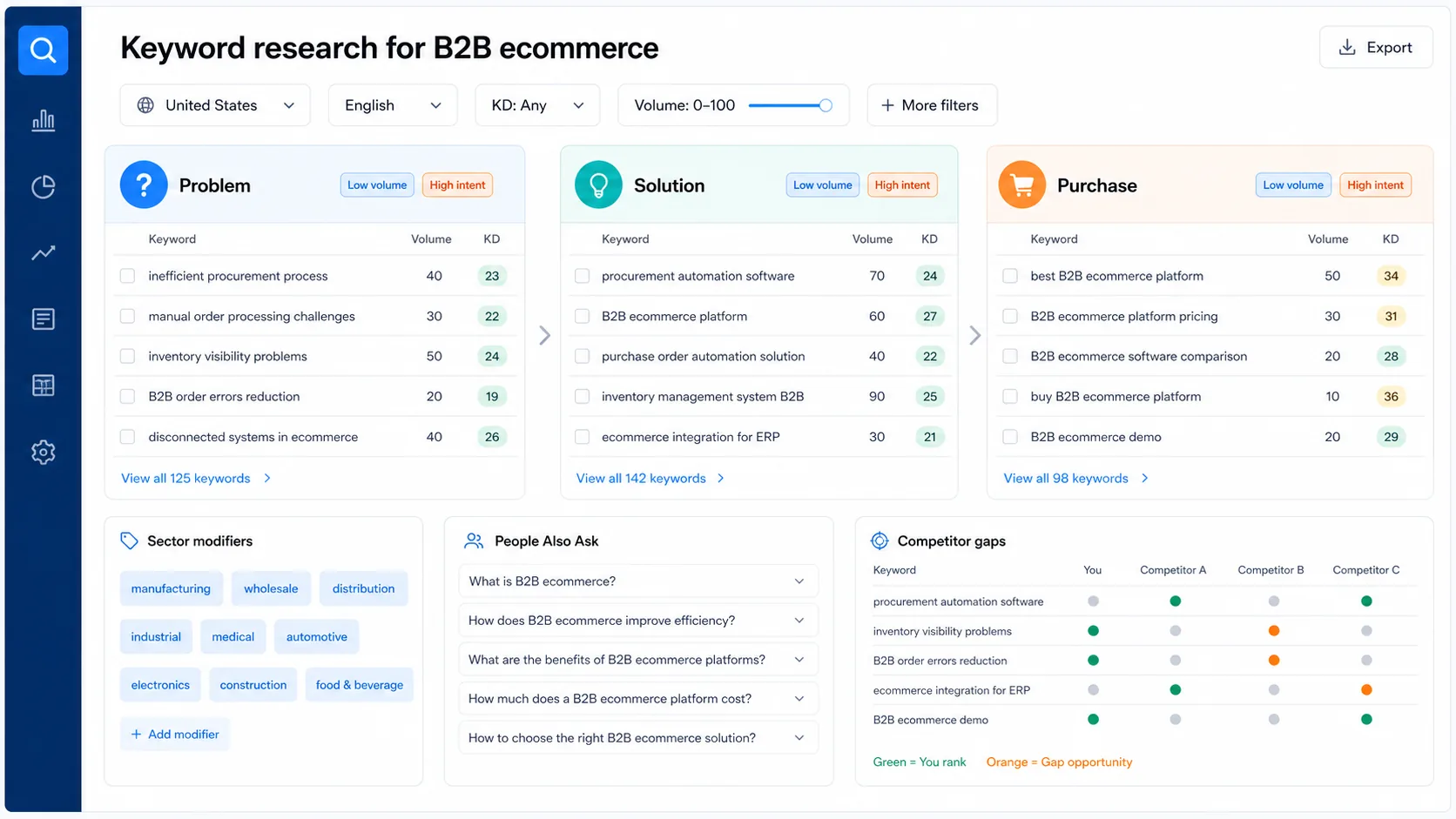
Good B2B keyword research covers three search types that correspond to three distinct moments in the buying process.
Problem-stage keywords (top of funnel)
These are searches buyers make when they have a problem but don’t yet know what solution they need. “How to manage enterprise customer orders,” “industrial equipment supplier issues at scale,” “alternatives to [manual process they’re running].”
Low volume, hard to attribute directly to revenue, but B2B clients who first engage with high-quality content require 20% fewer interactions before signing a deal. Content that captures someone here builds preference before they start comparing vendors.
Solution-stage keywords (mid funnel)
The buyer knows what type of solution they need and is evaluating options. “B2B ecommerce platform for distributors,” “catalog management software for wholesalers,” “bulk [product category] supplier with customer portal.” More competitive, more directly commercial.
The competitor research tool shows which mid-funnel terms competitors are capturing and from which pages, revealing actual gaps in the current strategy versus terms that are already heavily contested.
Purchase-stage keywords (bottom of funnel)
Direct transactional intent. Specific product names, comparison searches, terms with modifiers like “bulk pricing,” “wholesale supplier,” “volume discount,” “enterprise quote.” Low volume, very high intent.
Instead of “desk chairs” which returns results aimed at individual buyers, B2B targets “bulk desk chairs” or “office seating for corporate spaces,” which returns results for office managers looking to equip an entire workspace.
The most underused modifier in B2B
Adding sector-specific terms to generic keywords completely transforms the buyer profile. “Inventory management software” attracts everyone. “Inventory management software for pharmaceutical distributors” attracts exactly the right buyer.
The People Also Ask tool surfaces the adjacent questions around any keyword, which in B2B often reveals the sector-specific vocabulary that actual buyers use but that standard keyword research tools don’t surface.
Category pages vs. product pages: where the leverage actually is
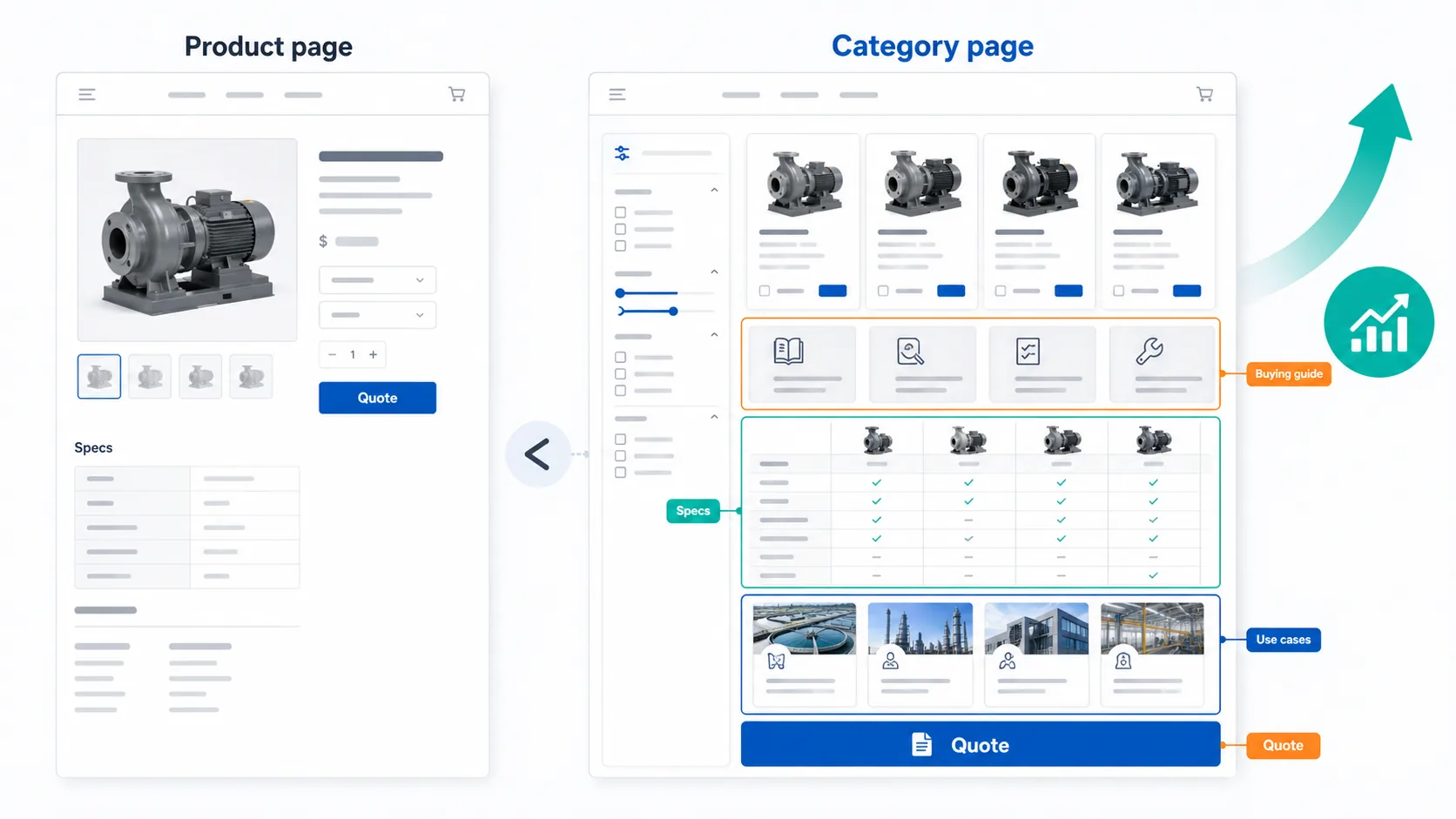
In B2C ecommerce, product pages get most of the SEO attention because they’re where the transaction happens. In B2B ecommerce, category pages are often the most valuable asset on the site, and most of them are under-optimized.
Why category pages matter more in B2B:
They capture buyers in the evaluation phase, when they’re comparing product families rather than specific SKUs. They survive product discontinuations—a hero product page becomes obsolete when that SKU goes away, a well-built category page lasts for years. And they have far more potential to capture search variants through supporting content: buying guides, spec comparisons, use-case breakdowns.
A B2B category page that ranks well isn’t a product grid with filters. It’s a page that answers the questions a buyer has before selecting a specific product: what distinguishes the options, which specs matter for which applications, what commercial terms are available at different volume levels.
The content analyzer tool identifies which category pages are underperforming relative to their potential compared to what competitors rank for on the same queries. In B2B, that’s almost always more actionable than hunting for new keywords.
Technical issues specific to B2B ecommerce
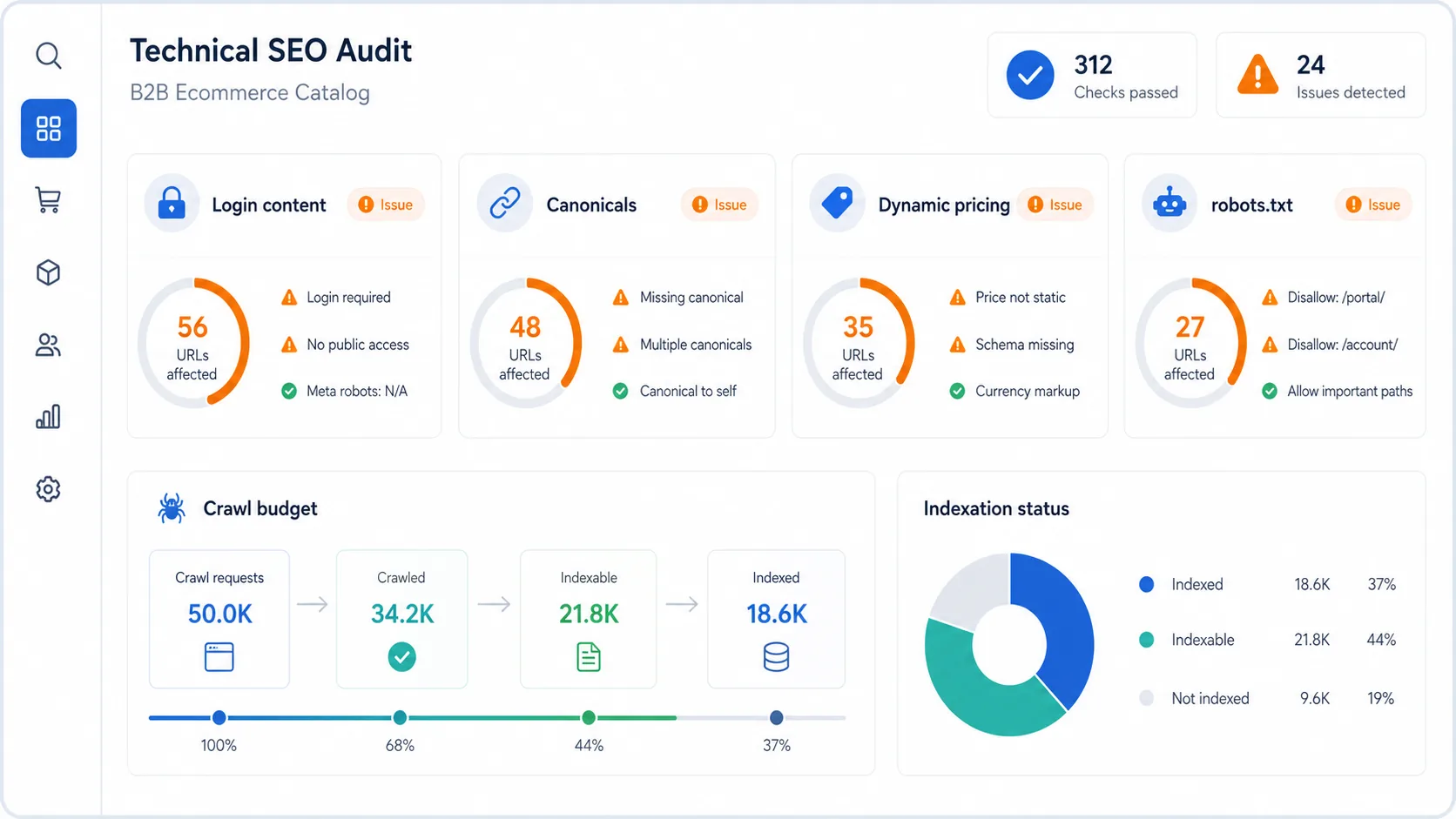
B2B ecommerce platforms generate technical problems that content sites don’t have and B2C platforms have to a much smaller degree.
Content behind login
Many B2B ecommerce sites put pricing, stock availability, or entire catalogs behind authentication. Googlebot can’t see that content. If your best product pages are only visible to registered customers, they’re not ranking.
The solution isn’t always making everything public. It’s deciding what content Google needs to understand and rank the site, and making sure that public version exists and is well-optimized, even if specific pricing or contract terms remain gated.
Large catalogs with product variants
An industrial distributor can have tens of thousands of SKUs with variations in size, material, finish, and technical specification. Each variant potentially generates its own URL. Without a clear canonical strategy, Googlebot spreads its crawl budget across thousands of near-identical pages and the pages that actually matter get crawled infrequently.
The SEO audit tool systematically identifies crawl budget waste: redirect chains, orphan pages, canonical problems on product variants, and duplicate content from filter parameters. On a large B2B catalog, these problems can affect hundreds of pages without anyone noticing because the pages load fine in a browser.
Dynamic pricing
B2B ecommerce frequently involves pricing that varies by customer, volume, or contract. If the price on the page changes based on who’s logged in, Google sees a price that doesn’t match what real buyers see, which can create inconsistencies in product schema rich results.
The standard approach is showing a base or list price in the publicly indexed version, making clear that volume or contract pricing is negotiated separately. The schema generator handles product markup with the right properties to avoid creating discrepancies between what Google indexes and what the buyer sees.
Customer portals and procurement system integrations
Many B2B ecommerce sites have integrations with ERP systems, custom client portals, or procurement tools that generate their own URLs. Those URLs frequently shouldn’t be indexed, but they also shouldn’t consume crawl budget. A properly configured robots.txt is the starting point; verifying those exclusions are working correctly without accidentally blocking pages that should be indexed is the second step.
Content that works in B2B: depth over volume
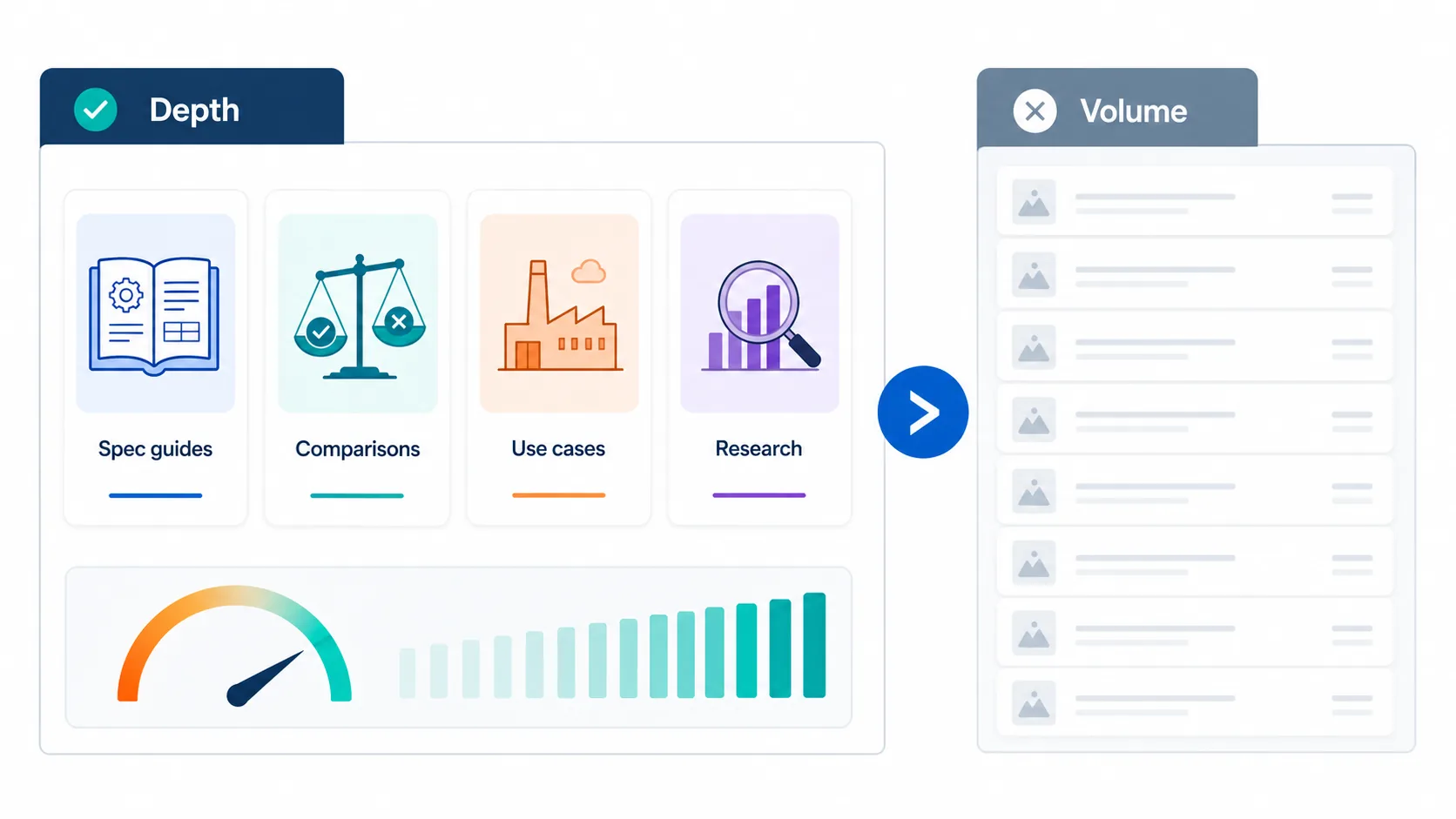
Companies publishing 16+ blog posts monthly generate 4.5x more leads than infrequent publishers. That stat is real but can lead to the wrong conclusion: that the answer is publishing more.
In B2B, depth consistently beats volume. 39% of brands report strong results from articles over 2,000 words. Not because length is a ranking signal, but because the topics that matter in B2B require substantial coverage to be genuinely useful, and usefulness is what generates both rankings and backlinks.
The content formats that convert in B2B
Technical specification guides. A buyer evaluating industrial equipment, management software, or components for integration into their production process needs to understand which specifications matter for their use case. A guide that explains this in depth captures research-phase searches and establishes technical authority before the buyer starts comparing specific vendors.
Comparison pages. “X vs Y,” “alternatives to [established vendor],” “how to choose between [product category].” B2B buyers actively search for these. 87% of B2B content has a major or moderate impact on vendor selection according to buyers themselves. An honest, well-informed comparison is exactly the type of content that creates that influence.
Use cases by industry. B2B SaaS sites that segment their target audience by industry increase organic traffic by an average of 28.7% vs. 4.1% for those without segmentation. The same principle applies to any B2B ecommerce site: a page that specifically addresses the use of your product in the pharmaceutical sector converts better for pharmaceutical buyers and ranks better for searches in that sector.
Original research. Businesses that publish original research see an 18.7% increase in SEO traffic. An industry data report, a buyer survey, a market trend analysis: these assets attract backlinks naturally and build the domain authority needed to compete on more commercial terms.
The long-tail opportunity in B2B
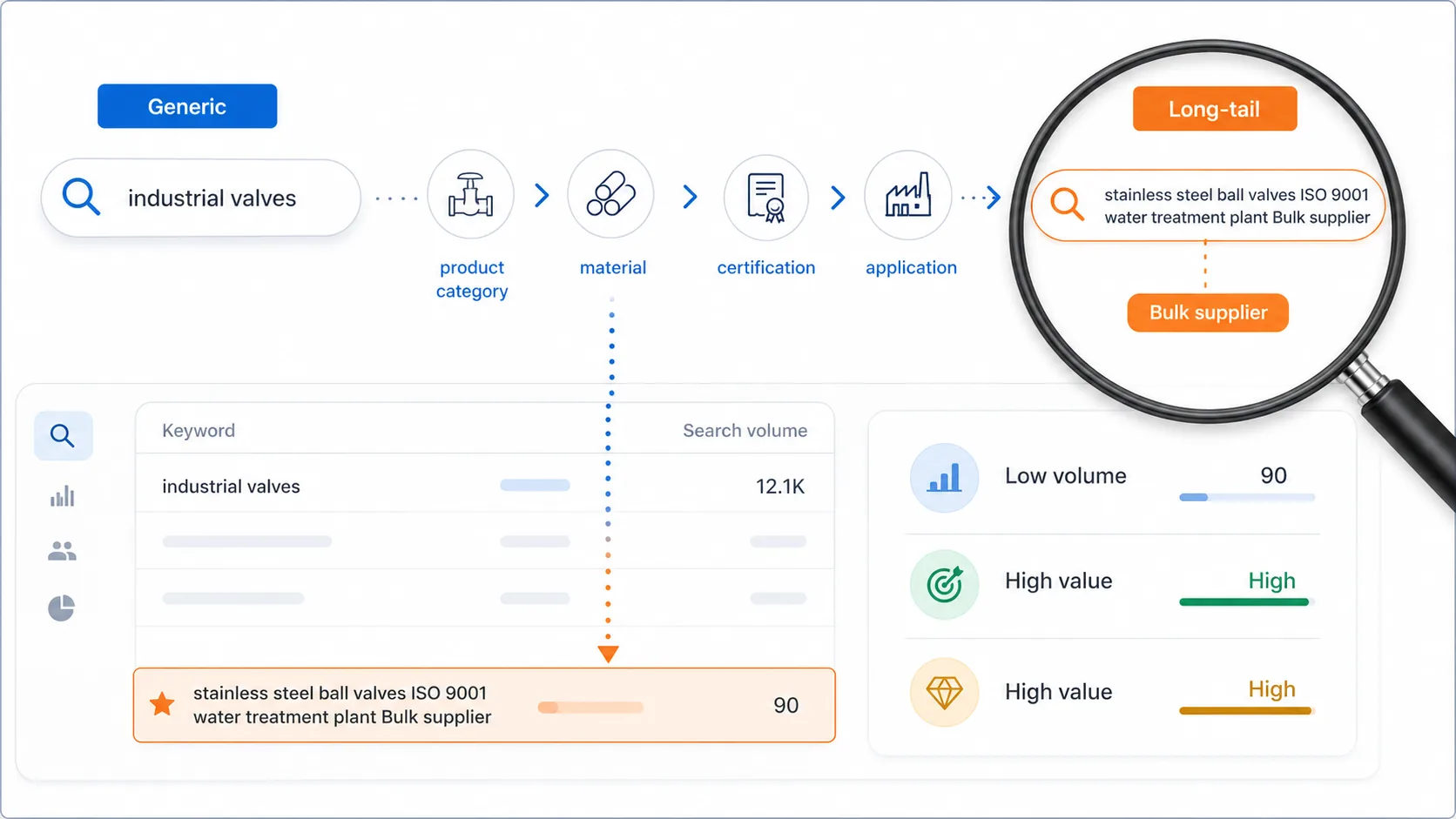
In B2B, the highest-converting keywords frequently have search volumes that a keyword research tool would flag as insufficient to justify building a page. That’s exactly the mistake competitors are making.
A manufacturer searching for “stainless steel A4 70 bolts marine applications bulk supplier” doesn’t generate much global search volume. But whoever runs that search knows exactly what they need and has budget to buy it. The average cost per lead for B2B SEO is $206, compared to Google Ads CPL which increases in 91% of industries year over year.
The strategy for capturing these ultra-specific keywords is programmatic: build category page variants organized by application, certification, technical specification, or sector. Not thin pages with a product name and little else, but pages that answer the specific questions that buyer has.
B2B ecommerce SEO and AI search
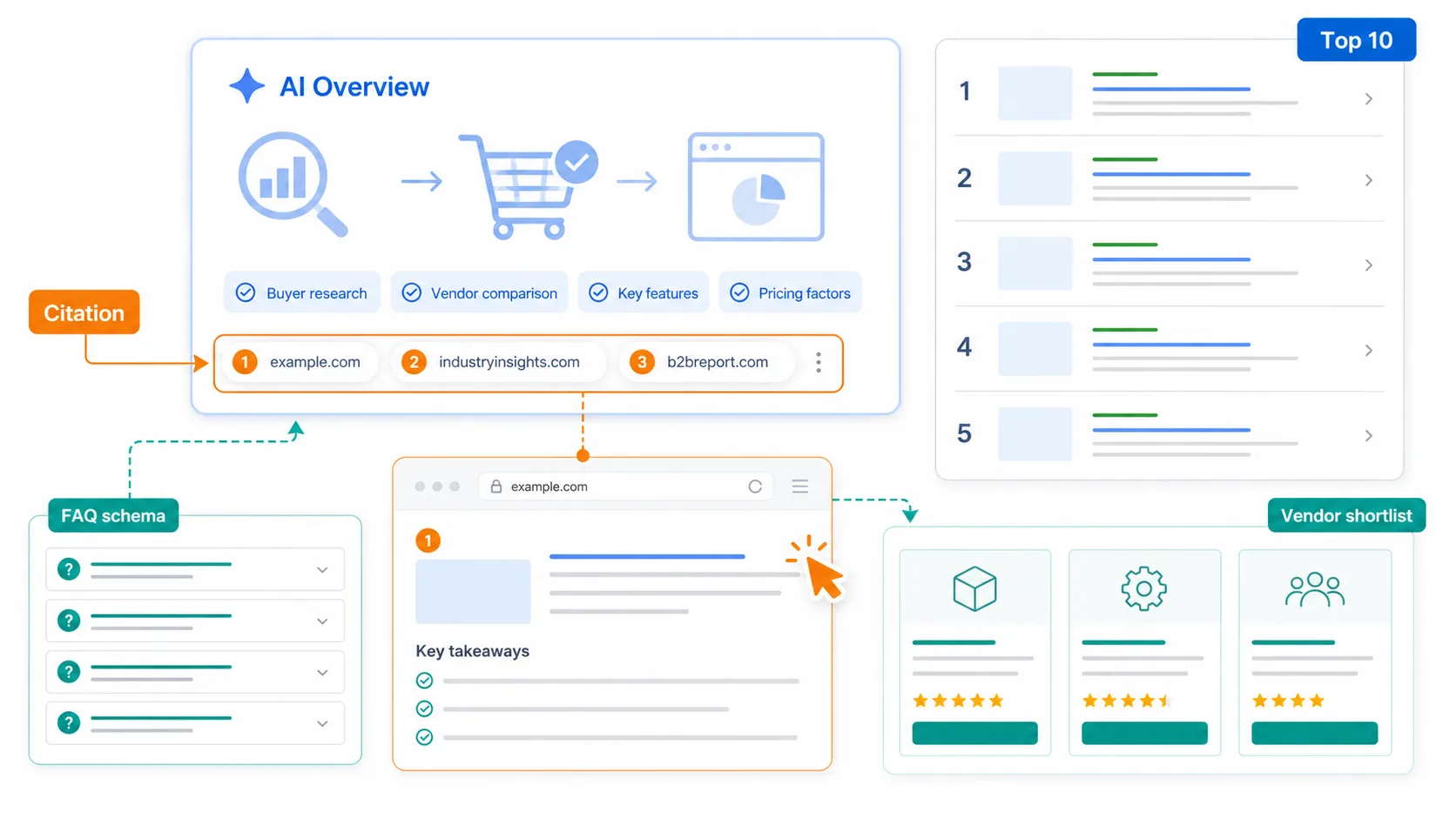
B2B buyer behavior in search has changed more in the last eighteen months than in the five years before. B2B buyers are adopting AI-powered search at three times the rate of consumers.
The data on what that means in practice:
94% of buyers use LLMs during their research process. 72% encountered Google’s AI Overviews during their most recent buying journey. And 90% of buyers who see a citation in an AI Overview click through to at least one cited source.
That last number is the important one. AI Overviews don’t eliminate B2B traffic, they filter it. Buyers who see a citation and click through are buyers who already have enough intent to investigate further. Appearing as a cited source in AI Overviews for relevant B2B queries can be more valuable than ranking in position three for the same query without a citation.
76% of AI Overview citations come from pages already ranking in Google’s top 10 organic results. Which means traditional SEO done well is the prerequisite for AI visibility, not its alternative.
The AI optimization tool tracks which pages are being cited by AI systems and which aren’t, and shows the specific structural and content changes that increase citation likelihood. In B2B, where the shortlisting phase increasingly happens inside AI interfaces, that visibility is becoming a deciding factor in which vendors even get considered.
Link building for B2B ecommerce
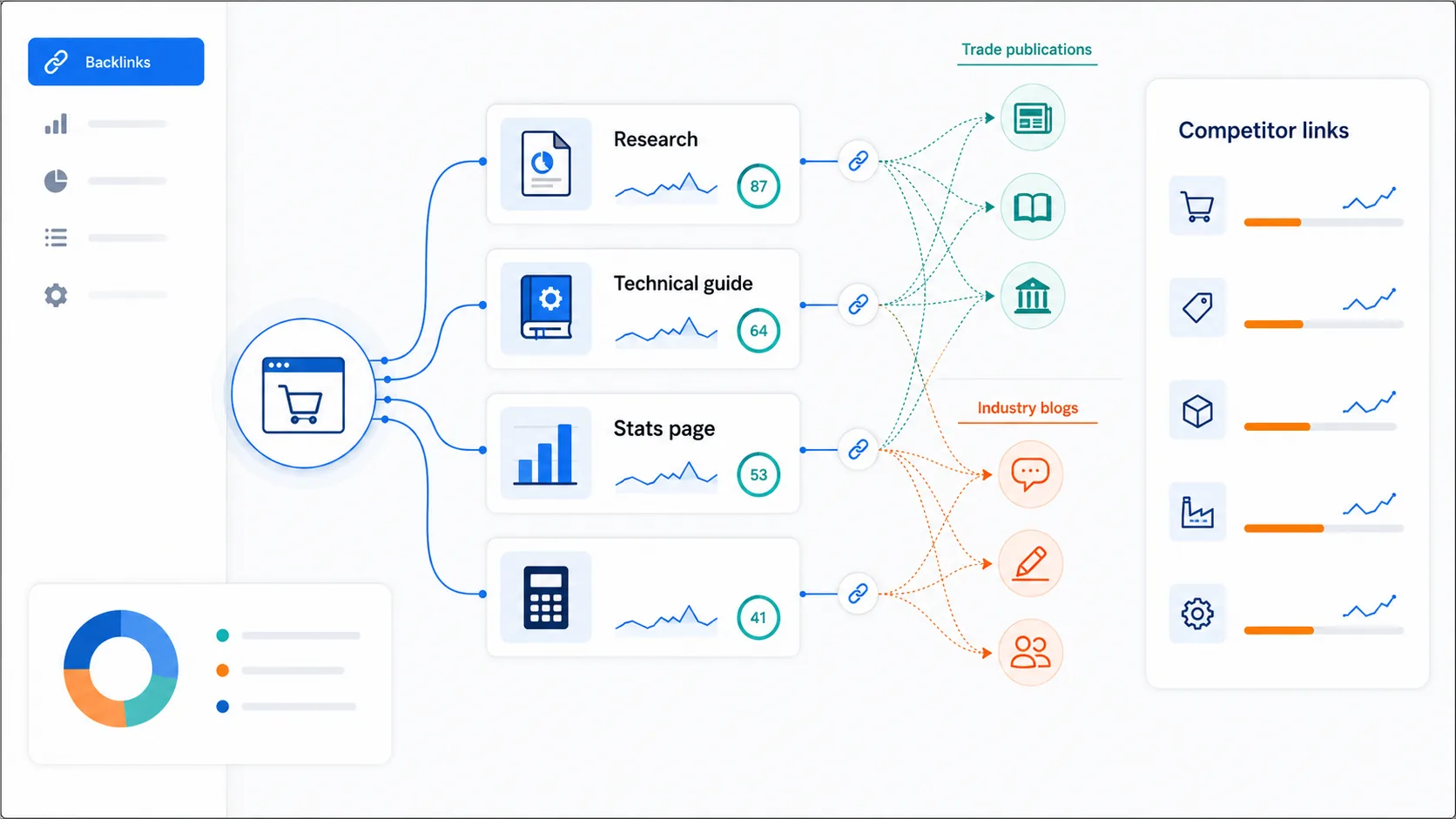
Over 90% of B2B content has zero backlinks. Most B2B ecommerce sites have weak backlink profiles not because it’s impossible to earn links in their sector, but because nobody has identified what content assets are worth linking to and deliberately built them.
The content types that earn B2B backlinks naturally:
Original research with proprietary data. Industry reports, buyer surveys, market trend analyses. Trade publications link to data they don’t have themselves.
Exhaustive technical resources. Specification guides, sizing calculators, product selection tools. Technical forums and professional communities reference these assets consistently.
Statistics pages. Pages that compile sector data get linked by analysis articles and specialist blogs looking for sources. 50.6% of B2B companies that opt for organic link building report better results compared to manual outreach, where only 35.3% see success.
The backlink explorer shows what type of content is attracting competitor links, which in B2B usually reveals replicable patterns: the same types of technical pages or research assets appear repeatedly as linked sources within industrial niches.
The metrics that matter in B2B ecommerce SEO
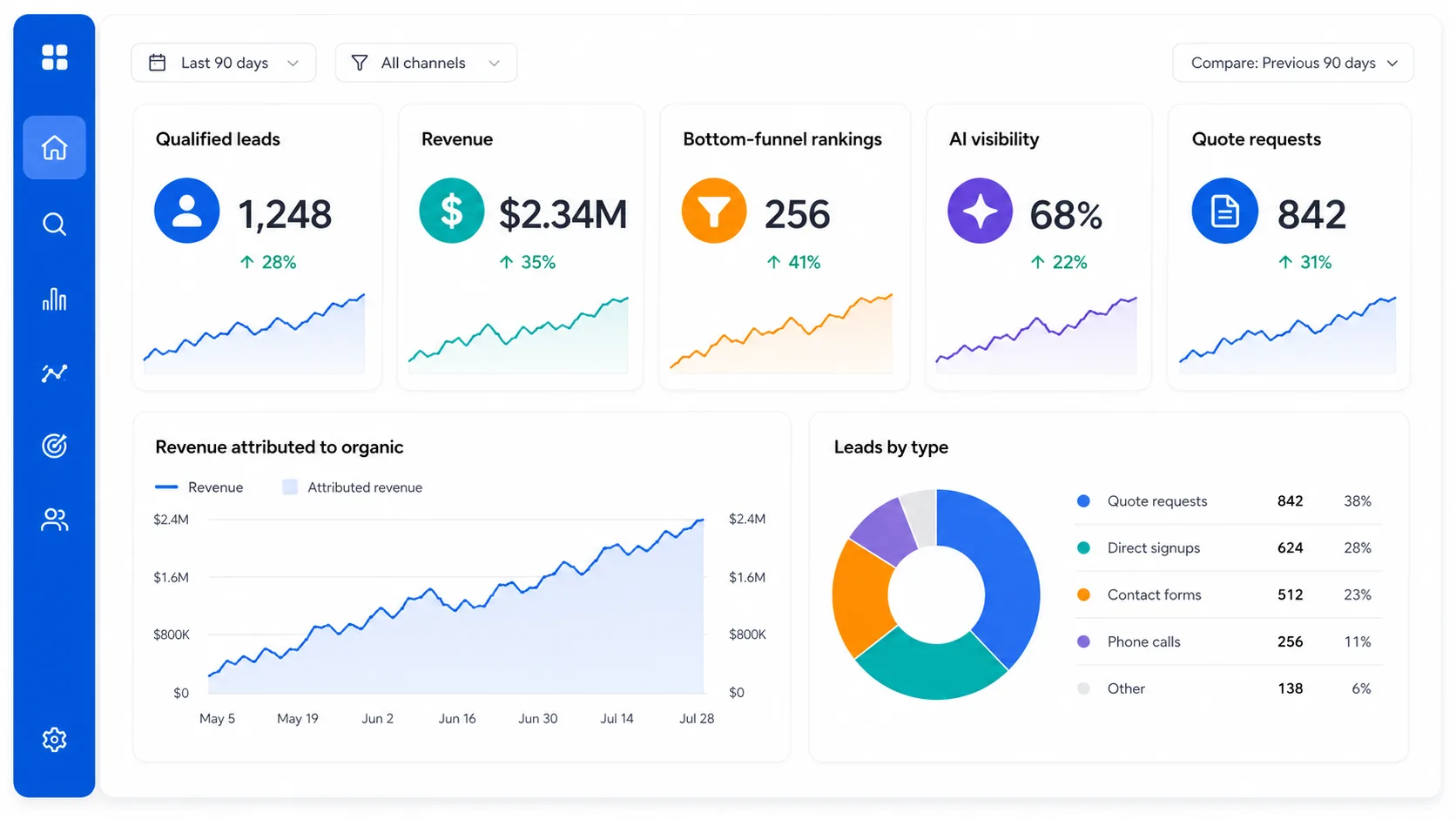
Organic traffic as the primary KPI has the same problem in B2B as everywhere else in 2026: it doesn’t tell the full story. But in B2B it has an additional complication: the attribution cycle is long enough that traffic today might convert into a lead four months from now.
What actually matters:
- Qualified leads from organic: quote requests, business account signups, catalog downloads, demo requests. Not visits, commercial-intent actions.
- Revenue attributed to organic: with multi-month sales cycles, this requires an attribution model that recognizes first touch, not just last click.
- Rankings on bottom-funnel keywords: positions on the specific transactional terms in your sector are a better leading indicator of pipeline than general traffic.
- AI visibility for buyer queries: what percentage of relevant sector searches generate a citation from your site in AI Overviews.
The rank tracker monitors position movements on the terms that actually matter to the business, separated from the noise of hundreds of informational keywords that generate impressions but not leads.
Where to start if you’re building from scratch
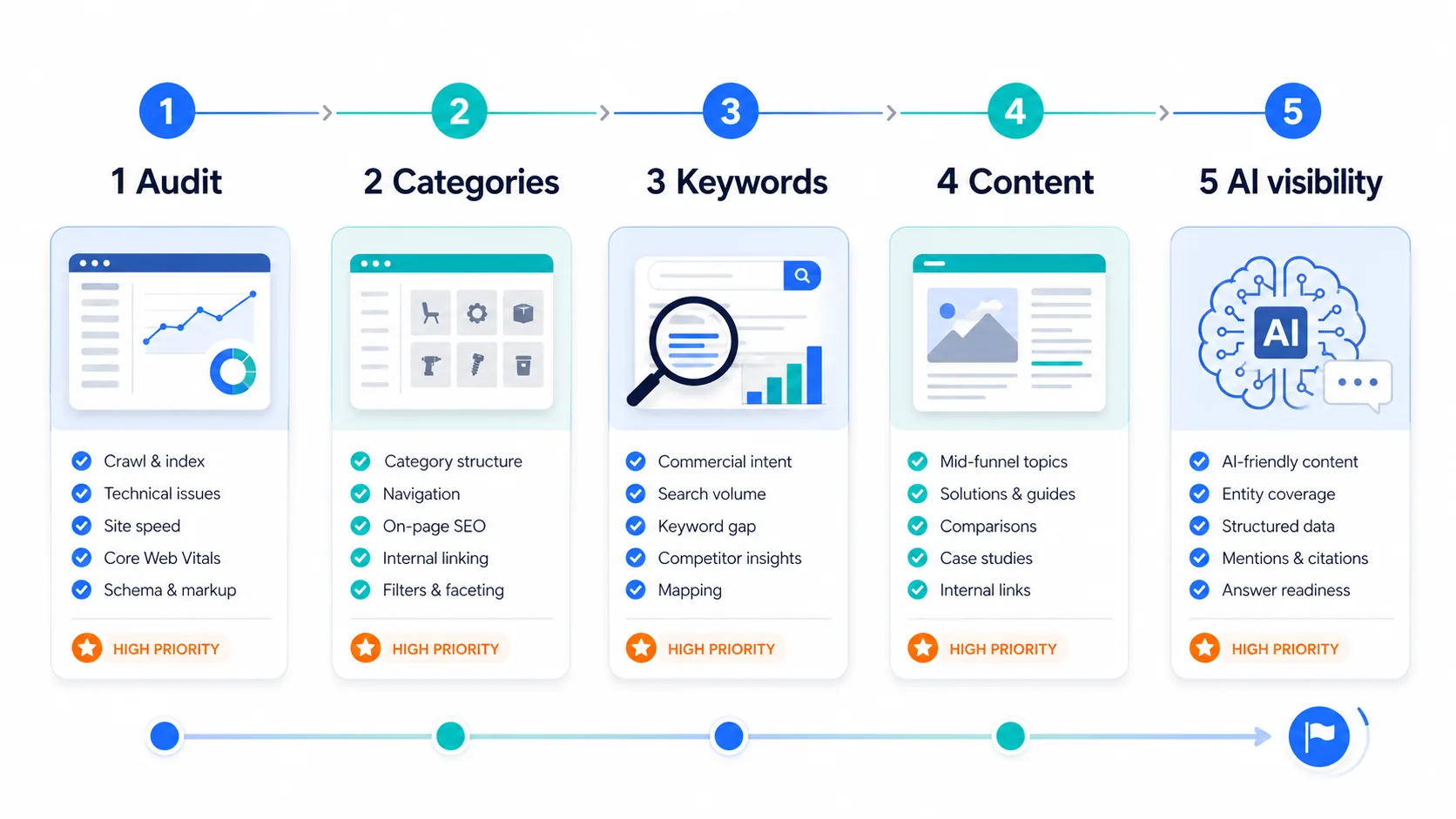
If the B2B ecommerce site has been running without an SEO strategy, or with a strategy borrowed from B2C, the right sequence is:
1. Technical audit first. A catalog with indexing problems, misconfigured canonicals, or content behind login doesn’t benefit from any content or link work that comes after it. The SEO audit gives you the full diagnostic before you invest in anything else.
2. Main category pages second. They’re the highest-leverage long-term asset. Getting them right for B2B buying intent, with substantial content and clean technical structure, produces more durable results than any content campaign.
3. Keyword research focused on commercial intent. Not volume. Intent. The keyword research tool filtered by real difficulty and paired with competitor analysis shows which terms competitors are capturing, where the actual gaps are, and which terms have the right buyer profile even when volume looks small.
4. Mid-funnel content. The technical guides, comparisons, and sector-specific use cases that capture buyers during the research phase. This content builds brand preference before the vendor evaluation even starts.
5. AI visibility. With the technical and content foundation in place, optimizing for AI Overviews and generative engines is the next layer of visibility. But it builds on traditional SEO, not around it.
SEO delivers 748% ROI for B2B companies, with break-even occurring in just 7 months according to First Page Sage research. Those numbers justify the investment. What they don’t justify is a strategy designed for the wrong buyer, built on the wrong playbook, and measured with metrics that don’t reflect how B2B purchasing actually works.
The Wisseo SEO tools suite covers each phase of this strategy: from the initial technical audit to rank tracking on the terms that matter, category page analysis, and AI optimization that increasingly determines which vendors make the B2B buyer’s shortlist.