


The honest answer is: it depends. But that’s the answer nobody comes here for, so let’s give it real shape.
Most small businesses in the US pay somewhere between $1,500 and $3,000 per month for ongoing SEO that actually produces results. Below $750, you’re mostly buying reports and activity theater. Above $5,000, you’re moving into mid-market territory where the work volume justifies the number.
The frustrating part isn’t the price range. It’s that the range is genuinely wide for good reasons, and understanding those reasons is what separates a decent investment from a wasted one.
This guide pulls from real agency pricing pages, industry survey data, and the actual line items you should expect at each budget level. No padding, no upselling.

SEO Budget Reality CalculatorCheck whether your SEO budget matches your market, stage, and required work. Open tool
What the budget must cover
Check the pieces your current investment can realistically cover.
Tight budget
It can work if focused, but not if it tries to buy everything at once.
What the market actually charges in 2026
Before getting into what affects price, here’s what you’ll find if you actually call agencies and ask:
WebFX, one of the largest US SEO agencies, publicly lists starting SEO prices at $2,500/month. Their local SEO packages start lower — around $500–$900/month for entry-level — but their full-service campaigns run $2,500 to $7,500/month depending on scope.
Boulder SEO Marketing, a well-regarded local SEO agency out of Colorado, charges a blended rate of around $125/hour and told me directly their typical small business engagement runs $2,000–$4,000/month. Their founder has been in the business since 2008 and publishes a transparent pricing guide — one of the few agencies that actually shows their numbers.

The broader survey data lines up with these real-world numbers:
| Provider Type | Typical Monthly Cost | What You Get |
|---|---|---|
| Freelancer | $500–$1,500 | One person, narrow scope, usually 1–2 specialties |
| Boutique agency | $1,500–$3,500 | Small team, local/regional focus, direct access to senior staff |
| Mid-size agency | $2,500–$6,000 | Full-service, content + technical + link building |
| Large agency (WebFX, Victorious) | $5,000–$15,000+ | Large accounts, dedicated teams, custom reporting |
| Enterprise | $10,000–$50,000+ | National/global campaigns, multiple verticals |
One number worth keeping in mind from SE Ranking’s survey of 260 agencies: 64% charge under $1,000/month. That sounds cheap until you understand most of those are freelancers doing basic citation work or one-person shops. Only 13% charge between $2,000 and $5,000 — which is actually the range where serious small business SEO happens.
The three pricing models and when each makes sense
Monthly retainer
The most common structure. You pay a fixed fee each month for an agreed set of work — technical optimization, content, link building, reporting. Most agencies require a minimum 6-month commitment, and 12 months is standard for competitive markets.
Retainers make sense when you want compounding gains over time. SEO builds on itself: a piece of content published in month 2 keeps accumulating rankings and links through month 18. A retainer keeps that engine running.
Watch out for: vague scope. A retainer that doesn’t specify monthly deliverables is just a monthly fee for “SEO stuff.” Ask what gets done every month, specifically.

Project-based
A flat fee for a defined piece of work: a technical audit, a site migration, building out 10 location pages. Projects typically run $1,500–$30,000 depending on complexity.
A technical SEO audit for a small business site (under 200 pages) costs $750–$2,500 from a competent provider. WebFX includes their audit in the retainer and won’t charge separately for it — a reasonable differentiator.
A site migration (replatforming, URL restructure, HTTPS switch) runs $3,000–$10,000+. This is not a place to cut corners. A migration done without proper redirect mapping can wipe out years of ranking equity in 48 hours.
Projects work well for businesses that have a specific problem to solve and an internal team that can handle ongoing maintenance.

Hourly consulting
Rates run $100–$300/hour for solid US-based SEO professionals with 5+ years of experience. Senior consultants and specialists in high-stakes verticals (legal, medical, SaaS) can run $300–$500/hour.
Hourly makes sense when you have an in-house marketing person who needs guidance on specific issues, not a full campaign. A 4-hour strategy session with a good consultant will surface more actionable insight than a month of reports from a cheap retainer.

What drives the price up or down
Your market competition
A plumber trying to rank in Boise has a different problem than a personal injury attorney trying to rank in Los Angeles. The attorney’s competitors are spending $8,000–$15,000/month. Matching that effort costs proportionally.
The industries where SEO is most expensive are legal, healthcare, finance, real estate, and home services in major metros. The industries where a modest budget can still win are professional services in secondary markets, B2B niches, and local businesses in cities under 200k population.

How many locations you have
One location, one city: straightforward. Five locations across three states: multiply the content work, the citation management, and the Google Business Profile maintenance by five, then add coordination overhead.
Multi-location SEO for small businesses typically adds $300–$800/month per additional location beyond the first, depending on competitive intensity.
Whether you need content production
Content is the most labor-intensive part of SEO. If your agency is writing 4–6 pieces of content per month, you’re paying for strategy, research, writing, editing, and optimization. That alone can represent $800–$2,000 of a $3,000 retainer.
If you already have a content team and just need SEO direction, your retainer cost drops accordingly.
Your site’s current technical state
A site that hasn’t had a technical SEO review in three years will likely need several months of foundation work before content efforts pay off. Crawl errors, duplicate content, broken canonicals, missing schema — these take time to fix, and that time costs money.
An agency inheriting a clean, technically sound site can move faster and spend more of the budget on the work that drives rankings.

What $1,000/month actually buys you

Let’s be specific, because the $1,000 tier is where most small business owners start their search.
At $1,000/month from a legitimate provider you’re getting, roughly:
- Monthly reporting and keyword tracking
- Google Business Profile management (posts, Q&A, photo updates)
- Basic citation monitoring and cleanup
- Minor on-page optimizations as needed
- Maybe one piece of content per month
What you’re likely not getting: proactive technical SEO, consistent link building, content strategy, or competitive gap analysis. You’re also not getting much senior attention. At this price point, most of the work is handled by junior staff following a checklist.
This doesn’t mean $1,000/month is useless. For a single-location business in a low-competition niche in a smaller market, basic maintenance and GBP management can sustain and slowly improve rankings. But if you’re in a competitive vertical or a major metro, $1,000/month is not a real SEO campaign — it’s a placeholder.
What $2,500/month actually buys you

This is where SEO starts working as a growth channel rather than a maintenance task.
At $2,500/month from a solid boutique agency or established freelancer team:
- 2–4 pieces of optimized content per month
- Technical SEO auditing and implementation
- Monthly link building (outreach-based, not directory spam)
- Competitive analysis and keyword gap identification
- Google Business Profile management
- Monthly reporting tied to leads/revenue, not just rankings
Boulder SEO Marketing’s stated blended rate of $125/hour means $2,500 buys you about 20 hours of work per month. That’s a realistic allocation across strategy, content, and execution for a single-location business in a moderately competitive market.
What $5,000/month actually buys you

Full-service SEO with dedicated resources. At this level you typically get:
- 4–8 pieces of content per month
- Active link acquisition (digital PR, editorial outreach)
- Technical SEO on an ongoing basis, not just one-time fixes
- Dedicated account manager (not shared across 30 clients)
- Competitor monitoring and response
- Coverage starting to include AI visibility (GEO/AEO)
This is also where you start seeing agencies include GEO optimization — making sure your content is structured to be cited by ChatGPT, Perplexity, and Google AI Overviews. Quality agencies integrate GEO into standard SEO services at this price point, including structured content (FAQ schema), strong E-E-A-T signals, and AI-parseable formatting — not as an add-on, but as part of how modern SEO is practiced.
The in-house vs. agency math

Some small businesses consider hiring someone in-house instead of working with an agency. Here’s what that actually costs:
An in-house SEO specialist with 3–5 years of experience in a US market commands $65,000–$95,000/year in salary. Add benefits, payroll taxes, and tools (Ahrefs or Semrush at $100–$450/month, plus supporting tools), and you’re at $85,000–$115,000/year minimum.
A full in-house team covering strategy, writing, technical SEO, and link building can run $250,000 to $500,000+ per year. An agency engagement delivering comparable output runs $60,000–$180,000/year.
For most small businesses, the math favors an agency. The exception is when your SEO needs are high-volume enough to justify specialization, or when your content is so technically complex that an external writer can’t credibly produce it.
A hybrid model often makes the most sense: an agency handles strategy, technical work, and link building; an internal person or team handles content production with SEO guidance from the agency.
Red flags that a cheap provider is actually expensive
Below $500 per month, it’s very hard to get meaningful, consistent work from an experienced team. Very low-cost SEO packages often cut corners on content quality, links, and strategy — and in the worst cases, rely on spammy tactics or do almost nothing behind the scenes while locking you into long contracts.
Specific things to watch for:
Guaranteed rankings. No legitimate SEO can promise a #1 position. Anyone who does is either lying or planning to use tactics that will eventually get your site penalized.
Vague deliverables. “We’ll optimize your website and build links” is not a scope of work. Ask for a monthly deliverable list before signing anything.
No attribution to leads or revenue. If their reporting only shows keyword rankings and traffic, they’re not connecting their work to your business outcomes. Rankings without revenue data is a vanity metric.
Offshore content at scale. Links built from low-quality foreign directories and content written by non-native speakers stuffed with keywords were tactics from 2012. They still get sold. They still damage sites.
Long contracts without exit clauses. A 12-month lock-in with no performance review clause protects the agency, not you. Good agencies earn renewal. They don’t mandate it contractually.
How to set an SEO budget that makes sense
The right question isn’t “what’s the cheapest SEO I can buy?” It’s “what level of investment is needed to compete in my specific market?”
A practical starting framework:
- Search your primary keyword in Google. Look at who’s ranking in positions 1–3. Check their sites on Ahrefs free tools or Moz’s free domain analysis. How many backlinks do they have? How much content? That’s your competitive benchmark.
- Estimate the value of ranking. If your average customer is worth $3,000 and you close 20% of leads, one new organic lead per day at conversion is worth roughly $219,000/year. What percentage of that justifies an SEO investment?
- Match budget to competitive intensity. Low competition, secondary market, single location: $1,000–$1,500/month may be enough to move. Competitive vertical, major metro, multiple locations: budget $2,500–$5,000/month and plan for 9–12 months before strong ROI materializes.
- Plan for timeline. Most small businesses see early movement in local search within 3–6 months, with strong local dominance taking 6–12 months of consistent work. If someone promises results in 30 days, they mean rankings for keywords nobody searches.
One more thing: the cost of doing nothing
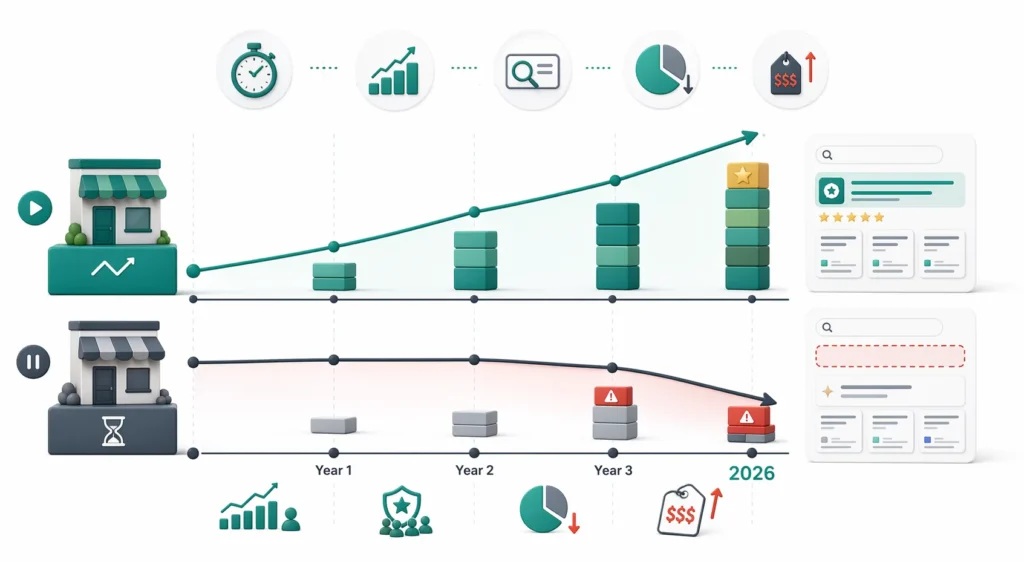
56.2% of SEO agencies are raising prices in 2026, according to SE Ranking’s agency survey. Zero-click searches now account for 60% of all Google queries. The landscape is getting more competitive, not less.
The businesses that started SEO three years ago are now the ones ranking. Waiting another 12 months means competing against 12 more months of their accumulated authority.
That’s not a sales pitch. It’s just the math of compounding.
What to do before you hire anyone
Before signing a contract with any SEO provider, run through these five checks:
- Ask for a sample monthly report from an existing client (anonymized). If they can’t produce one, they don’t have a reporting system worth having.
- Search their agency name + reviews on Google and Clutch. Look for patterns in the complaints, not just the star average.
- Ask specifically who will work on your account — a named person with a LinkedIn profile, not “our team.”
- Request the first 90 days as a project, not a locked retainer. Agencies confident in their work don’t need to trap you.
- Use Google Search Console to establish a baseline before anyone touches your site. If you don’t have it set up, set it up today. It’s free and it’s the most honest data you’ll have about your current organic performance.
The best SEO investment is one where you know what you’re buying, who’s doing the work, and what “success” looks like in month 6. Everything else is a guess dressed up as a proposal.