
Keyword research tools have one problem: they give you a number and ask you to trust it.
Listen to the article summary
A short version explaining how to find attackable keywords by reading the SERP without relying on tools.
Download the keyword teardown PDF
Keep a practical guide for evaluating keywords, spotting green signals, and deciding whether content is worth creating.
Download free PDFAhrefs keyword difficulty, Semrush keyword difficulty, and the score from almost any other platform are calculated from the backlink profile of the pages that rank. It is a reasonable approximation, but it is still an approximation. It does not measure whether the content that ranks is good. It does not measure whether it answers search intent properly. It does not measure whether there is a 2021 article sitting in position 3 that nobody has updated in years.
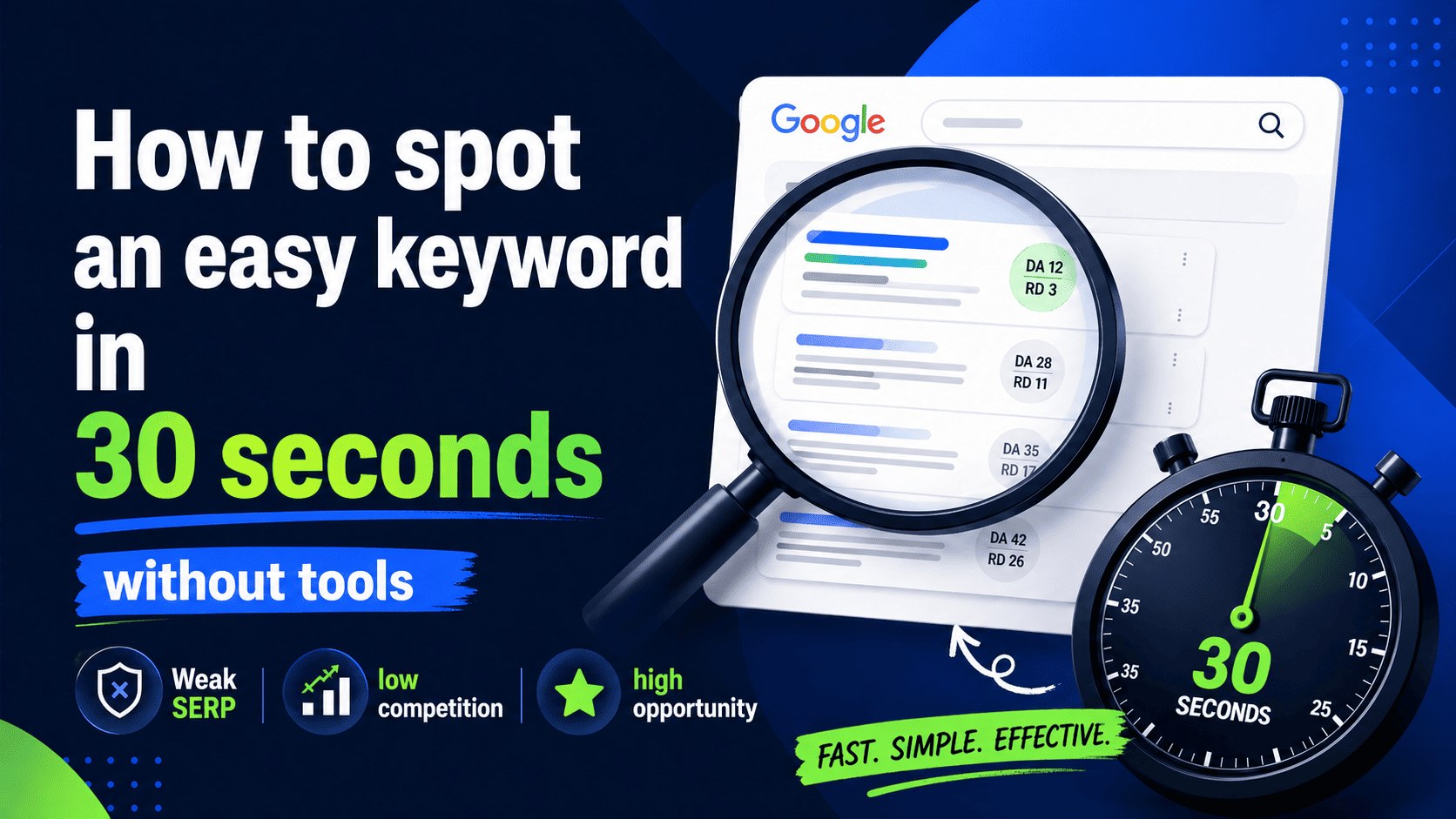
The SERP does show you all of that. And reading it takes 30 seconds.
I am not saying you should stop using tools. I sell one, and it checks a lot of this too. This is about knowing what to look at when you open Google in incognito mode and need to decide quickly whether a keyword is worth your time.
Why the SERP is a better signal than KD
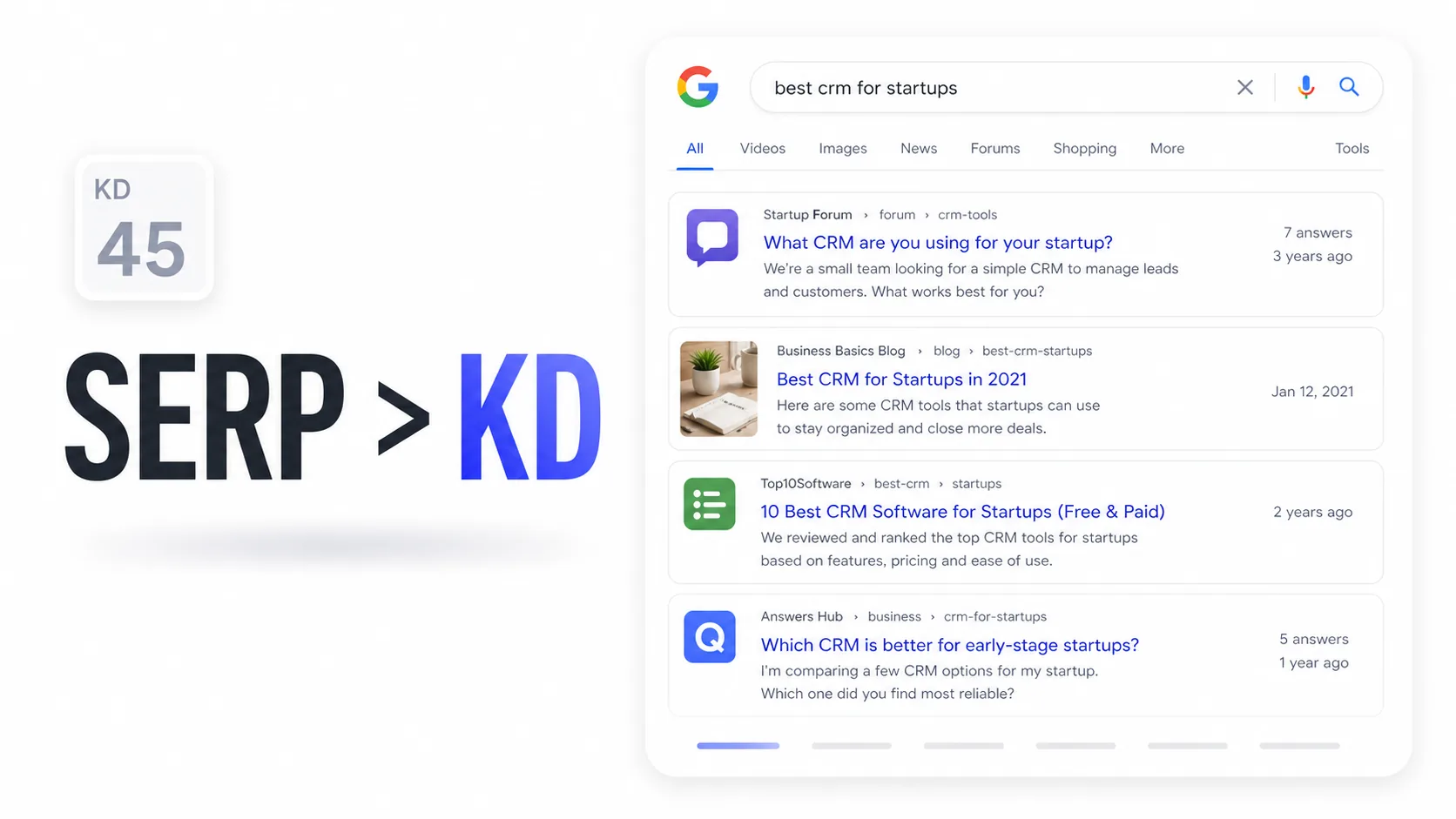
Keyword difficulty is a proxy. What really determines whether you can rank for a keyword is not how many backlinks the top-ranking pages have, but whether you can create something better than what is already there.
A keyword can have KD 60 and still be perfectly reachable if the ranking pages are generic, several years old, or do not answer exactly what the user is looking for. Another keyword can have KD 20 and be almost impossible if the top 10 results are all from highly authoritative domains in the topic, with strong, updated content.
What the SERP tells you directly is who you are competing against, how well they are doing, and whether there are gaps you can occupy.
The 30-second analysis: what to check in order
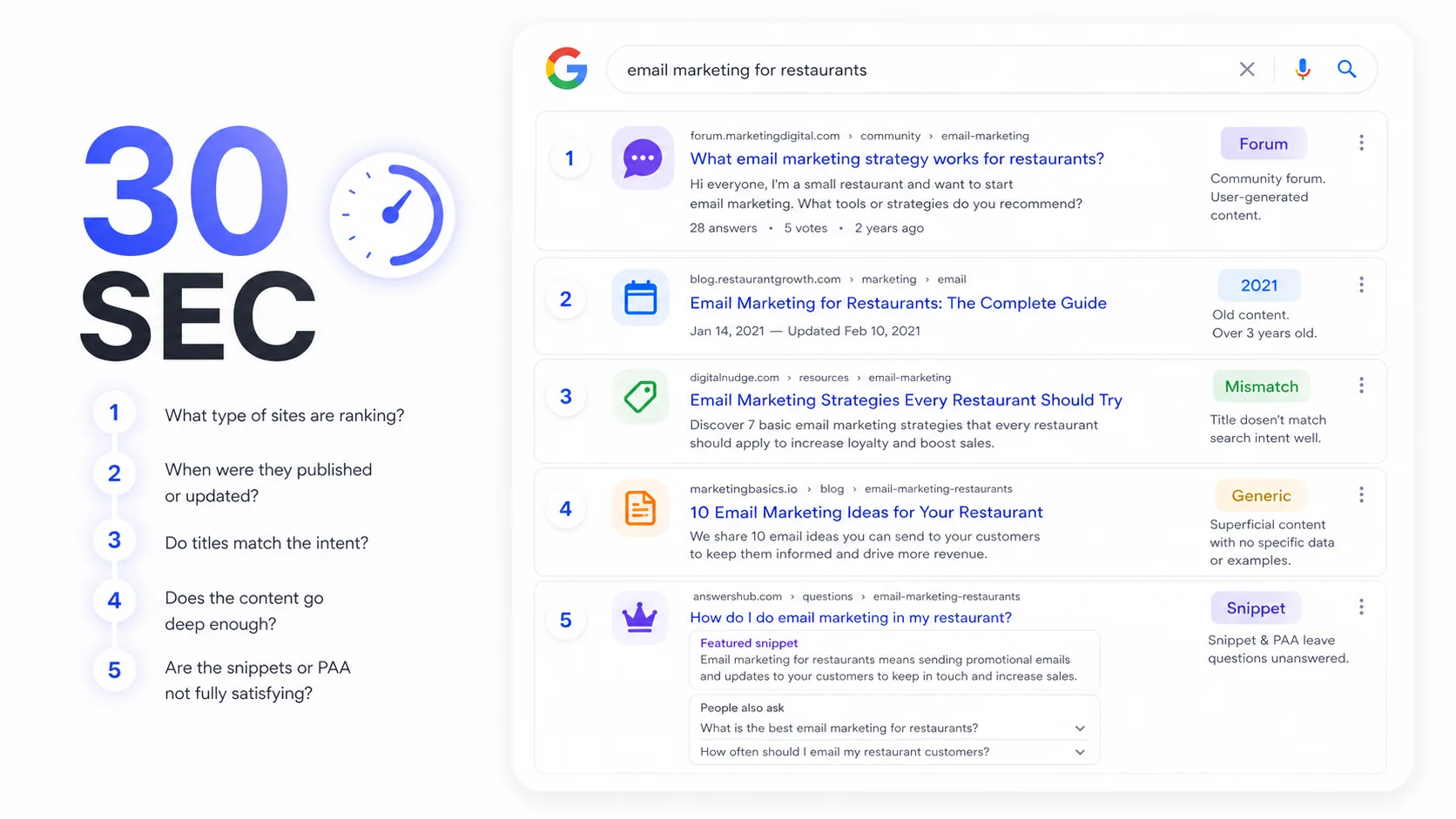
Open the SERP in incognito mode. Without history or personalization, the results are closer to what a generic user sees. Then check these five things in this order.
1. What type of sites are ranking?
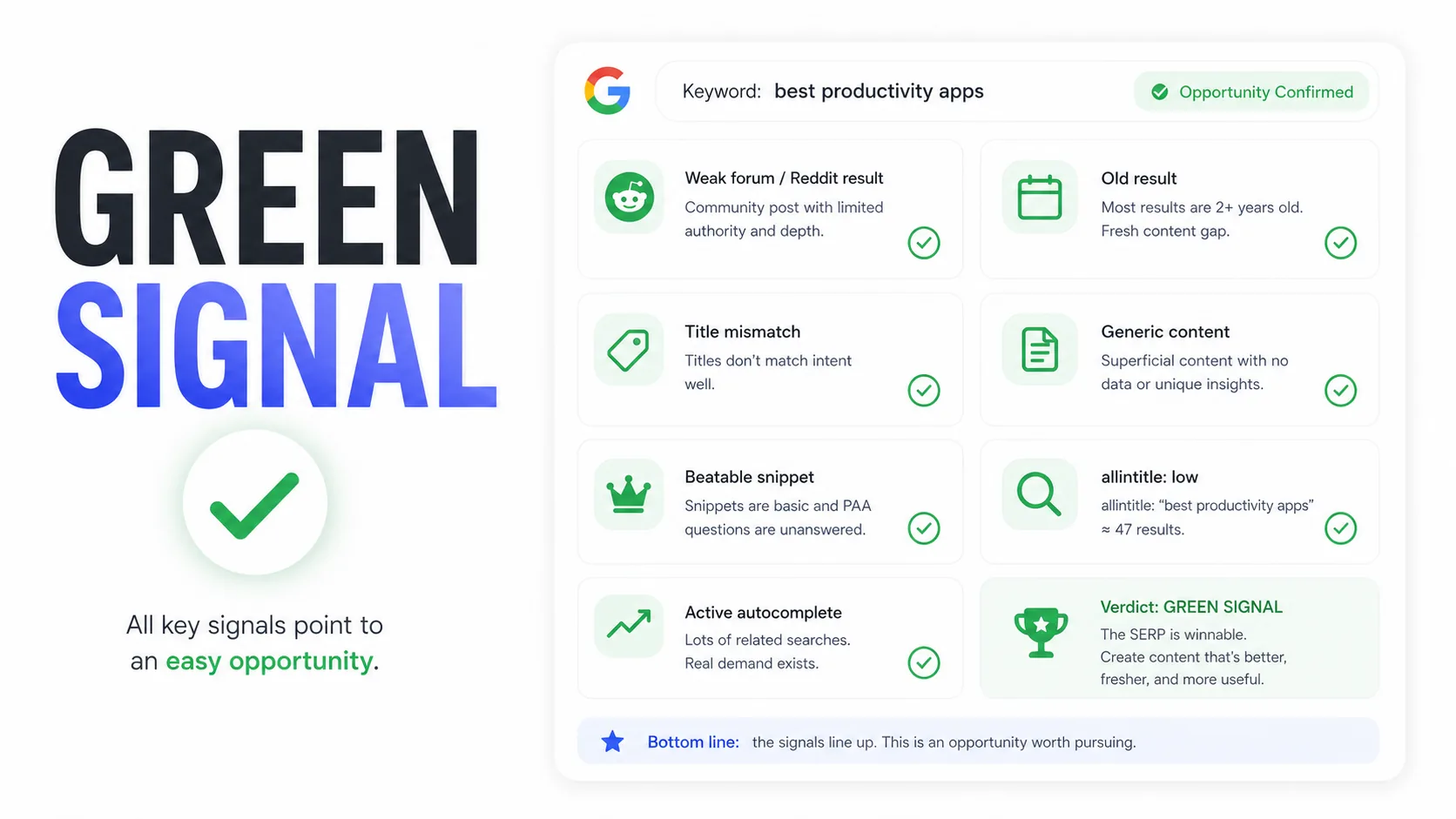
The first step is to identify whether the top 10 contains sites that are not there because they deserve to be there on content quality alone: forums, Reddit threads, Quora answers, wikis, or generic directories. These domains may have high authority, but the content is often weak. They are ranking because nobody has published something better on that topic, not because they are hard to beat.
If the top 10 has two or three results like this, the keyword is almost by definition attackable. A well-structured article that answers the query better than a forum thread can outrank it even if your domain is new.
If the top 10 is made up of ten industry publications with a lot of traffic, all updated in the last year, all with proven topical authority, that is real competition.
2. When were the ranking articles published and updated?
Look at the dates. Google shows them in the snippet most of the time. If there are articles from 2020 or 2021 in positions 3 to 7 for a topic that has evolved, they are vulnerable. Updated content has an advantage over stagnant content, especially when freshness matters.
An article from 2021 that nobody has touched can be beaten by one published today if it covers the topic with current data and answers intent better. Not always, but very often.
3. Do the titles answer the query exactly?
Look for title mismatch: ranking pages whose titles do not quite match what the user is searching for. This happens more often than it seems, especially in long-tail queries where there is enough traffic to send visits to a page that touches the topic sideways but does not answer it directly.
If you search “how to build links for a small ecommerce site” and the first results are generic link building guides with no mention of ecommerce, there is an intent mismatch you can exploit. A page that answers that exact query has a structural advantage over pages that only answer it tangentially.
4. Does the ranking content have real depth, or is it generic?
Open two or three of the first results and scan them. You do not need to read them fully. Check whether the structure is generic: the same advice you could find in any article in the industry, with no original data, no concrete examples, and no first-hand perspective. Then ask whether there is something there that you could not easily replicate.
Generic content on a high-authority domain is more vulnerable than it looks. If you can write something more useful, more current, and more concrete, user behavior signals such as time on page and pogo-sticking can eventually work in your favor.
5. Is there a featured snippet or People Also Ask result without a clear answer?
If there is a featured snippet occupied by a weak, incomplete, or confusing answer, there is an opportunity. Google wants to show the best available answer in that box. If the current answer is not good, a page that answers better and uses the right structure can replace it.
The People Also Ask block is also an opportunity signal. The questions that appear there are real sub-queries users ask. If none of the top 10 pages answers them directly in the content, you have a clear reason to structure yours so it does.
SERP Opportunity Analyzer
SERP Opportunity Analyzer Use it to get a practical recommendation. Open tool
SERP Opportunity Analyzer
Analyze any keyword and decide whether it is worth creating content for.
What do you see in Google’s top 10?
allintitle result
What this returns
Mini brief for writing the content
The signs that a keyword is genuinely hard
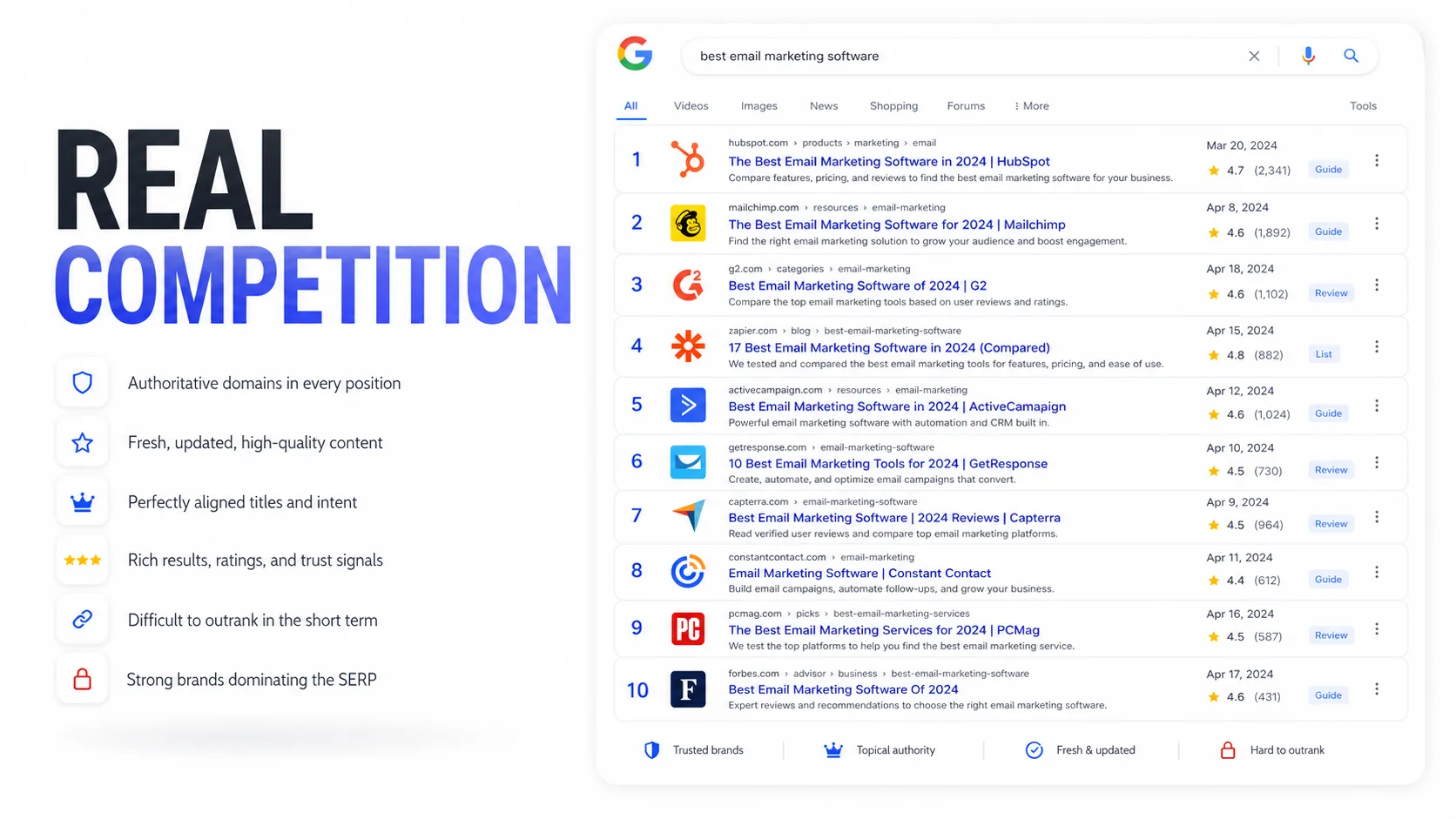
There are signals in the opposite direction that are also easy to read, and tools do not always capture them well.
Domains with real topical authority in every position. If the first ten results are from sites that have covered that topic in depth for years, all with visible organic traffic and updated content, the problem is not KD. The neighborhood is already occupied by the people who know the topic best. You may rank eventually, but not in 30 days.
Very strong content in position 1. If the first result is a long, well-structured article with original data, recent updates, and a domain with authority in the niche, ask yourself what you would add that the article does not already have. If the honest answer is “not much”, that keyword is not for now.
Transactional intent with big brands. If you search something like “best email marketing tool” and the top 10 is full of HubSpot, Mailchimp, and publishers with thousands of SEO articles behind them, that is a keyword you win with time and budget, not just with one well-written article.
The detail that changes everything: intent
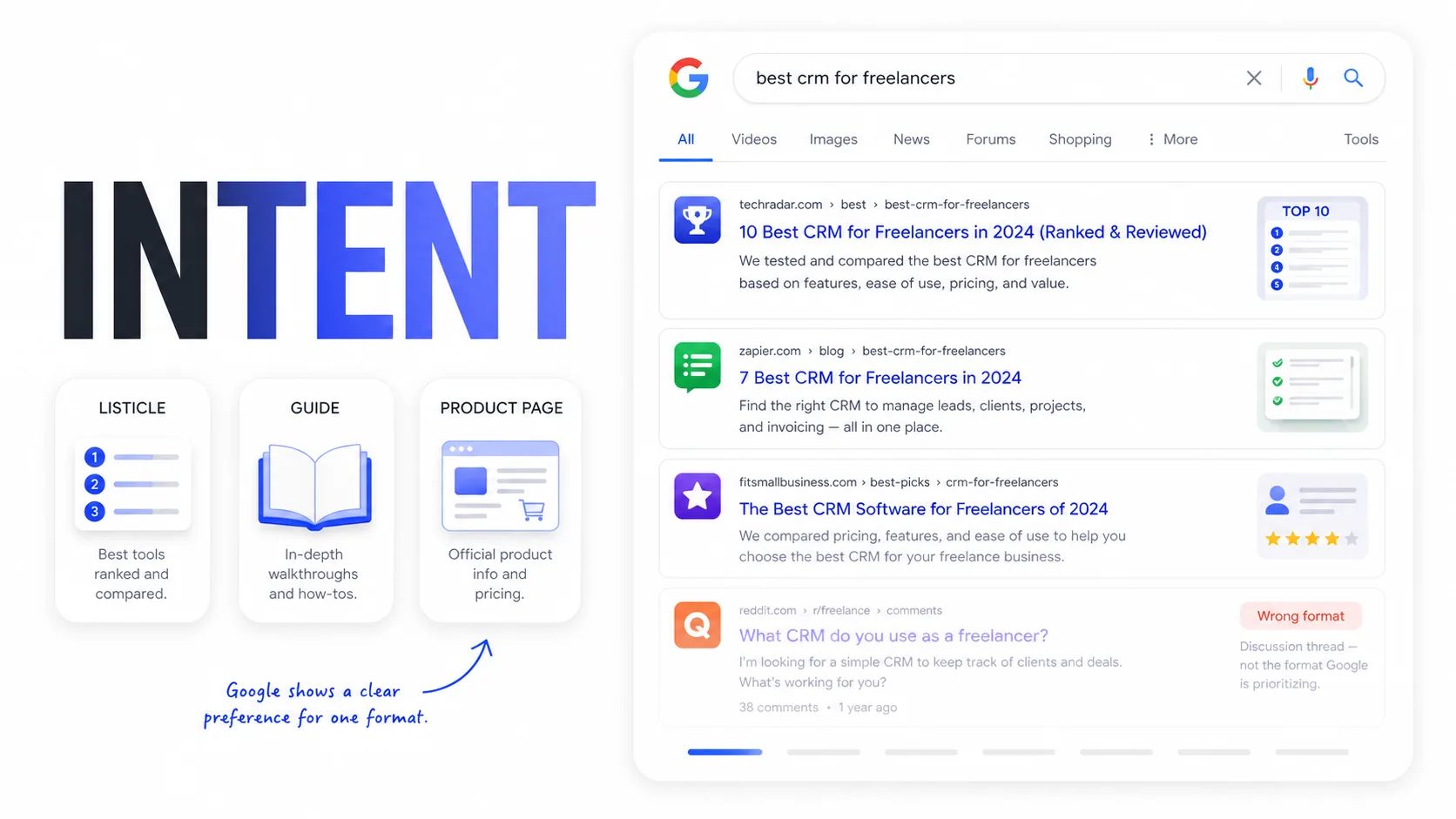
The 30-second analysis only works if you first understand what type of result Google expects for that query. You can read that in the SERP too: if the first ten results are listicles, the format you need is a listicle. If they are long guides, you need a long guide. If they are product pages, the user wants to buy, not read.
Publishing the wrong format for an intent is one of the fastest ways to fail to rank even if the content itself is good. Tools do not always tell you that. The SERP does.
The Wisseo content analyzer can help you check whether the pages you already have published match the format Google is rewarding for those queries. Sometimes the problem is not the keyword. It is that you have an article when Google wants a product page, or a product page when Google wants an article.
Three search operators that add data without leaving Google
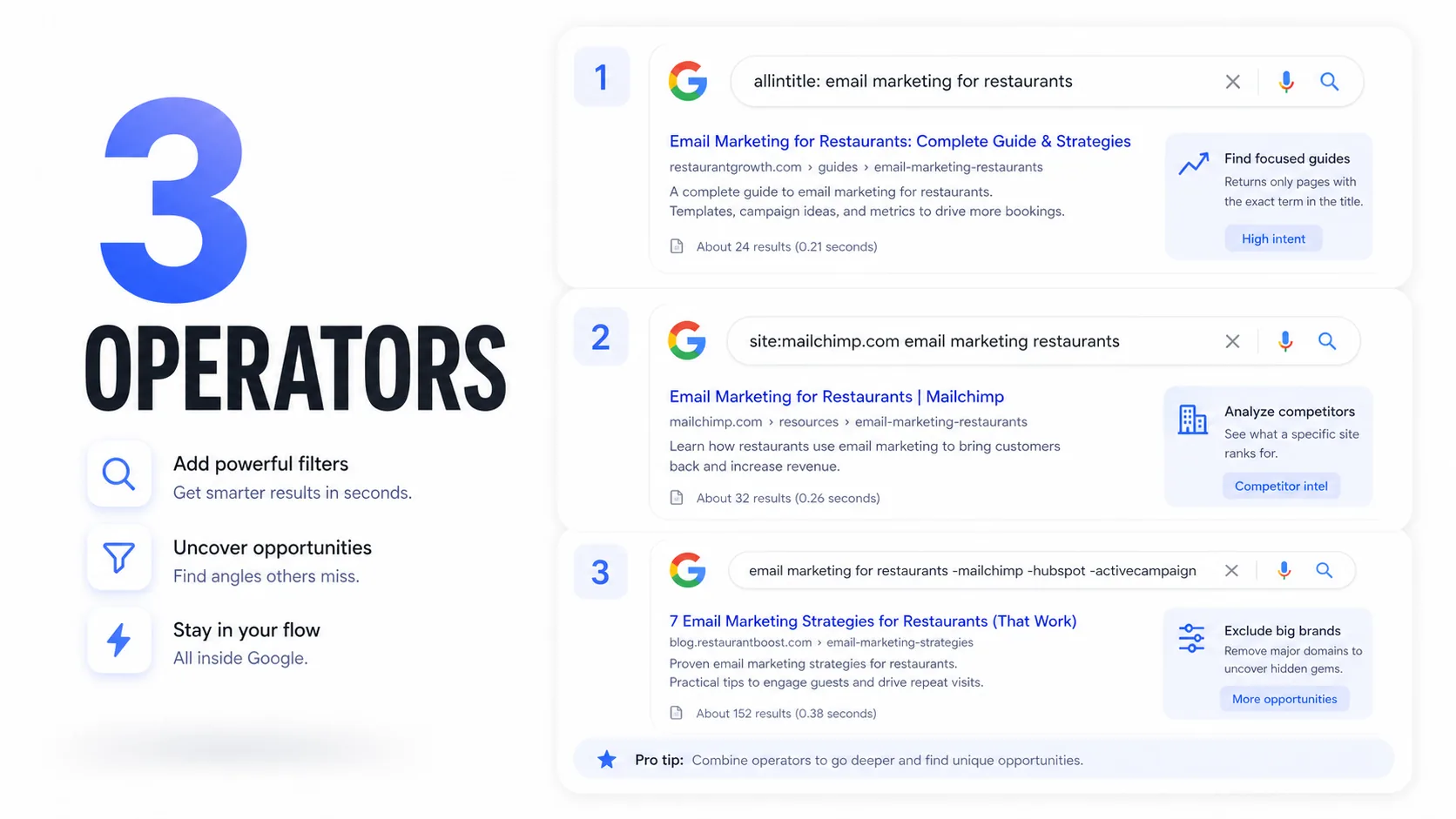
The visual SERP analysis is qualitative. If you want to add an objective data point in the same 30 seconds, there are three native Google search operators that do not require any paid tool.
allintitle: is the most useful one. Search it like this: allintitle: "your exact keyword". Google returns only pages that have that phrase in the title, which is the strongest sign that someone has deliberately optimized for that query. If there are fewer than 50 pages worldwide, almost nobody has created content aimed at capturing that search. It does not matter how many pages mention the topic in passing. What matters is how many put it in the title. Fewer than 50 is a clear green signal. Fewer than 10 is an opportunity few agencies will have spotted.
site:competitor.com "your keyword" answers another quick question: has the market leader already covered this angle? If you search site:maincompetitor.com "email marketing for restaurants" and Google returns zero results, that competitor has a gap you can fill. You do not need to analyze its entire content strategy. Google audits it for you in three seconds.
-brand1 -brand2 is useful for filtering out giants when the SERP is dominated by big names. If you search “invoicing software” and the top 10 is full of Intuit, FreshBooks, and Zoho, a search with -intuit -freshbooks -zoho shows who else is ranking underneath them. That second layer of competitors is the one you actually want to compare yourself against.
The zero-volume trap
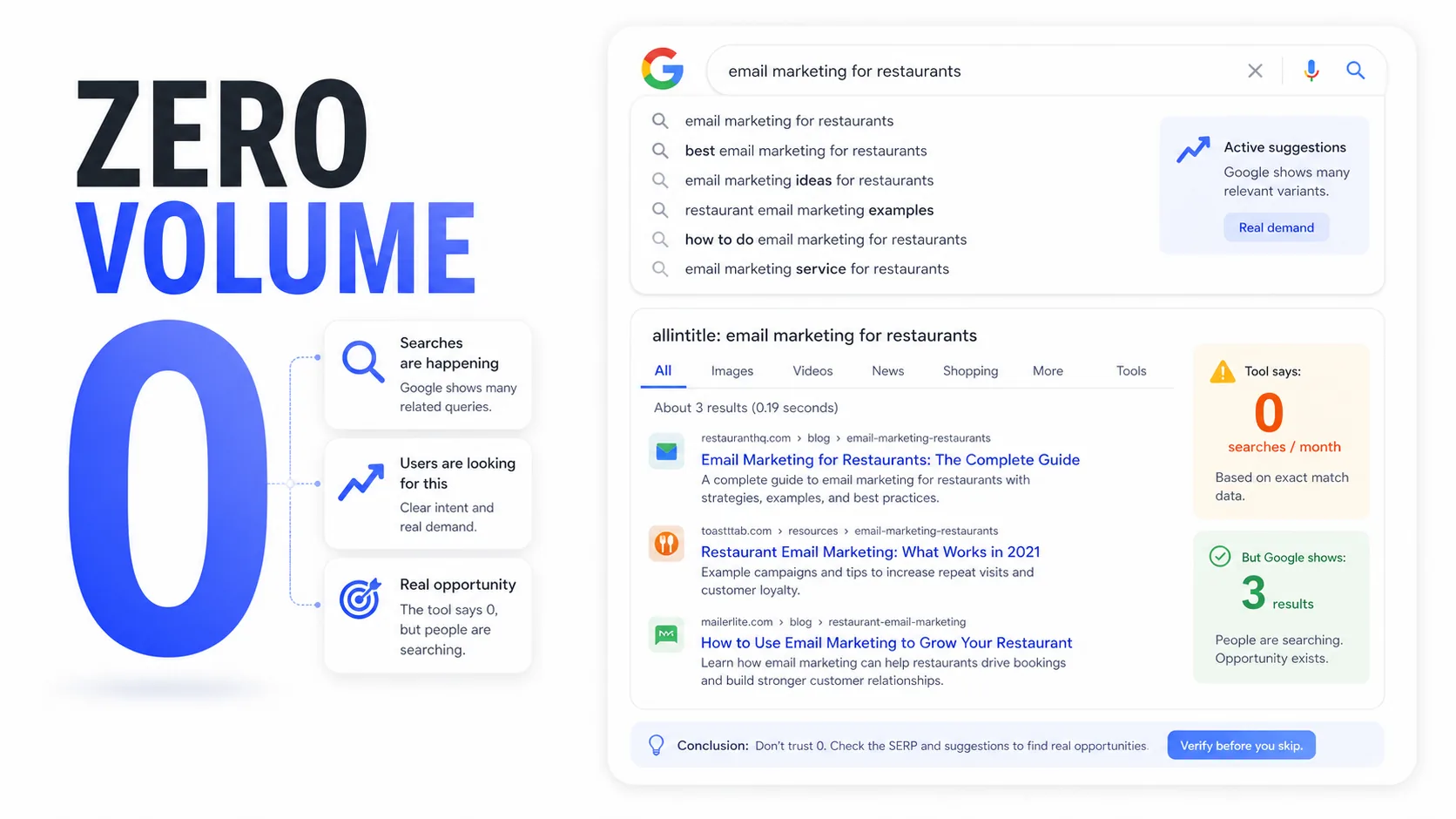
Tools report zero volume for many long-tail keywords that do have real traffic. Semrush, Ahrefs, and similar databases are built from historical click data and samples from the Google Ads API, which is designed for PPC, not organic search. Any phrase that is new enough, specific enough, or conversational enough can appear as “0 monthly searches” even if people are searching it right now.
About 15% of daily searches on Google are completely new: they have never been entered into the system before. By definition, no tool has data for them.
The practical implication is simple: if a keyword appears in Google Autocomplete, there is demand. The search engine only suggests phrases searched by a critical mass of real users. If allintitle: also returns fewer than 30 results, you have a keyword with demonstrated demand and no optimized competition. The fact that Semrush says “0” does not change either of those things.
Most agencies and SEO teams automatically filter out any keyword with fewer than 100 monthly searches. That means the entire low-volume or unmeasured long tail is effectively abandoned by the competitors with the most resources. A new or mid-authority site can occupy that space with little friction, build topical authority in the niche, and eventually use it to attack head terms with measured volume.
When to use tools anyway
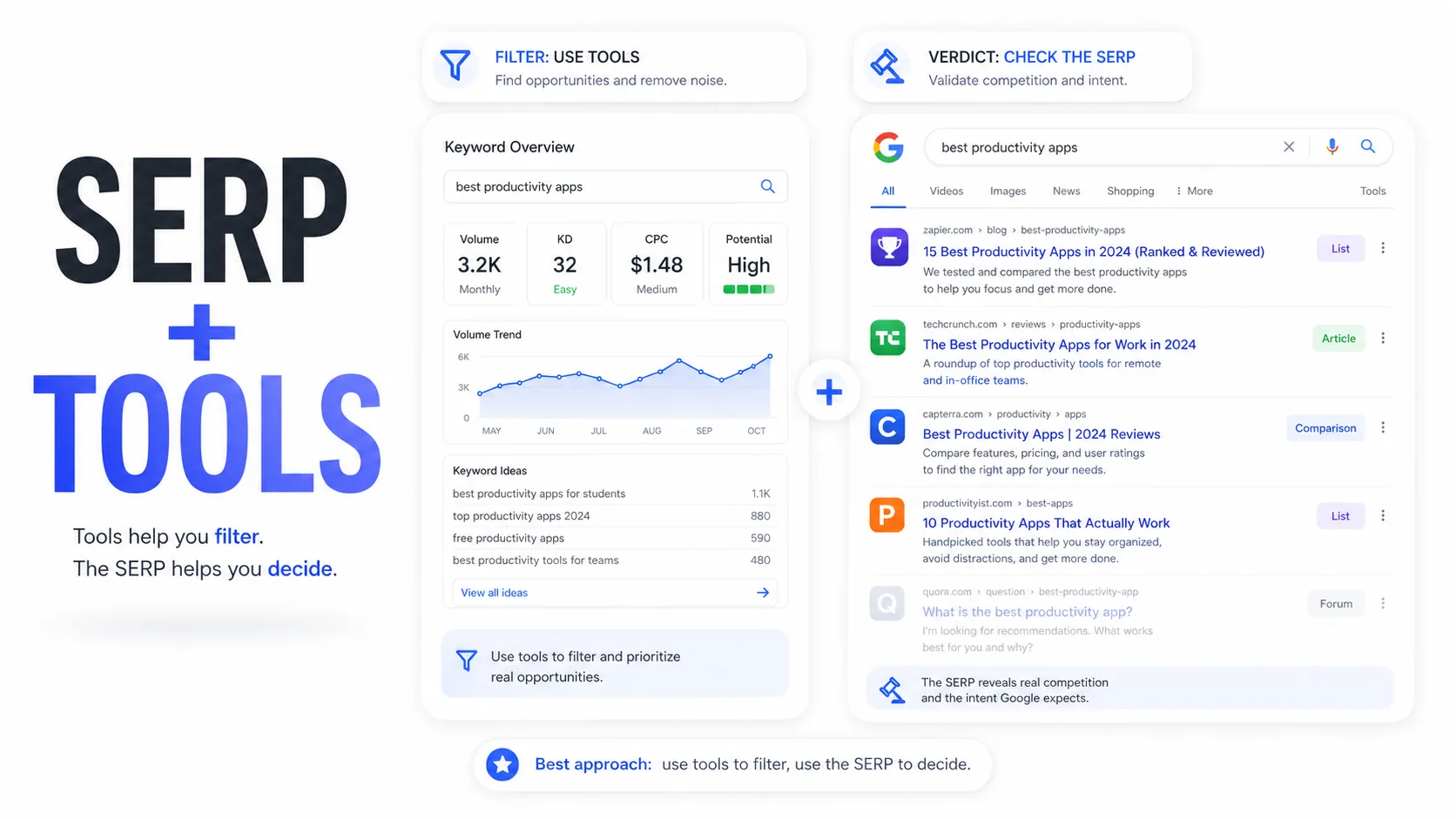
Manual SERP analysis is fast and reliable when you need to decide whether a keyword deserves an article. But it has obvious limits: it does not tell you search volume, it does not show trends, and it does not scale well if you need to analyze a hundred keywords at once.
What works in practice is this: use tools to find candidates, meaning keywords with reasonable volume in the difficulty range you care about, and then do the manual analysis to decide which ones to attack first. The tool score is the initial filter. The SERP is the final verdict.
The Wisseo keyword explorer combines volume, difficulty, and SERP data in a single view, which makes the process much faster than switching tabs constantly. But the logic of what you look at once you reach the SERP is the same as the logic in this article.
The summary you do not need to read if you read the rest