

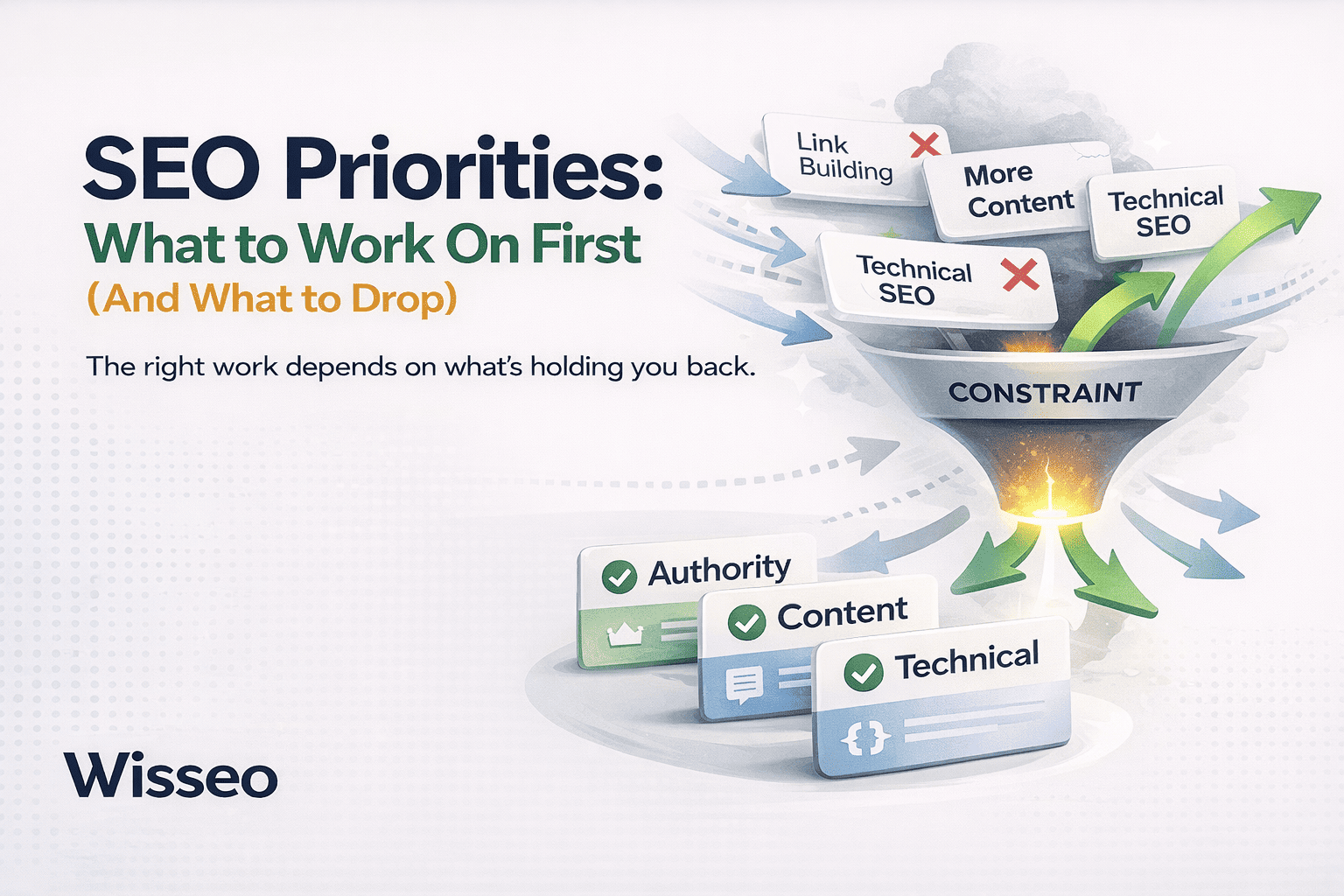
Most SEO advice skips the question that matters.
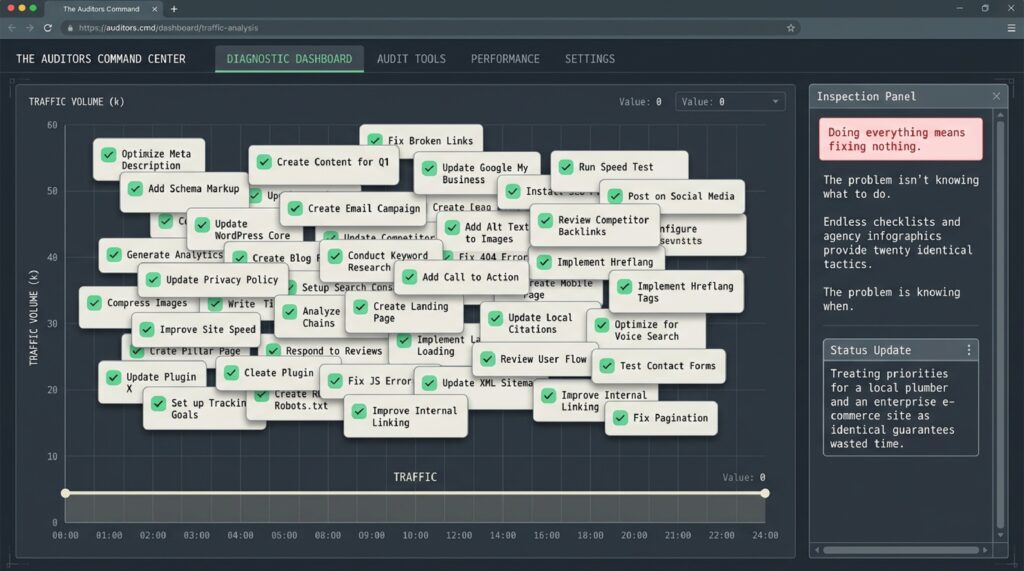
Not what to do. There’s plenty of that: endless checklists, tutorials, agency blog posts recycling the same twenty tactics with fresh infographics. The question that never gets answered directly is when. When does link building pay off? When does technical SEO become a distraction? When is publishing more content exactly the wrong move?
The answer depends on where you are. A new site and an established publisher have opposite problems. An e-commerce store with a crawl budget issue has nothing in common with a local plumber wondering why his Google Business Profile isn’t showing up. Treating their SEO priorities as identical, and most advice does, doesn’t help either of them.
This piece argues that the right SEO work is always situational. The same tactic that accelerates a mid-sized publisher will stall a brand-new site. The same technical fix that rescues an e-commerce catalog will be irrelevant to a service area business. Getting priorities wrong doesn’t mean you fail to improve. It means you spend real time on the wrong thing while the actual bottleneck goes untouched.
The Thing That Blocks Everything Else
Before tactics, one principle.
Every site has a primary constraint: one thing limiting organic performance more than anything else. The mistake most SEO practitioners make, and most clients push them toward, is working on several things at once, or working on the visible and measurable things rather than the limiting ones.
Identifying the constraint first changes how the whole priority list looks.
For a new site, the constraint is almost always authority. The domain is unknown, unlinked, and Google has no basis for trusting it. Publishing fifty articles doesn’t fix that. Improving page speed doesn’t fix that. The only fix is time, accumulated backlinks, and proof that real people find the content useful. Keyword research can point you toward the right topics, but until that authority foundation exists, most other optimization is rearranging furniture in an empty building.
For a publisher with three hundred posts and declining traffic, the constraint is usually content quality, but not in the way most people mean it. Not thin content, not AI content, not short content. The constraint is stale content: posts that ranked two or three years ago on information that has since been superseded, rewritten by competitors, or answered directly in a Google feature. The fix is auditing and updating existing pages, not writing new ones. Publishing new posts while old ones decay is running on a treadmill.
For an e-commerce site with thousands of product pages, the constraint is often technical. Faceted navigation generating millions of thin URL variants. Duplicate content from filter and sort parameters. Crawl budget eaten by pagination. No amount of copywriting or link acquisition overcomes Googlebot spending its entire visit on pages you don’t want indexed.
The first job in any SEO engagement is identifying which of these problems, authority, content quality, or technical health, is actually limiting performance. Everything else follows from that answer.

What Is Almost Always Worth Doing
A few fundamentals pay off regardless of site stage, industry, or competition level. Not because they’re exciting, but because they’re the floor. Everything else sits on top of them.
Get indexed correctly
This sounds obvious and gets skipped constantly. Verify the site in Google Search Console. Check that the pages you want indexed are indexed. Check that the pages you don’t want indexed, thank-you pages, admin routes, parameter URLs, are either noindexed or excluded from crawling. An alarming number of sites have been accidentally configured to block Googlebot. An alarming number of others are wasting crawl budget on pages that contribute nothing.

Write title tags that reflect search intent, not brand voice
The title tag is the first thing a searcher reads in the results. If it doesn’t match what they searched for, they don’t click. Brand teams hate this because they want the clever tagline, the evocative phrase, the voice. Fine for the homepage. Wrong for a blog post targeting “best project management software for freelancers.” That searcher wants confirmation they’ve found what they searched for. Give it to them in the first few words.
Fix internal linking
Most sites underinvest here. Internal links pass authority, signal topical relationships to Google, and help users navigate. A strong piece of content that no other page links to has no path for authority to flow in, and Google has no signal about its importance relative to everything else on the site. According to Google’s own documentation on how Search works, links are one of the primary ways Googlebot discovers and evaluates pages.
Make the site fast on mobile
Not because Core Web Vitals are a major ranking factor, the evidence for that remains limited, but because slow pages lose users before they convert. Google’s research on page speed shows that as load time increases from one second to ten, the probability of a mobile visitor bouncing increases sharply. A page that loads in six seconds on a phone is turning away a significant fraction of the people who would otherwise read it.
These four things aren’t sufficient. They don’t differentiate a site in a competitive niche or rescue a publisher with two hundred stale posts. But without them, nothing else works as well as it should.

The Situation Changes the Whole List
What you do next depends on what kind of site you’re running and what stage it’s at. The sections below break this down by scenario. Each one has a different primary bottleneck, a different set of high-leverage moves, and a different set of things that look productive but aren’t.
The SEO tactics that get the most coverage, link building, content production, technical optimization, are not universally valuable. They’re valuable when they address the actual constraint. When they don’t, they’re expensive distractions.
New Site (0 to 6 Months): Build the Floor Before the Walls
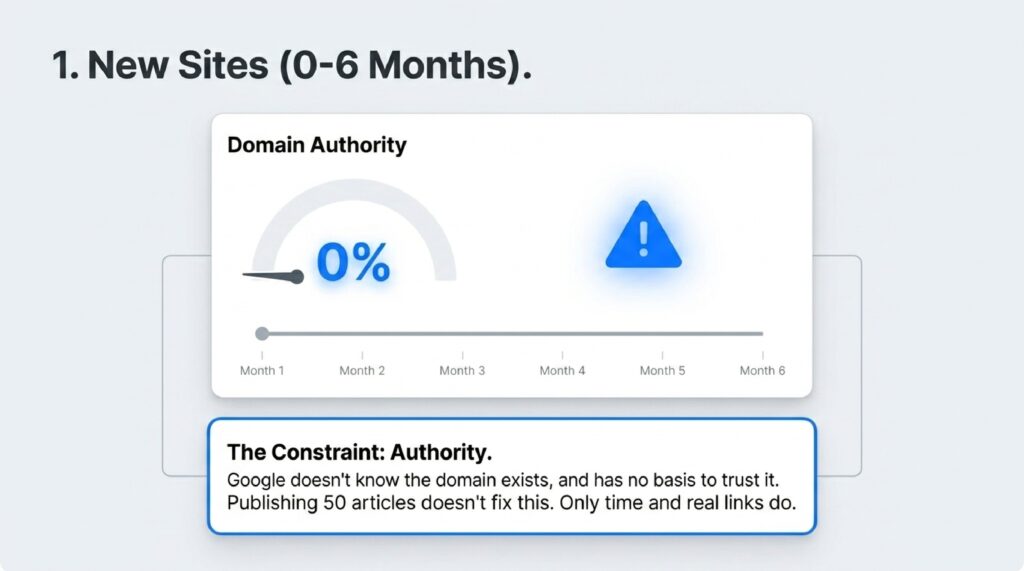
A new domain has one problem that outranks everything else: Google doesn’t know it exists, and when it finds it, has no reason to trust it.
This is not a content problem. It’s not a technical problem. It’s an authority problem, and authority is earned through time and links, not through publishing volume or on-page optimization. The most common mistake at this stage is treating SEO like a checklist where every item carries equal weight. It doesn’t. Ninety percent of the checklist is irrelevant until the domain has a baseline of trust.
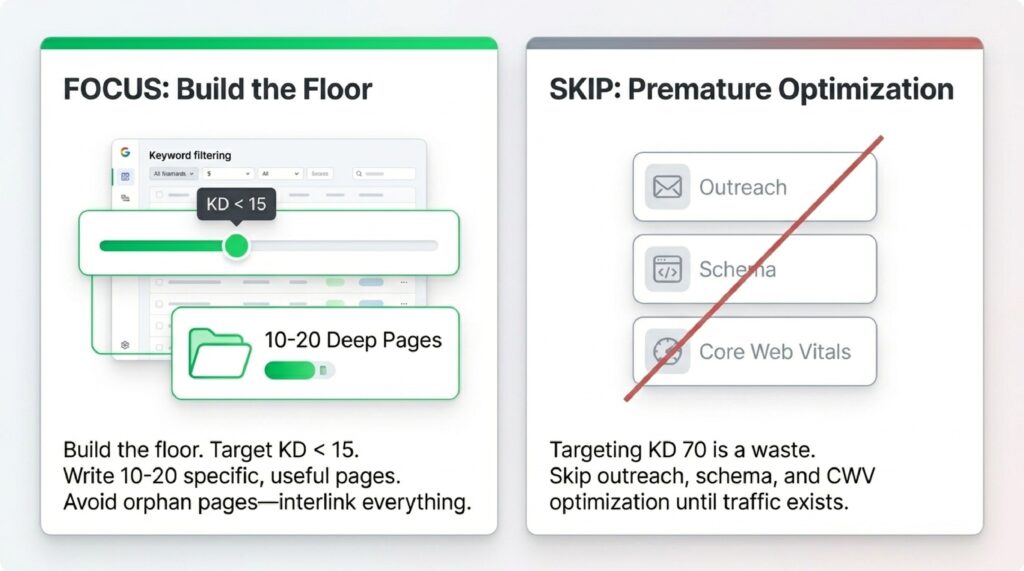
What that means in practice: pick a narrow set of topics where the competition is genuinely thin. Not “marketing tips.” Not “best running shoes.” Topics with real search volume but few credible pages addressing them. Targeting a keyword with a difficulty score of 70 on a three-month-old site is not ambitious. It’s a waste of content budget.
What to prioritize in the first six months
- Target long-tail keywords with low competition and clear informational intent
- Build 10 to 20 deeply useful, specific pages rather than publishing for volume
- Acquire the first backlinks from real, relevant sources, even if they’re small
- Set up Google Search Console and confirm every target page is indexed
- Link every new page to at least two or three other pages on the site
- Analyze which keyword gaps are actually winnable at this stage using a competitor research tool
What to skip entirely
- Link building outreach campaigns that require a reputation you haven’t built yet
- Schema markup refinements on pages that aren’t indexed yet
- Core Web Vitals optimization on a site that gets forty visits a month
- Competing for head terms against domains with years of authority advantage
These are not bad tactics. They’re tactics for a different stage.
Competitive Niches: Depth Beats Volume Every Time
A site competing in a crowded space, financial services, health, SaaS, legal, faces a different problem than a new site. The domain may have authority. The content may be technically correct. The rankings still don’t move.
The usual diagnosis is “we need more content.” The actual diagnosis, more often, is that the content covering the most important topics isn’t good enough to displace what’s already ranking. Publishing faster doesn’t solve that. It compounds it.
Google’s Quality Rater Guidelines describe what their evaluators look for when assessing whether a page deserves to rank: demonstrated expertise, evidence the author has real knowledge of the subject, content that serves the searcher’s actual need rather than performing the appearance of serving it. In competitive niches, the pages that rank have usually satisfied that bar. The pages that don’t have usually imitated the format without matching the substance.
The competitive gap analysis
The practical response is to analyze the pages currently ranking for your target terms before writing a single word. Three questions worth answering:
- What are they covering that you’re not?
- What angles are they missing that your actual expertise could fill?
- What questions are searchers asking that none of the top-ranking pages answer?
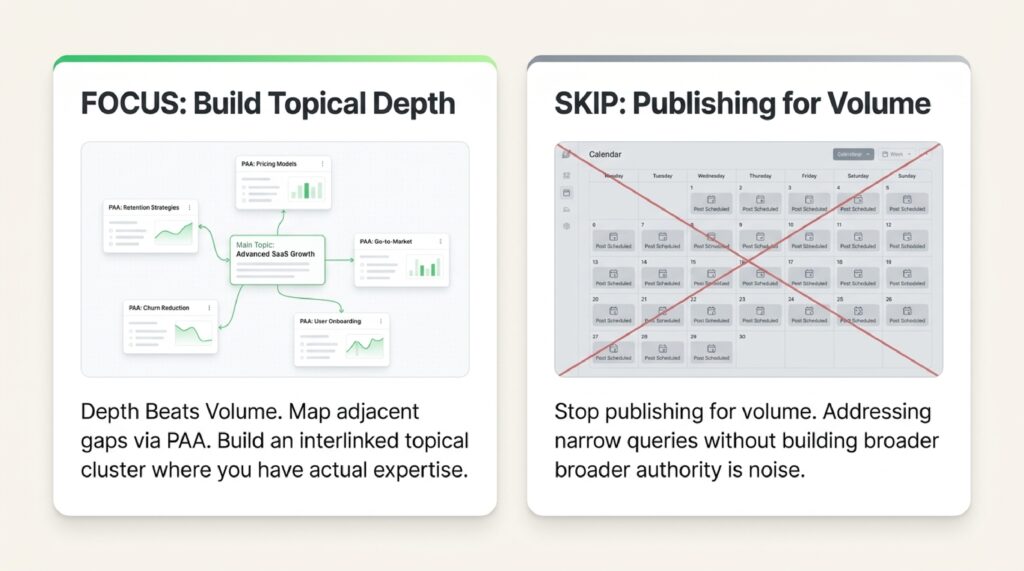
The People Also Ask boxes in Google’s results are useful here. They map the adjacent questions around any keyword, which is where most competitive gaps actually live. A page that answers the main query and the three follow-up questions searchers have tends to hold position more durably than one that answers only the primary query.
Topical authority matters here more than anywhere else. A site that covers one subject thoroughly and consistently outperforms a site that covers ten subjects lightly, even if the second site has more pages and more backlinks. Building a cluster of interlinked pages around a core topic is how sites establish that signal, and a well-structured internal linking strategy is what makes that cluster legible to Google.
One thing to drop in competitive niches: publishing a new post every time a keyword shows up with decent search volume. That produces a catalog of pages that each address one narrow query without building any broader authority. Pick the topics where you can be genuinely better than what’s ranking. Everything else is noise.
Local Businesses: The Ranking Factors Are Different Here
Local SEO operates on a separate set of rules from organic search, and most general SEO advice doesn’t account for this. The factors that move the needle for a law firm in Manchester or a dentist in Valencia have limited overlap with what matters for a national publisher or an e-commerce store.
The Google Business Profile is the most important asset most local businesses underuse
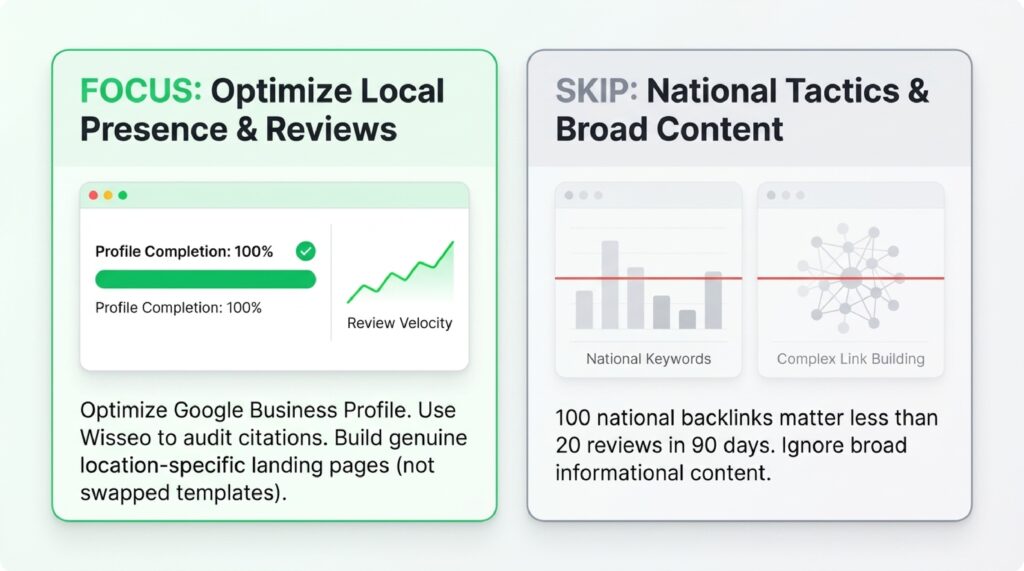
Completeness matters: every relevant category selected, every service listed, photos updated regularly, questions answered. What matters more is recency of reviews and the consistency of the business name, address, and phone number across every directory where it appears. Google uses NAP consistency as a signal of legitimacy. A business listed as “Smith’s Plumbing Ltd” in one directory and “Smiths Plumbing” in another creates a small but real trust gap that accumulates across dozens of listings.
Location-specific landing pages
A business that serves multiple areas needs a separate page for each one. One page targeting “electrician London” doesn’t rank in Manchester. This is obvious in principle and frequently ignored in practice: businesses that serve ten cities often have one page that mentions all ten cities rather than ten pages that each establish genuine local relevance.
Each page needs content that’s actually specific to the location:
- Local job examples or case studies
- References to local regulations or requirements where relevant
- Area-specific context that couldn’t be copy-pasted onto a page about a different city
Not just the city name swapped into a template.
What to skip for most local businesses
Link building programs targeting national sites, content marketing aimed at broad informational queries, and complex technical SEO work that doesn’t affect the local pack. The ranking factors in the local pack are proximity, relevance, and prominence within the local context. Twenty reviews in the last ninety days and a fully built-out Google Business Profile will move the needle faster than a hundred backlinks from generic directories.
E-Commerce: Technical Problems Eat Everything Else
E-commerce sites have a category of SEO problem that most content-focused sites never encounter. When a catalog has tens of thousands of product pages, plus the URL variants generated by filters, sorting options, color and size selectors, and pagination, the site can produce millions of indexable URLs. Most of those URLs are thin, duplicative, or both.
Googlebot has a crawl budget for every site. A large e-commerce site that doesn’t control which URLs are crawlable will burn that budget on filter parameter pages, sorted views, and out-of-stock product variants, leaving the actual category and product pages crawled infrequently. Pages crawled infrequently don’t get updated quickly in the index. Pages not updated in the index don’t reflect price changes, availability changes, or new content.
The priority order for e-commerce SEO
Before touching content or links, resolve these in order:
- Canonical tags on all filter and sort parameter URLs pointing to the clean category page
- Noindex directives on pagination beyond page one where the content is near-duplicate
- Redirect chains from previous URL structures or product page migrations
- Orphan pages for out-of-stock products that should be redirected or consolidated
An SEO audit is the fastest way to find all of these at once rather than hunting through the site manually.
Category pages over product pages
Category pages deserve more attention than product pages in most cases. A category page targeting “women’s trail running shoes” reaches every searcher at the consideration stage, regardless of which specific product they end up buying. A product page targeting one specific model reaches a much narrower audience, and that audience disappears when the product goes out of stock.
Investing in category page content, including genuinely useful buying guides, comparison information, and filtered navigation structured to avoid duplicate content, compounds in value over time in a way that individual product pages don’t.
Schema markup at scale
Product schema with price, availability, and review data enables rich results in Google’s search display. Rich results don’t guarantee higher rankings, but they consistently improve click-through rates on the positions you already hold. For an e-commerce site with hundreds of product pages, generating schema manually is not realistic. A schema generator that produces structured data at scale solves this without requiring a developer for every update.

Content Publishers: Update Before You Publish
A site with a large content archive faces a problem that accumulates quietly over time. Every post published is a commitment to keep that post accurate and competitive. Most sites don’t honor that commitment. They keep publishing and let the archive decay.
Content decay is real and measurable. A post that ranked in position four two years ago may have slipped to position fourteen today, not because Google penalized it, but because twelve other sites published better versions in the meantime. Ahrefs research on content decay found that the majority of pages lose organic traffic over time if they aren’t actively maintained. For a publisher with two hundred posts, that’s a slow leak that adds up to a significant traffic loss across the archive.
Finding and fixing decaying content
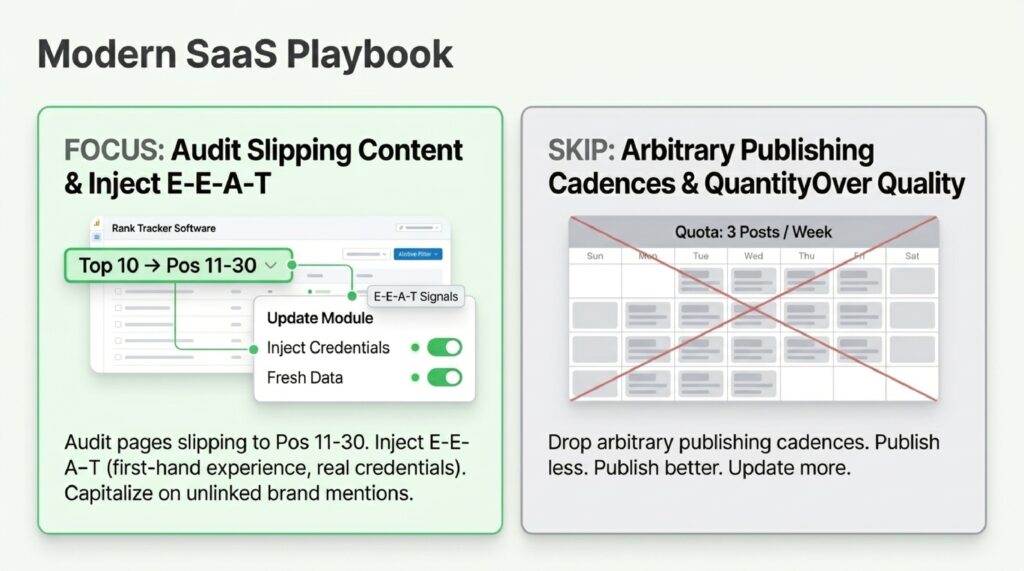
The audit process starts with the rank tracker: find every page that held a position inside the top ten twelve months ago and now sits between eleven and thirty. Those pages had enough relevance to rank, and they’ve slipped for fixable reasons. Then analyze what the currently ranking competitors have that the slipped page is missing:
- Depth on specific subtopics the original post glossed over
- Fresher data or updated statistics
- Cleaner structure that answers the main question faster
- Stronger answers to the follow-up questions the searcher has after the primary one
Updating those pages, not just refreshing the publish date but genuinely improving the content, produces faster results than publishing new posts. A page that already has backlinks, indexing history, and some residual authority recovers position faster than a new page that has none of those things.
E-E-A-T and why it matters more for publishers
E-E-A-T (Experience, Expertise, Authoritativeness, Trustworthiness) matters more for content publishers than for any other site type. Google’s documentation on helpful content is direct about this: pages written by people with genuine first-hand experience in the subject outperform pages that aggregate or summarize information without adding original insight.
Author bios with real credentials, links to the author’s other work, evidence of actual expertise in the subject: these are signals that publishers can build deliberately rather than hoping they emerge from the content itself.
What to drop
Publishing cadences that exist to maintain a posting frequency rather than to answer real questions. A site that publishes three posts a week because the editorial calendar demands it, regardless of whether those posts are genuinely better than what’s already ranking, is producing content that will be in the decay pile within eighteen months. Publish less. Publish better. Update more.
Technical Bottlenecks: Fix the Foundation Before Everything Else
Some sites have none of the above problems as their primary constraint. The content is strong. The authority is real. The rankings still underperform relative to what the domain should be capable of. In those cases, the bottleneck is usually technical, and it requires a different kind of investigation.
Start with Search Console coverage data
Pages excluded from the index, pages with crawl errors, pages returning unexpected status codes: these are concrete problems with concrete fixes. A page that Google can’t crawl can’t rank, regardless of what the content says.
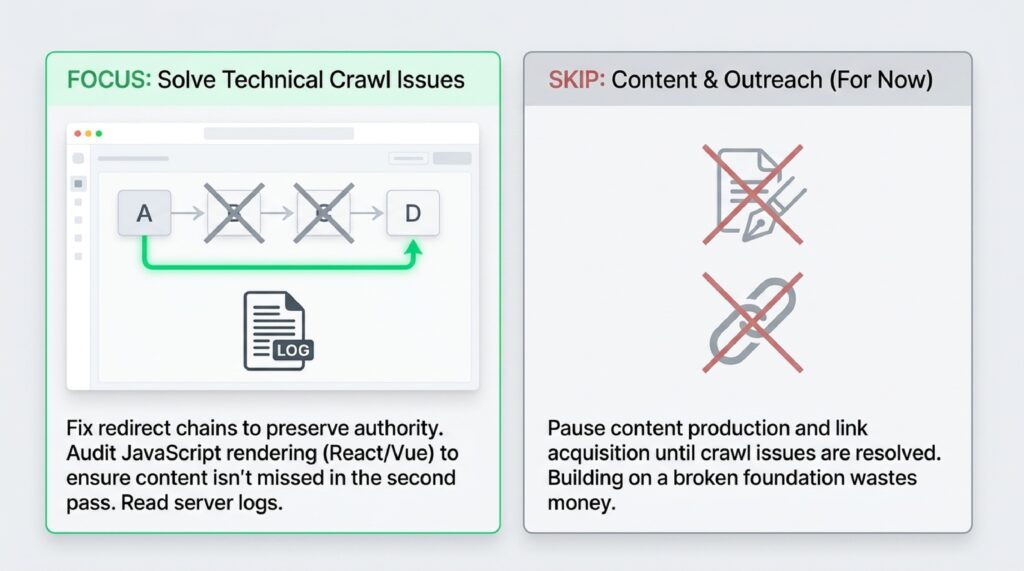
Redirect chains are a specific technical problem that compounds over time on sites that have gone through redesigns, URL structure changes, or CMS migrations. A redirect that goes A to B to C to D passes less authority than a redirect that goes directly from A to D. Over a large site, redirect chains can affect hundreds of pages without anyone noticing, because the pages still load in a browser and nothing appears broken from the outside.
JavaScript rendering
This is a specific technical issue for sites built on React, Vue, or Angular frameworks. Googlebot can render JavaScript, but it does so in a second pass that happens later than the initial crawl. Content that only appears after JavaScript executes may not be indexed at the same time as the rest of the page, or may not be indexed at all if the rendering fails.
For sites where important content, navigation, or internal links live inside JavaScript components, this creates invisible indexing gaps that look like authority problems but are actually rendering problems. The tell is pages that look correct in a browser but show thin or empty content when viewed through Google’s URL Inspection tool.
Log file analysis
Log files answer a question that Search Console data doesn’t fully address: what is Googlebot actually doing when it crawls the site? Which pages is it visiting most frequently? Which pages is it skipping entirely? Where is crawl budget going that it shouldn’t? Server logs contain this data directly. Reading them is the most reliable way to understand how Google actually experiences the site rather than how you intend it to.
What to skip when addressing technical bottlenecks
Content production and link acquisition until the crawl issues are resolved. Both cost real money and time, and both are less effective when Google is missing significant portions of the site or crawling the wrong pages. Fix the technical foundation first, confirm it’s working through Search Console data, and then resume content and link work on solid ground.
For Sites Investing in AI Search Visibility
This is increasingly relevant. Google’s AI Overviews, Bing’s Copilot integration, and the growing share of searches that get answered without a click all change the calculus in ways that traditional SEO frameworks don’t address.
The rules here differ from traditional ranking optimization in one key way: AI systems favor pages that give clear, direct answers to specific questions over pages optimized for broad topical coverage. A page that answers one question precisely and cites its sources will be featured in an AI Overview more often than a page that covers a topic comprehensively but makes the reader work to find the specific answer.
The practical implication: structured content with clear headings, direct answers in the opening paragraph of each section, and factual claims supported by credible sources performs better in AI-mediated search than content designed purely around keyword density or topical breadth. If this is a priority for your site, Wisseo’s AI optimization tool is built specifically around these requirements.
The right SEO priority is never the same twice. It depends on what’s actually blocking growth, not on what the latest industry conversation is about. A new site needs authority before anything else. A content publisher needs to stop the decay before adding to the archive. An e-commerce site needs clean crawlability before investing in content or links. Getting the sequence right is most of the work.