

Link building for GEO is not simply traditional link building with a new acronym. AI answers assemble claims from sources that can discover, explain, and corroborate an entity. A link may help, but an independent mention, a comparison page, a directory profile, or original research can play a different and equally useful role.
To see what actually appears in AI answers, Wisseo audited 60 searches in English and Spanish across Google AI Overviews and Perplexity. We recorded up to 120 responses, classified every verifiable citation, and built a downloadable dataset rather than treating anecdotal screenshots as a strategy.
Download the study data. The ZIP includes prompts, citation rows, methodology, metrics, and reusable charts under CC BY 4.0.
GEO Link Opportunity EvaluatorScore a placement by its likely role in AI discovery and corroboration.Open tool
GEO Link Opportunity Evaluator
Opportunity score
Medium priority
Likely role: corroboration
Pitch one useful contribution: original data, expert commentary, or a missing comparison.
The score prioritizes outreach. It does not guarantee an AI citation.
What link building for GEO really means
Classic link building usually asks whether a page can pass authority and improve rankings. GEO adds another question: can this source help an AI system discover or corroborate the claim we want associated with our brand?
Those are not identical jobs. A commercial product page may be the clearest source for features and pricing. An independent comparison can validate positioning. A forum can reveal user language and real-world objections. Original research can supply the quotable fact that anchors an answer.
This is why the practical unit of work is not “a backlink.” It is a credible external occurrence of your entity, claim, or evidence. The best opportunity may include a followed link, an unlinked mention, a structured directory listing, a quote, or a citation to your data.
How the 60-search study was run
Between June 21 and June 23, 2026, we ran 30 English and 30 Spanish prompts in both Google AI Overviews and Perplexity. Each language used ten provider comparisons, ten professional or local searches, and ten informational or recommendation queries.
For each observation we recorded the prompt, date, engine, response presence, citation position, URL, domain, language, and source type. We removed duplicate URL fragments, reviewed ambiguous classifications manually, and performed a second pass on an additional 20% sample.
| Measure | Observed result | How to interpret it |
|---|---|---|
| Google response rate | 80% | Local and professional queries were less likely to trigger an AI Overview. |
| Perplexity response rate | 100% | Perplexity answered every prompt, although not every visible response exposed the same number of verifiable citation URLs. |
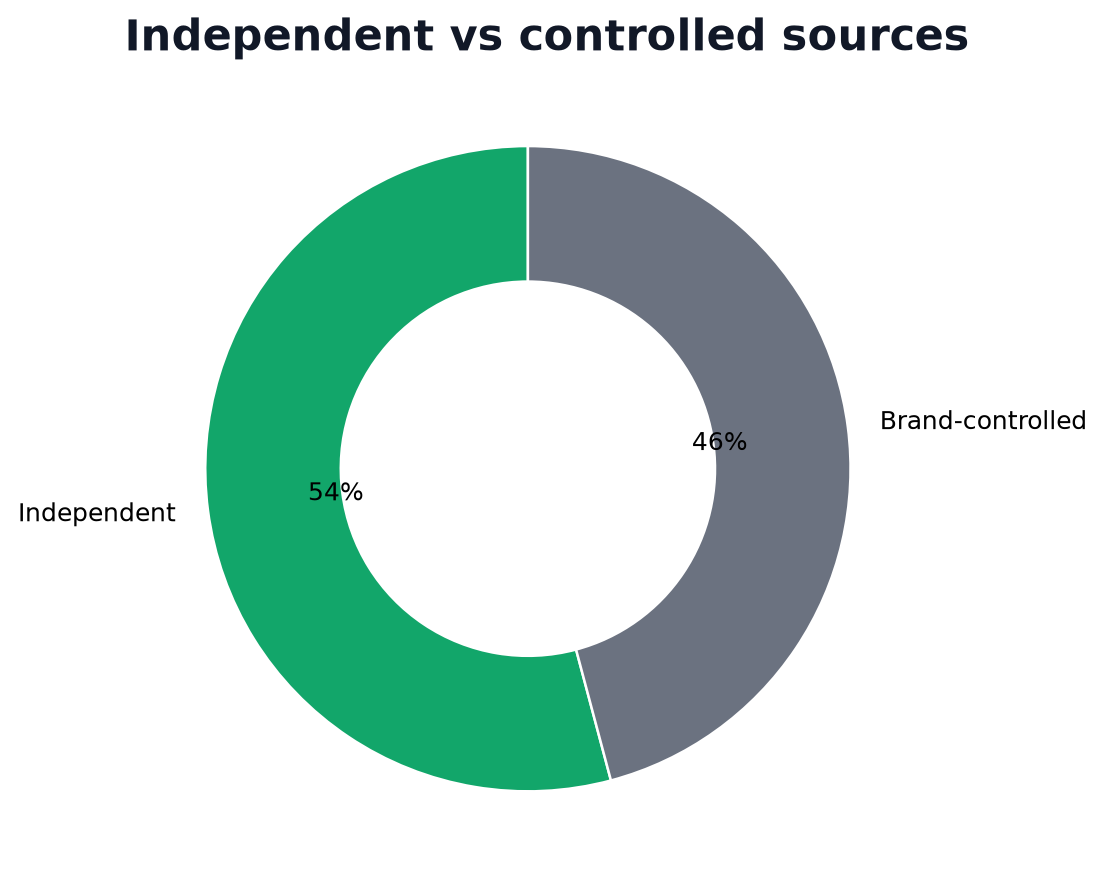
| Independent-source share | 45.1% | Brand-controlled pages remain common; independent corroboration is valuable but not the only path. |
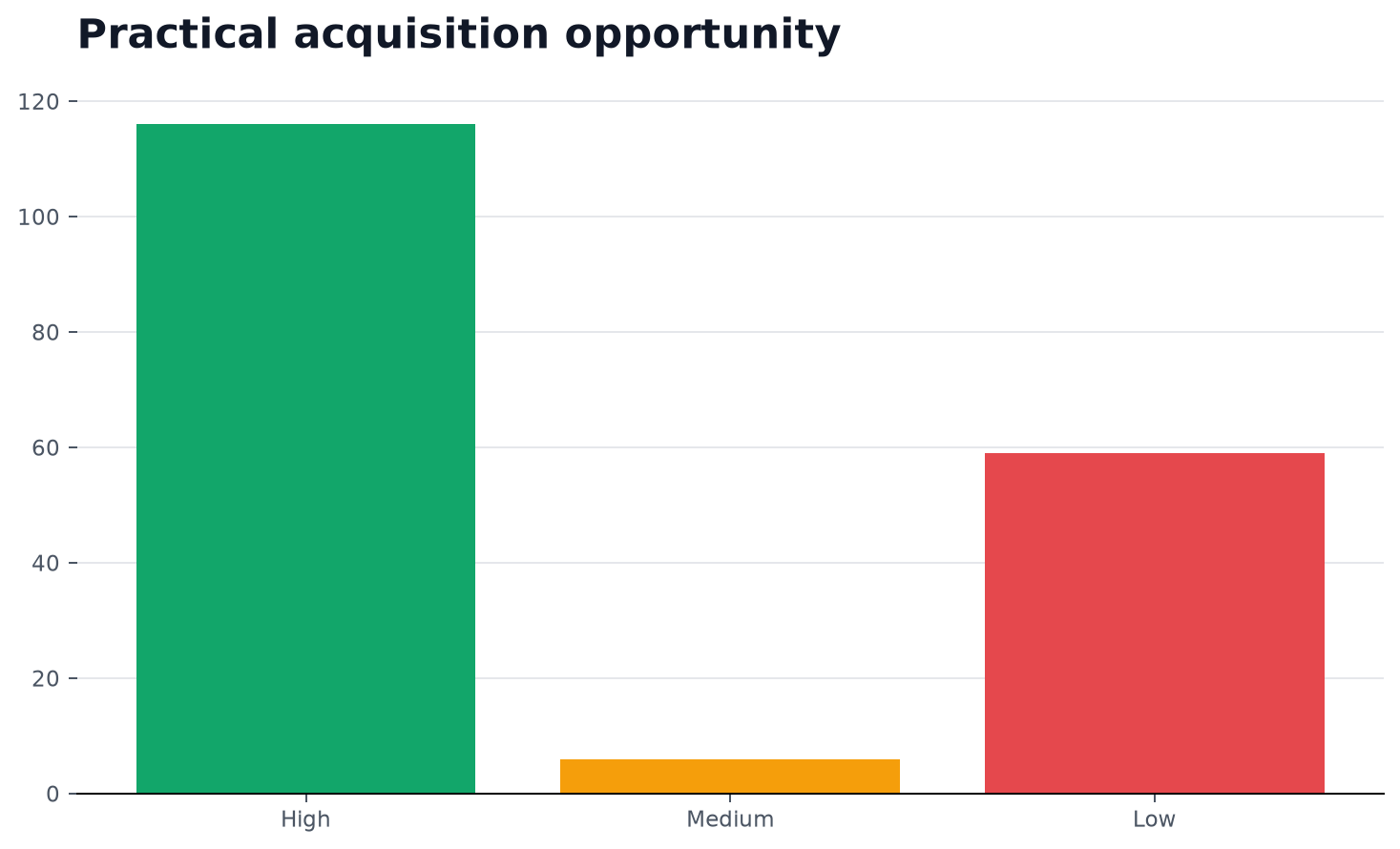
| Realistic acquisition share | 60.4% | Most observed sources were at least plausible outreach, contribution, PR, listing, or partnership targets. |
What types of sources were cited most
The largest group in the full sample was direct commercial pages, followed by comparisons, brand educational content, and communities. That matters because a GEO campaign focused only on press links would miss a large part of the observed source ecosystem.
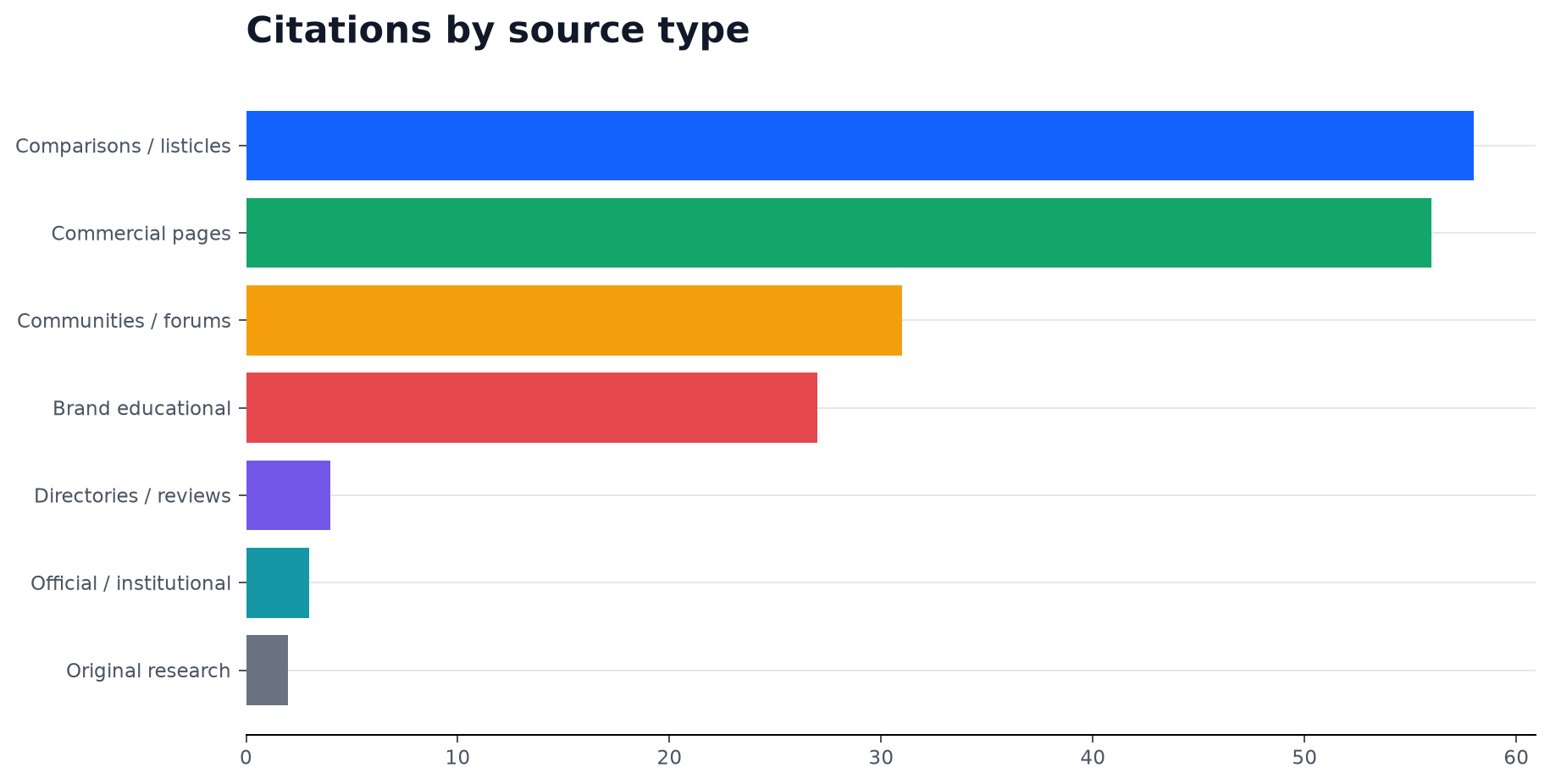
Commercial citations do not mean every company can simply make its own claims and expect inclusion. They suggest that clear, indexable source pages still matter for first-party facts. Independent pages become more important when an answer needs to compare, rank, validate, or explain competing claims.
Google AI Overviews and Perplexity did not behave identically
Google produced more verifiable citation rows in this collection, partly because its result panels often expanded into related links and community material. Perplexity was more selective in the URLs visibly exposed during the audit. The counts should not be treated as a universal benchmark; they show that measurement must be engine-specific.
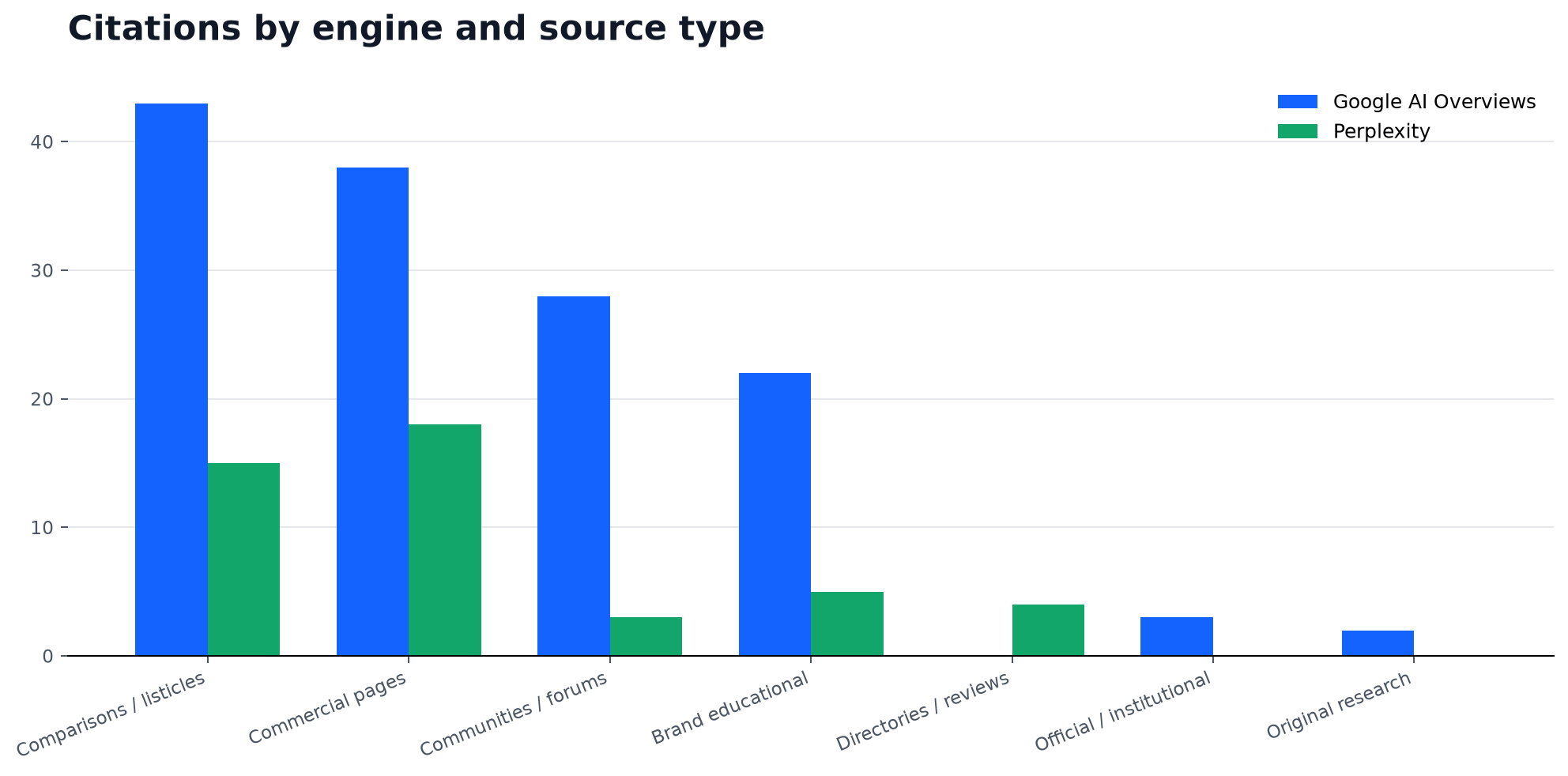
The useful operational lesson is simple: do not report “AI visibility” as one blended number. Track the exact engines, prompts, cited domains, and landing pages. Our guide to LLM tracking tools explains how to build that monitoring stack.
Query type changes the opportunity
Provider comparisons generated the most citations in the sample. Informational queries also produced many Google citations, while professional and local searches were less consistent. This affects where outreach effort should go.
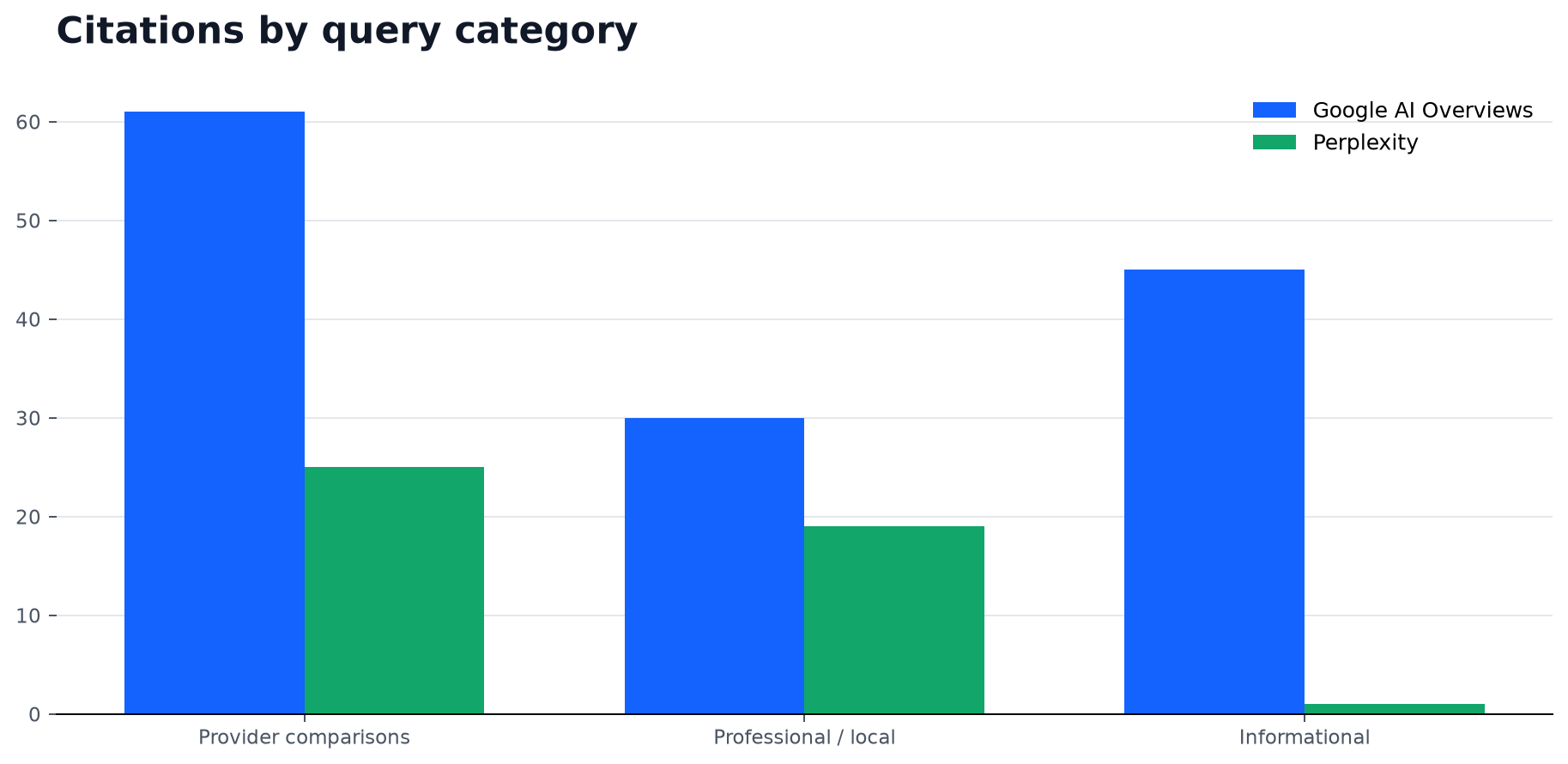
If your revenue depends on “best,” “alternatives,” or category-comparison queries, independent listicles and specialist reviews are obvious targets. For local services, authoritative profiles, reviews, local publishers, and professional directories may provide a stronger corroboration layer than a generic guest post.
Links, unlinked mentions, and entity corroboration
A hyperlink is technically useful because it gives crawlers an explicit path. But AI retrieval also works with text, entity relationships, structured records, and repeated claims. An unlinked mention on a trusted page may strengthen recognition even when it passes no conventional link equity.
Think in four functions:
- Discovery: a source helps the system find a page, entity, or claim.
- Corroboration: an independent source supports a claim made on your own site.
- Reputation: repeated coverage establishes that others know and discuss the entity.
- Entity reinforcement: consistent names, categories, locations, people, and products reduce ambiguity.
This fits the broader approach in our tactical link building for GEO guide. The guide explains execution; this study shows where those tactics can realistically land.
A practical strategy by source type
Independent comparisons and listicles
Do not send a generic “please add us” email. Show the editor what is missing: a category not represented, fresher pricing, a verifiable benchmark, a distinct use case, or a transparent methodology. Make the page better whether or not you receive a link.
Original research
Create a dataset other publishers can check. Publish methodology, dates, definitions, limitations, and downloadable rows. Our article on creating citable content covers the page-level mechanics.
Directories and reviews
Prioritize databases that are already cited for your query class. Complete the entity record: category, service area, founders, pricing model, reviews, and consistent URLs. A complete profile is more useful than fifty thin listings.
Communities
Participate where buyers genuinely discuss the problem. Do not manufacture endorsements. Useful answers, disclosed affiliation, and concrete examples create durable references; spam creates a reputation liability.
Brand educational pages
Partnerships, integrations, expert quotes, and co-created resources can place your entity inside an already trusted knowledge graph. These sources are controlled by a brand, but they can still provide discovery and topical context.
A 90-day GEO link acquisition plan
- Days 1-15: define 20-30 commercially meaningful prompts, record current citations, and group the cited domains by source type and function.
- Days 16-30: repair first-party source pages. Make claims explicit, add evidence, publish authorship, improve indexability, and keep entity facts consistent.
- Days 31-60: pursue ten high-fit external placements. Lead with data, expert contribution, integrations, missing comparisons, or genuine directory completeness.
- Days 61-90: rerun the same prompts. Track new mentions, cited URLs, referral visits, assisted conversions, and changes in the domain set.
How to measure results without claiming false causality
Measure leading and lagging indicators separately. Leading indicators include accepted contributions, new independent mentions, indexation, citation-ready assets, and source-page updates. Lagging indicators include share of cited prompts, citation frequency, referral traffic, branded search, qualified leads, and assisted revenue.
When visibility changes, record the timing but avoid the sentence “this backlink caused the AI citation.” A defensible statement is: “after the placement, the domain began appearing for four monitored prompts.” That is still useful, and it is honest.
For broader context, compare these findings with our AI search statistics and citation audit.
Cancillo, David. “Link Building for GEO: What 60 AI Searches Reveal About the Sources That Get Cited.” Wisseo, June 23, 2026. https://blog.wisseo.app/link-building-for-geo-ai-citations-study/
Reuse the data and charts. The dataset is licensed CC BY 4.0 with attribution to David Cancillo / Wisseo and a link to this canonical page.