

AI search is reducing clicks, increasing no-visit answers, and creating a new referral channel that is growing quickly. Yet many statistics about the shift appear to contradict one another because they measure different things.
This analysis brings together 25 AI search statistics from original English-language research by Pew Research Center, Ahrefs, Semrush, and Similarweb. It was last reviewed on June 19, 2026. Every figure includes its most important sample detail or limitation, so it can be cited without stripping away the context.
Original study: how well are AI search statistics cited?
We audited 50 articles, 25 in Spanish and 25 in English, reviewing up to ten numeric claims per page. The dataset contains 461 audited claims. The aim was not to decide whether a figure “sounds credible,” but whether a reader can trace it to an identifiable source and understand its context.
The question we wanted to answer
AI search statistics roundups constantly cite one another. We wanted to test something more fundamental than how popular a figure had become: can a reader trace the claim from the article back to the research that produced it?
This is not a study of whether AI search is growing or shrinking. It is a citation quality and traceability audit. It examines how articles present evidence about AI Overviews, ChatGPT, referral traffic, and search behavior.
How we built the 50-article sample
- We ran five searches related to AI search statistics in Spanish and five in English.
- We selected 25 eligible results per language, recorded in the order observed on June 19, 2026.
- We excluded Wisseo, product pages, paywalls, and pages devoted solely to presenting one original study.
- We limited the sample to two articles per domain so that one publisher could not dominate the results.
- We included public roundups and analyses containing enough numeric claims to assess their citation practices.
The sample is not intended to represent the entire web. It is a reproducible snapshot of the articles a user could find through those searches on the collection date.
What we audited
The unit of analysis was not the whole article but each numeric claim. We reviewed up to ten per article: 221 from Spanish-language pages and 240 from English-language pages, for a total of 461 claims.
What we found
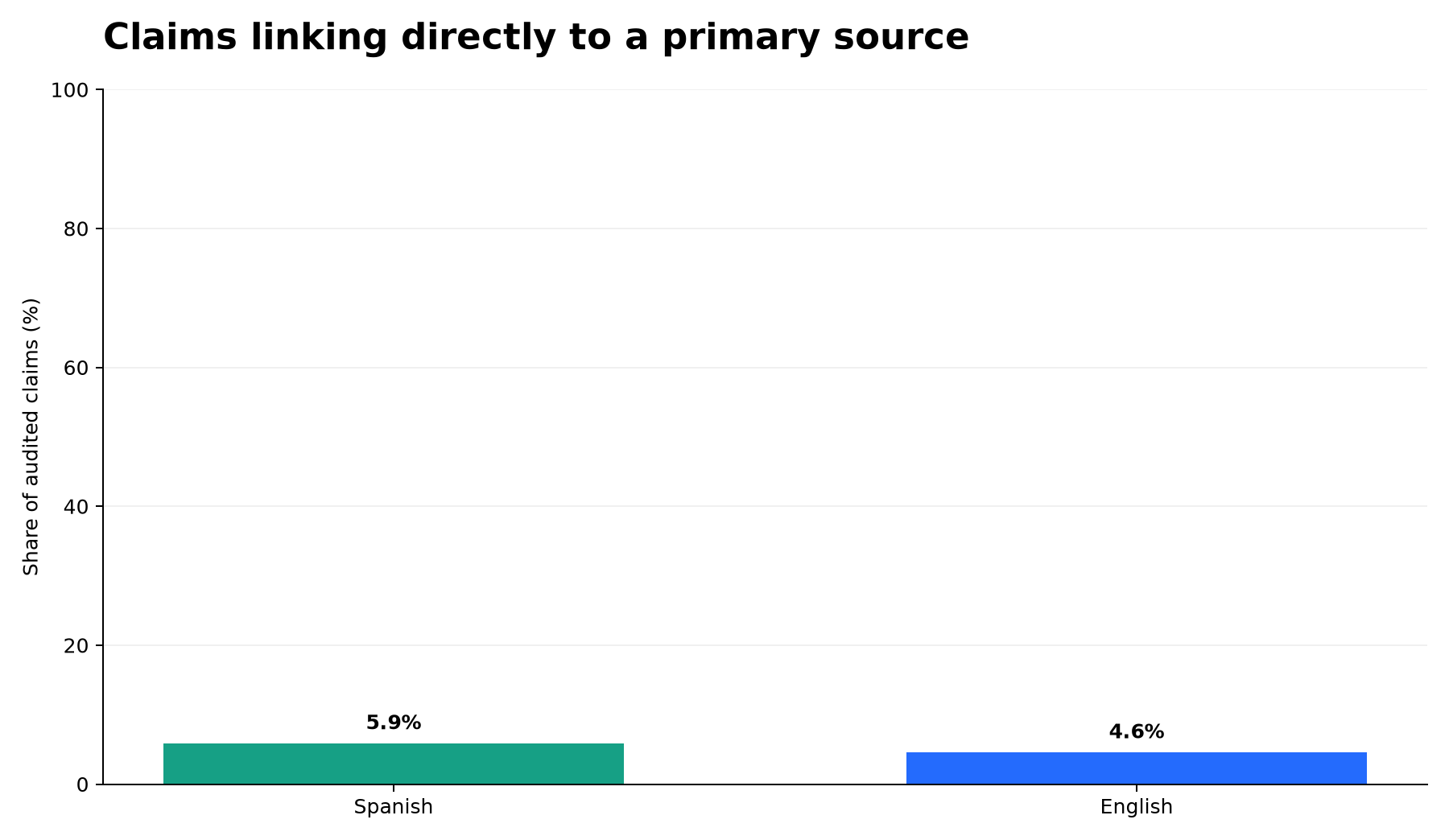
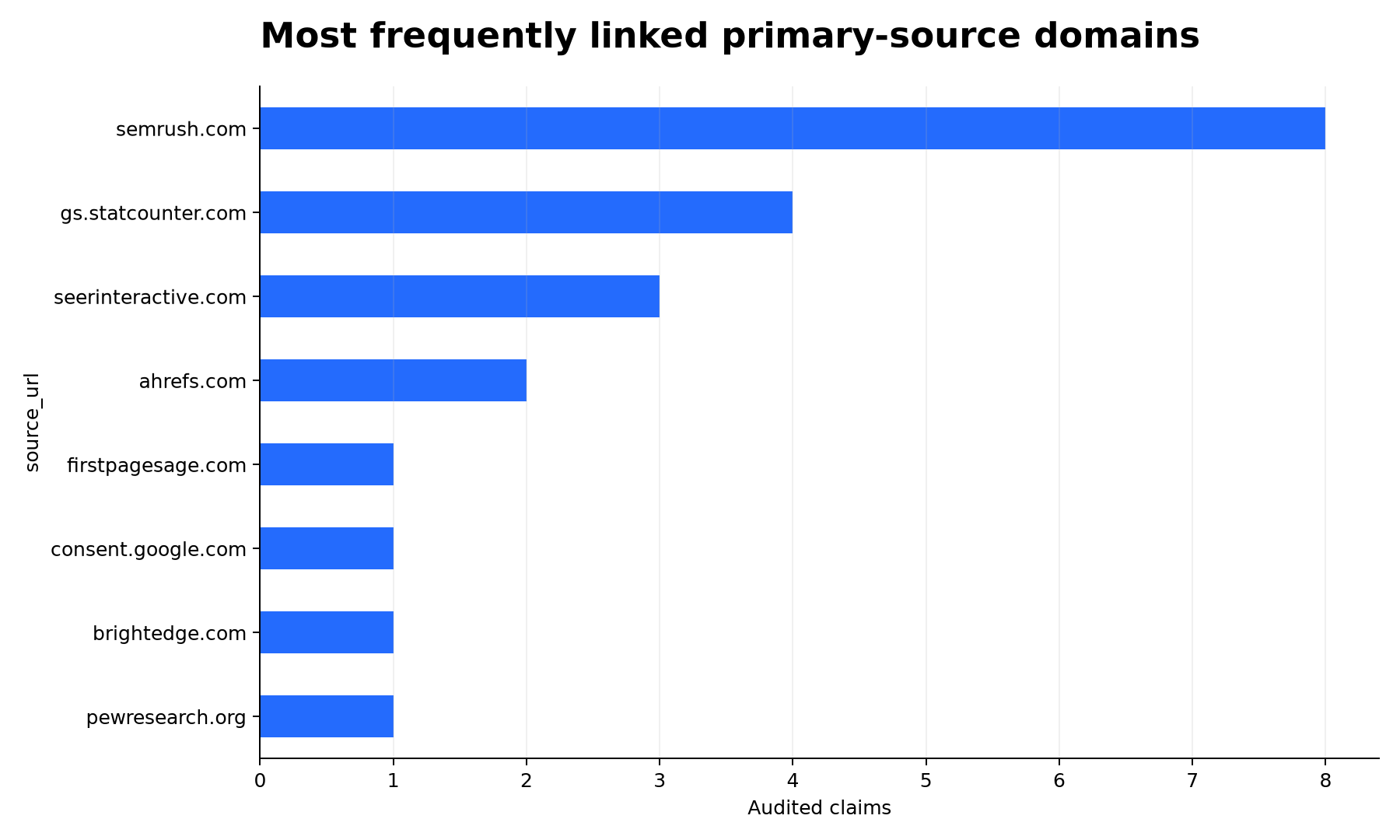
The main finding is how difficult it is to reach the origin of many figures. Only 5.9% of audited Spanish claims and 4.6% of English claims linked directly to a primary source. In more than 80% of cases, we found no external source link attached to the claim in the block where it appeared.
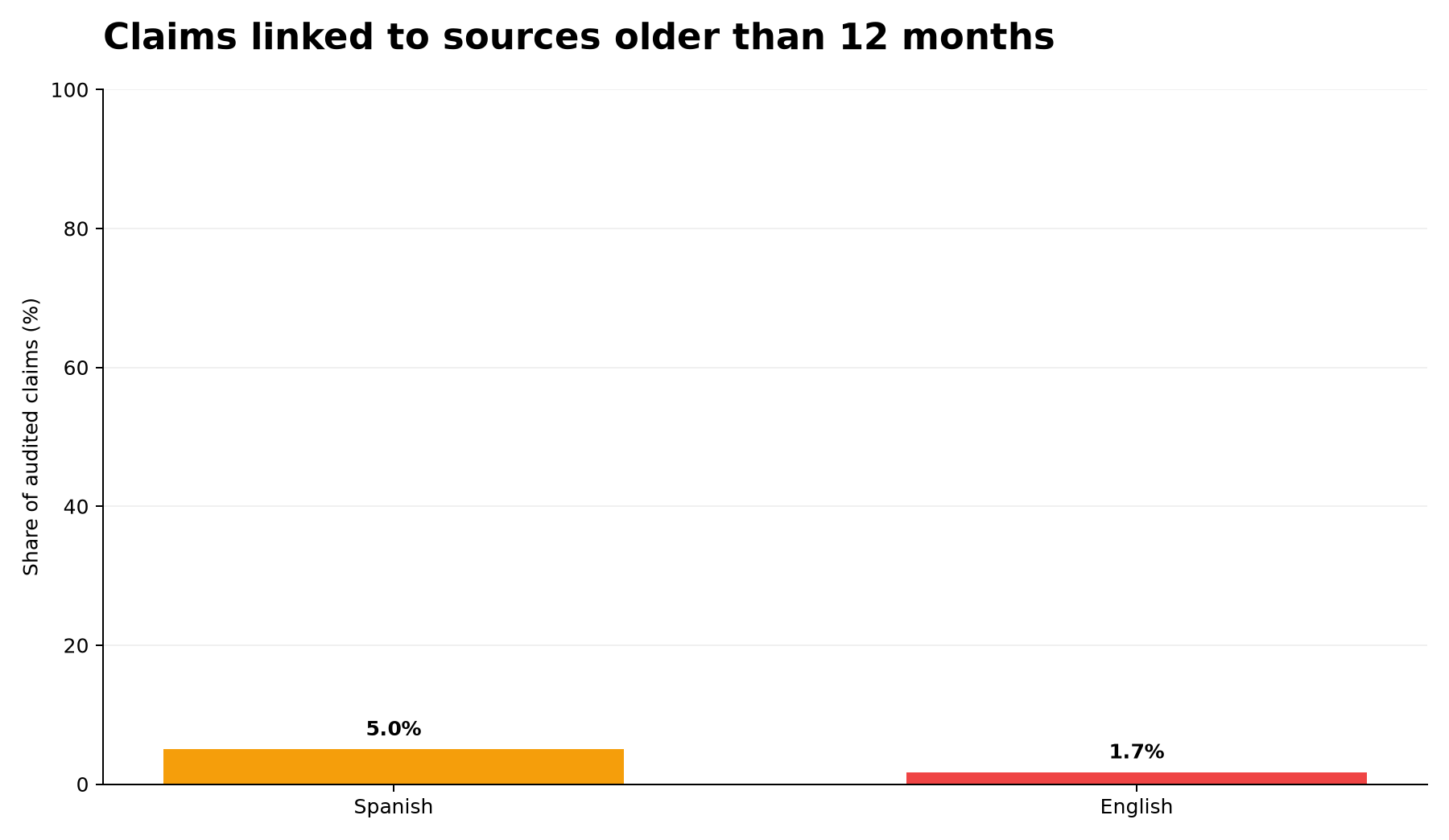
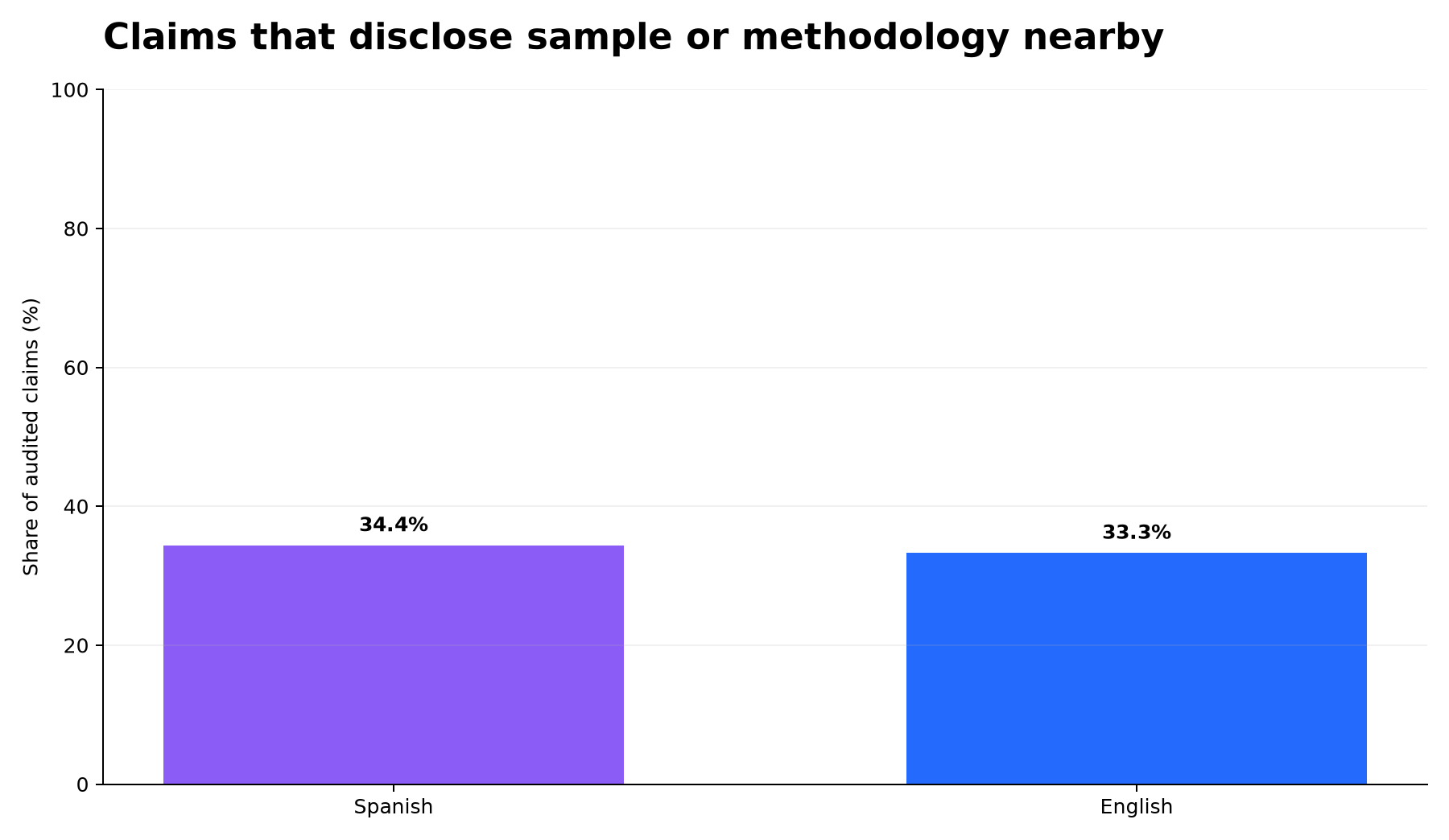
English articles placed a date near the claim more often than Spanish articles —45% versus 33.5%— but sample or methodology disclosure was almost identical: 33.3% in English and 34.4% in Spanish. The difference between languages was smaller than the shared problem: many figures circulate without enough context to reuse them safely.
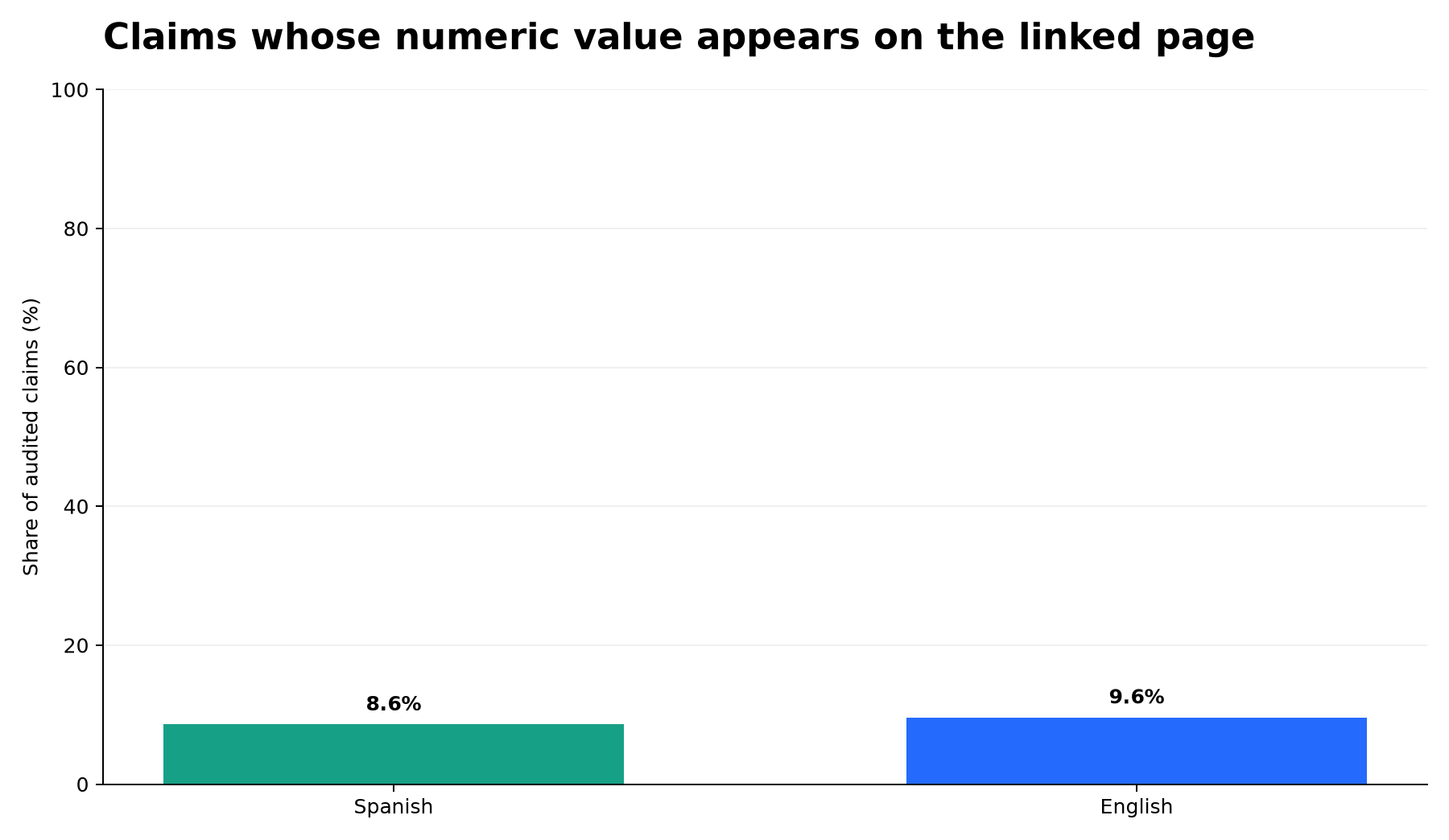
The low share of values found on linked pages must be read alongside the high number of claims without a direct link. It does not mean that more than 90% of the statistics are false. It means that, from the audited article, the verification path was missing, incomplete, or ended at another secondary source.
Why this matters for SEO and AI visibility
When many articles repeat a number without linking to the original study, search engines and AI systems may encounter apparent consensus rather than independent evidence. An easy-to-copy statistic can be cited hundreds of times even after its sample, date, and definition have disappeared.
Truly citable content should meet a higher standard: link to the primary source, name the sample and time period, define what the percentage measures, and avoid presenting estimates or correlations as universal facts.
| Metric | Spanish articles | English articles |
|---|---|---|
| Claims audited | 221 | 240 |
| Primary-source link | 5.9% | 4.6% |
| Secondary-source link | 10.4% | 13.3% |
| No direct source link | 83.7% | 82.1% |
| Sample or method disclosed | 34.4% | 33.3% |
| Value found on linked page | 8.6% | 9.6% |
Methodology and limitations
The sample was collected on June 19, 2026 through five queries per language. We excluded Wisseo, paywalls, and product pages, and limited each domain to two results. We recorded visible source links, source type, date, sample or methodology, HTTP status, and whether the numeric value appeared on the linked page. A second pass covered at least 20% of rows and every ambiguous case. Some websites load content with JavaScript or block crawlers; those limitations remain visible in the CSV files.
“No direct link” does not necessarily mean a claim is false. It means the audited page does not let a reader verify it from the claim. Likewise, finding the same number on a source page does not by itself prove that the context or interpretation is correct.
Open data, not a black box.
Includes articles.csv, claims.csv, methodology, metrics, and all ten PNG charts. Licensed under CC BY 4.0.
Cancillo, David (2026). Wisseo AI Search Statistics Citation Audit: 50 articles and 461 claims. Wisseo. https://blog.wisseo.app/ai-search-statistics-2026/
This study complements our guides to content AI can cite, measuring AI visibility, and organic and AI visibility.
The 25 statistics at a glance
| Metric | Finding | Source and sample |
|---|---|---|
| Google searches with an AI summary | 18% | Pew, 68,879 searches |
| Result click with / without an AI summary | 8% / 15% | Pew, observed behavior |
| Click on an AI-summary citation | 1% | Pew |
| Estimated position-one CTR impact | -58% | Ahrefs, 300,000 keywords |
| Keywords with an AI Overview | 15.69% in Nov. 2025 | Semrush, 10M+ keywords |
| AI traffic as a share of all visits | <0.15% | Semrush, 50,000+ websites |
| AIO citations also present in top 10 | 37.9% | Ahrefs, 4M citations |
AI Overviews and clicks: the clearest shift
1. AI summaries appeared in 18% of the Google searches analyzed. Pew examined 68,879 unique searches made by 900 U.S. adults in March 2025. This is real browsing behavior, but it is limited to the United States and one period. Source: Pew Research Center.
2. Fifty-eight percent of participants encountered at least one AI summary during the month. A feature can appear on 18% of searches while reaching a much larger share of people because each user performs multiple searches.
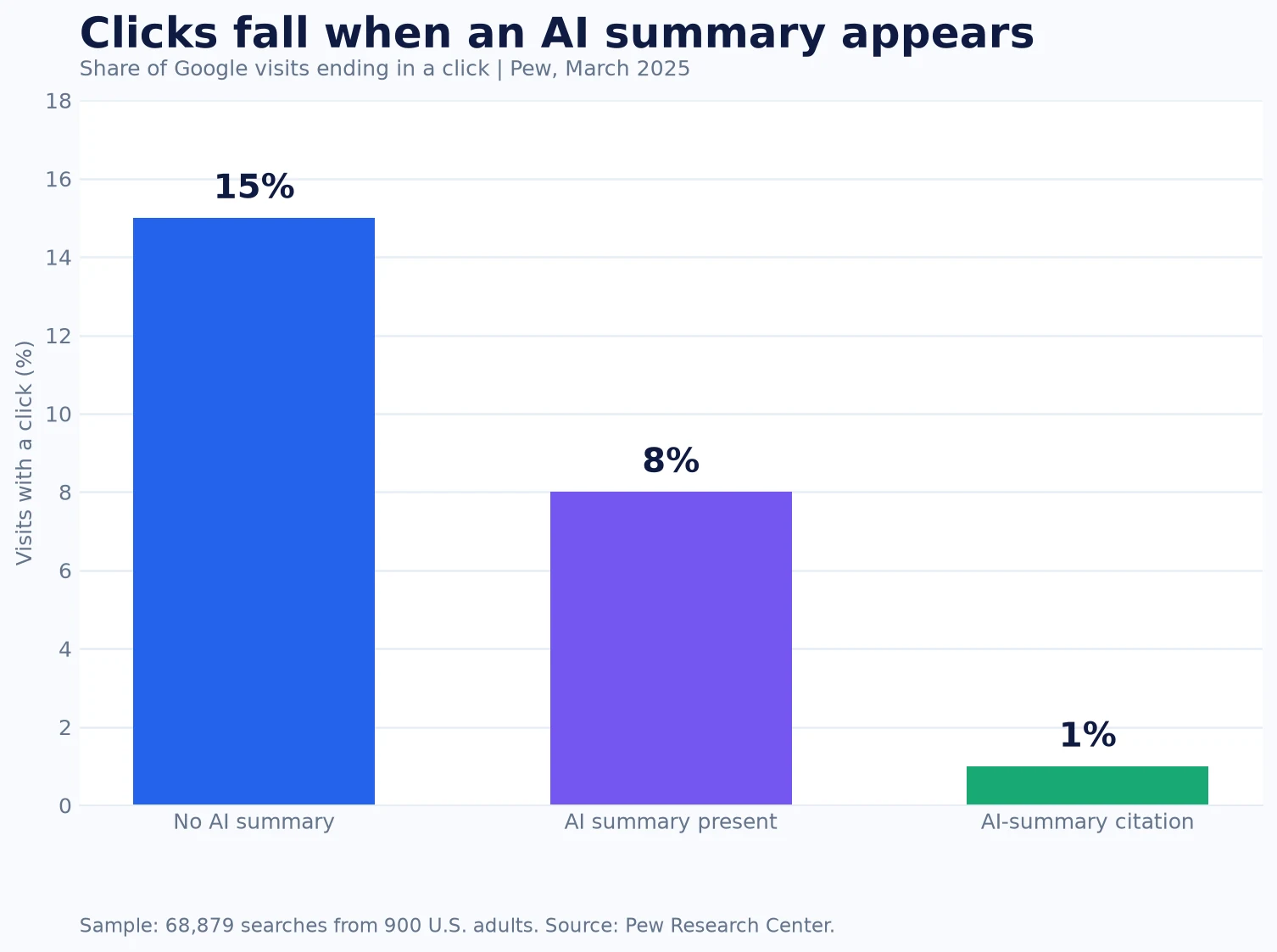
3. When an AI summary appeared, only 8% of visits ended in a click on a traditional result.
4. Without an AI summary, 15% of visits produced a result click. In this sample, observed click probability was almost twice as high when Google did not show a summary.
5. Just 1% of visits containing an AI Overview produced a click on one of its cited links. A citation can create brand visibility, but it should not automatically be treated as likely referral traffic.
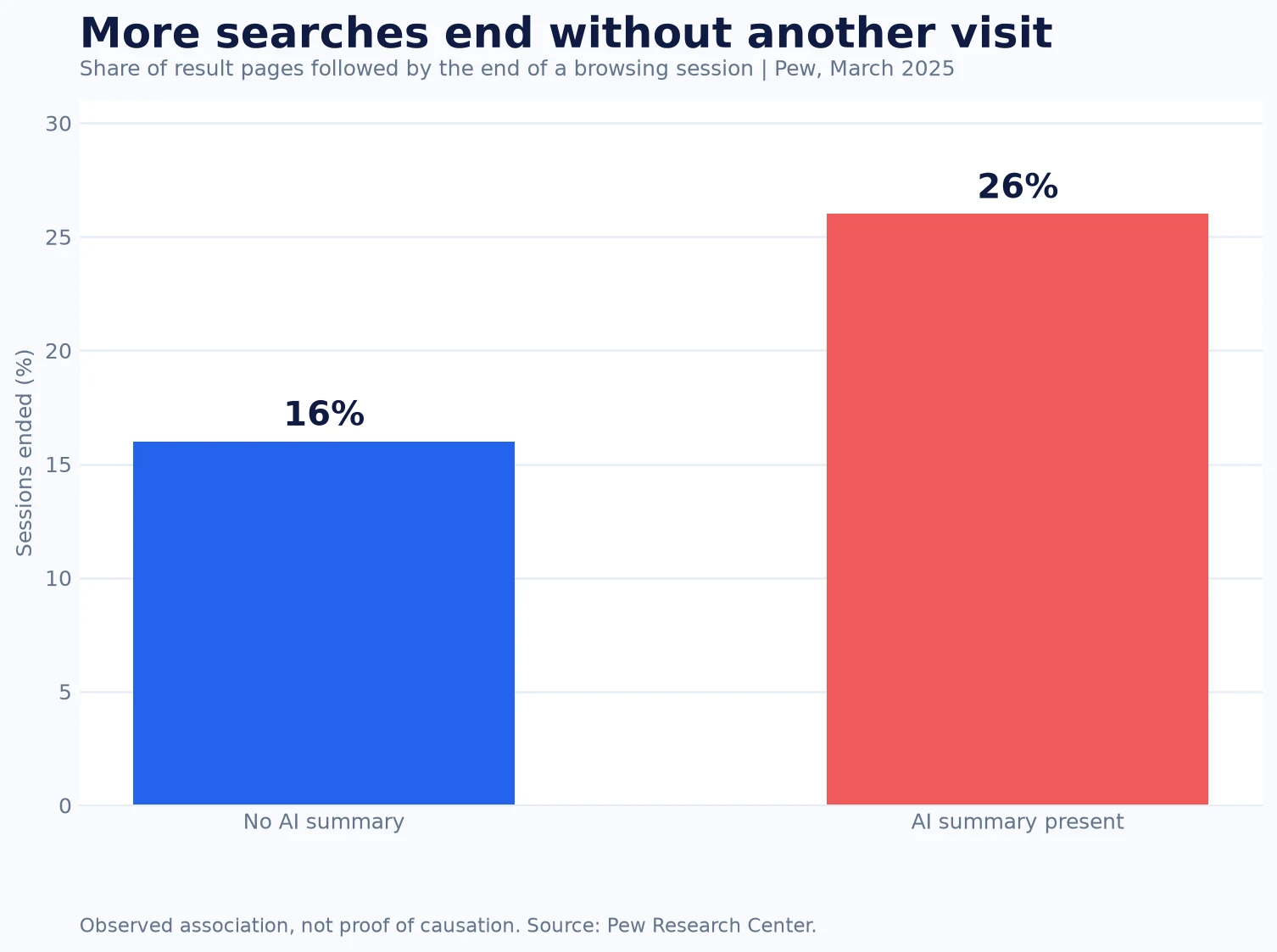
6. Twenty-six percent of visits to a search page with an AI summary ended the browsing session.
7. On pages without a summary, the session-ending rate was 16%. This is an observed association, not proof that the AI Overview alone caused the difference. Queries that trigger summaries may also be easier to resolve.
8. Ahrefs estimates that an AI Overview reduces the CTR of the number-one result by 58%. Its February 2026 study compared 150,000 keywords with an AIO against 150,000 informational keywords without one, using aggregated Search Console data. Source and methodology: Ahrefs.
9. The estimated impact remains -50.8% in position two and -46.4% in position three. The loss becomes smaller further down the ranking.
10. Even position ten showed an estimated impact of -19.4%. Applying the -58% figure to every result would be inaccurate: Ahrefs found a different effect at each position.
How many searches show AI-generated answers?
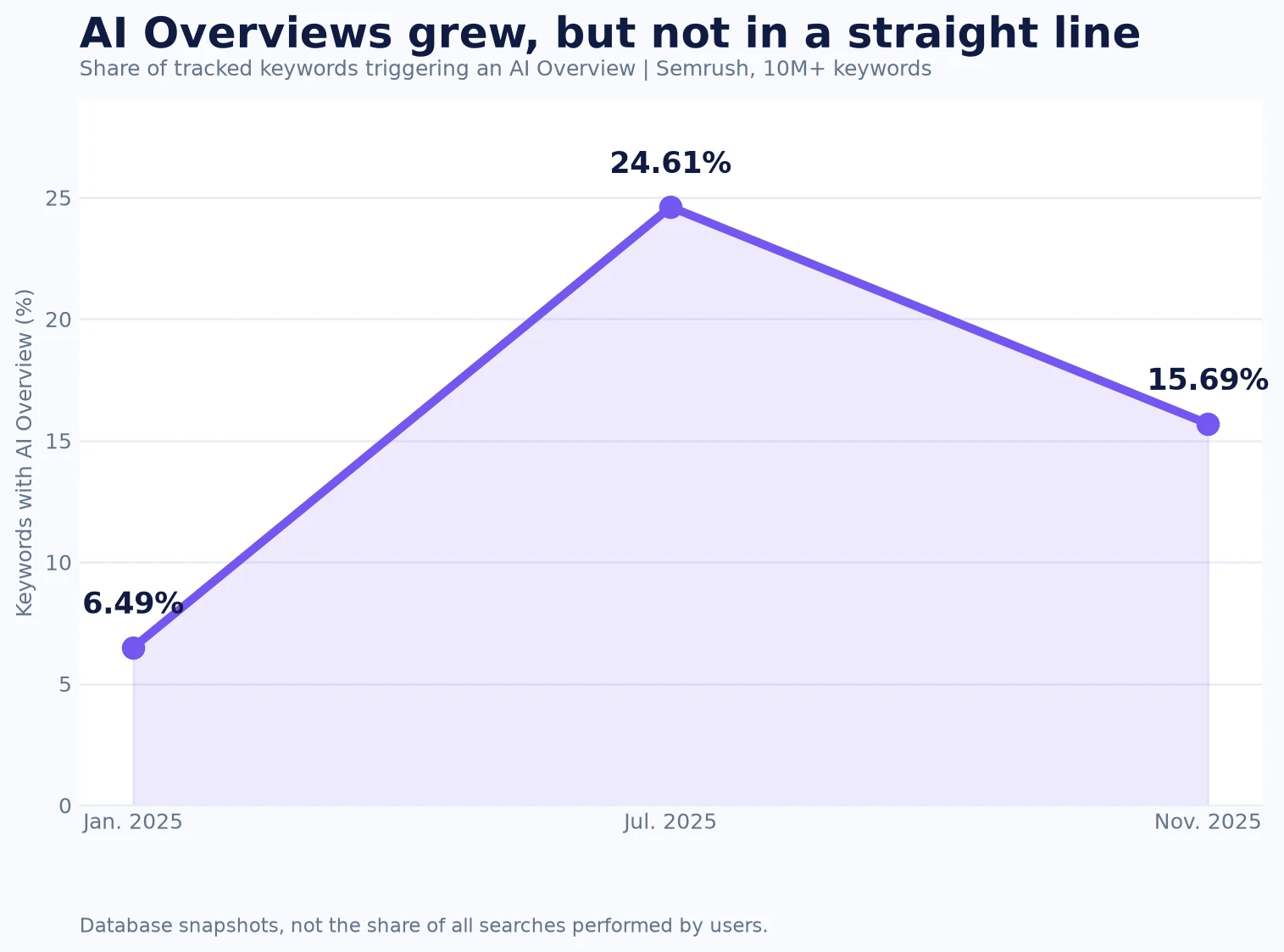
11. Semrush found AI Overviews on 6.49% of tracked keywords in January 2025. The analysis followed more than 10 million keywords, not every search performed by users. Source: Semrush AI Overviews study.
12. Prevalence peaked at 24.61% in July 2025.
13. By November, it had fallen to 15.69%. The rollout was not linear. A snapshot from one month can quickly become outdated or describe a temporary test.
14. In January 2025, 91.3% of queries triggering AI Overviews had informational intent.
15. By October, the informational share had fallen to 57.1%. This does not necessarily mean fewer informational summaries in absolute terms. Commercial, transactional, and navigational queries gained share.
16. Navigational searches triggering AI Overviews rose from 0.74% in January to 10.33% in October. AI search is no longer confined to definitions and how-to questions.
17. Sixty-five percent of U.S. adults said they encountered AI summaries at least sometimes. This was an August 2025 survey of 5,153 adults, separate from Pew’s browsing panel. Source: Pew survey.
18. Forty-five percent said they saw them often or extremely often. This measures reported perception rather than audited SERPs.
Referral traffic from ChatGPT and other assistants
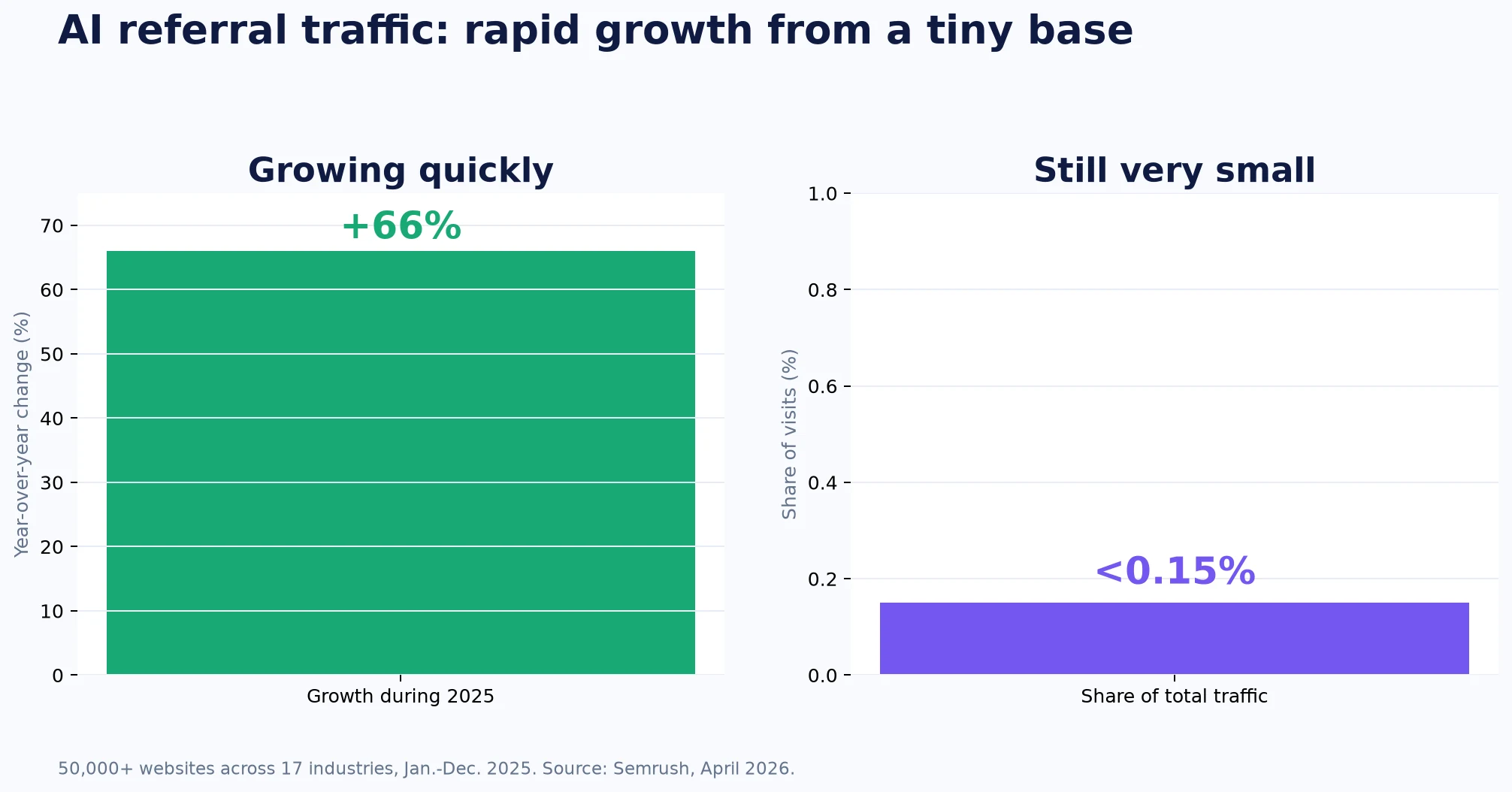
19. Traffic from AI systems grew by 66% during 2025. Semrush analyzed billions of visits across more than 50,000 websites and 17 industries. Source: Semrush, April 2026.
20. Despite that growth, AI accounted for less than 0.15% of total visits. The percentage increase looks dramatic because it starts from a very small base.
21. Similarweb estimated more than 1.1 billion referral visits from AI platforms in June 2025. Its global report described this as 357% year-over-year growth. Source: Similarweb.
22. Similarweb estimated an approximately 7% conversion rate for AI referrals to transactional sites. The conversion definition and site mix matter; this is not a benchmark that can be applied directly to every business.
23. In an earlier sample of 3,000 websites, Ahrefs found that 63% had received at least one identifiable visit from a chatbot. AI visits without referral data can be classified as direct, so visible attribution is a minimum. Source: Ahrefs.
In that sample, chatbots supplied an average of 0.17% of site traffic; three assistants generated 98% of attributable AI visits, and ChatGPT accounted for roughly half. These numbers help prioritize measurement, but they date from February 2025 and the platform mix changes quickly.
AI citations and traditional rankings
24. In March 2026, only 37.9% of URLs cited by AI Overviews also appeared within the first 10 blocks of the same SERP. Ahrefs analyzed four million cited URLs across 863,000 search-results pages. Source and methodology: Ahrefs.
25. Another 31.2% appeared in positions 11-100, while 31% sat outside the first 100 blocks. In the blue-link-only analysis, 36.7% of cited URLs did not rank in the organic top 100.
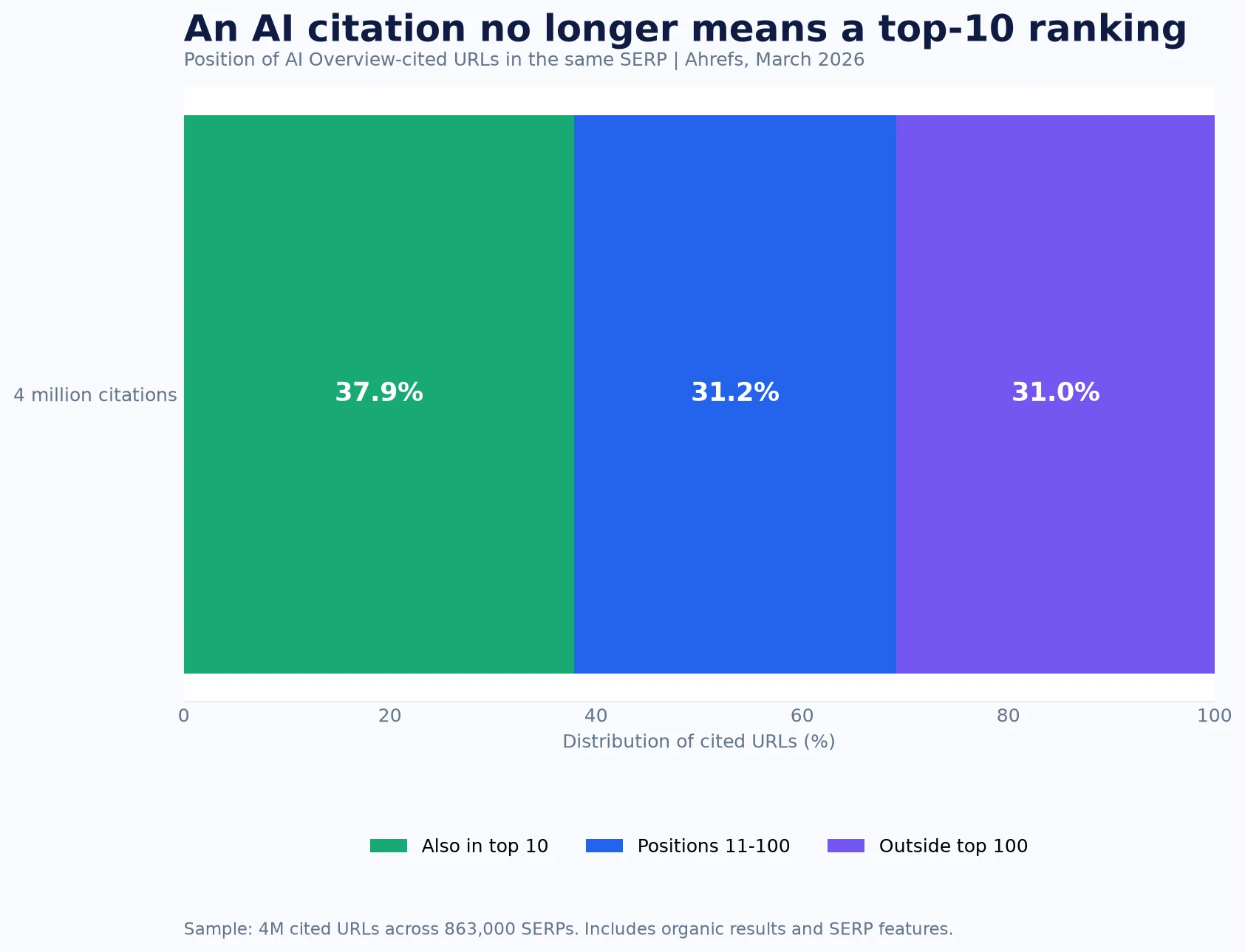
This challenges a common simplification: ranking in Google helps, but it no longer fully explains citations. An earlier Ahrefs study found 76% top-10 overlap. Some of the difference may be real, while some reflects improved citation parsing, so the change should not be presented as a perfectly comparable fall from 76% to 38%.
Three additional figures that need a warning label
Several attention-grabbing numbers add useful context but should not become universal benchmarks:
- AI traffic grew 9.7 times in one year in Ahrefs’ June 2025 sample of 81,947 websites. Read the study. The period and small starting base explain part of the increase.
- At Ahrefs, 0.5% of visitors produced 12.1% of signups, and AI visitors converted 23 times better than organic search visitors. Read the case study. This is one company with an unusually AI-aware audience.
- Eighty-eight percent of Pew’s observed summaries cited three or more sources, but more sources did not translate into evenly distributed clicks: only 1% of visits produced a citation click.
What these statistics mean for SEO
The first conclusion is uncomfortable: an organic impression is worth less when the complete answer appears before the link. Search Console can show more visibility and fewer clicks at the same time. Separate keywords with AI Overviews, branded queries, and pages whose value depends on a site visit.
The second conclusion is more optimistic. AI referral traffic is still small, but it may arrive with advanced intent. That does not justify abandoning Google or chasing AI mentions at any cost. It does justify tracking ChatGPT, Perplexity, Gemini, and Copilot as distinct sources, preserving their landing pages, and recording conversions.
The third conclusion is strategic: AI Overviews and standalone assistants do not choose sources in the same way. Google AIO citations remain related to rankings, but URL-level overlap is much lower than early research suggested. This favors content that answers query variants, contributes original evidence, defines entities clearly, and can be cited in self-contained passages.
How to cite these figures correctly
- Always include the study date. Six months can materially change an AI-search result.
- Name the unit: people, searches, keywords, pages, websites, or visits.
- Do not turn correlation into causation. “Fewer clicks were observed with AIOs” is more accurate than claiming the AIO caused the entire decline.
- Do not mix share and growth. A channel can grow 357% while remaining a tiny part of all traffic.
- For vendor research, name the provider and sample size. These studies are valuable, but they are not universal censuses.
Methodology for this collection
We prioritized original English-language studies with visible samples and methods. We excluded statistics repeated by blogs that did not link to a primary source and avoided averaging results from incompatible methodologies. Every chart in this article is an original recreation of data published by the named source; datasets were not combined.
This article will be updated when comparable 2026 studies become available. If you reuse a figure, link to the original study as well. That preserves the context and lets readers check whether the provider has revised its findings.
Reuse the study.
Download the CSV files and charts under a CC BY 4.0 license.