

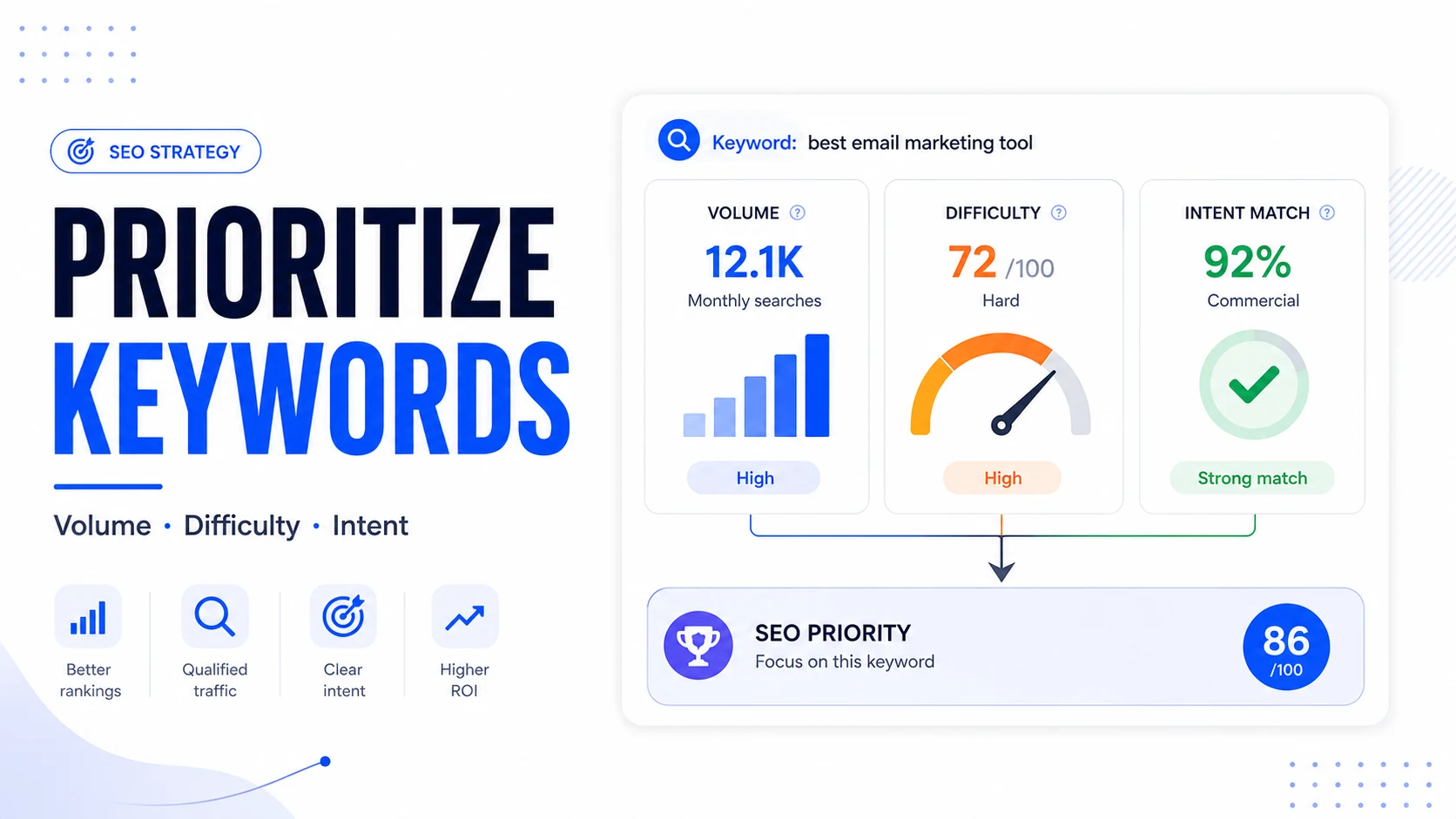
Keyword prioritization is easy when every signal points in the same direction. High volume, low difficulty, clear intent: go. The real problem starts when the metrics disagree.
A keyword can have high search volume and almost no business value. Another can look difficult, but be so important to your business that you cannot ignore it. Another can look easy, but the SERP may demand a page format your site cannot support yet.
That is why prioritizing keywords is not about sorting a spreadsheet by volume or KD. It is about deciding where SEO effort is most likely to turn into learning, authority, qualified traffic or revenue.
Calculator: real keyword priorityTurn volume, difficulty, intent and business value into an actionable decision.Open tool
Keyword signals
Statistics that should change how you prioritize keywords
External data points to the same conclusion: isolated metrics are misleading. Volume does not always become clicks, difficulty does not always capture real effort, and a strong page can rank for far more searches than its primary keyword.
Why volume, difficulty and intent do not weigh the same
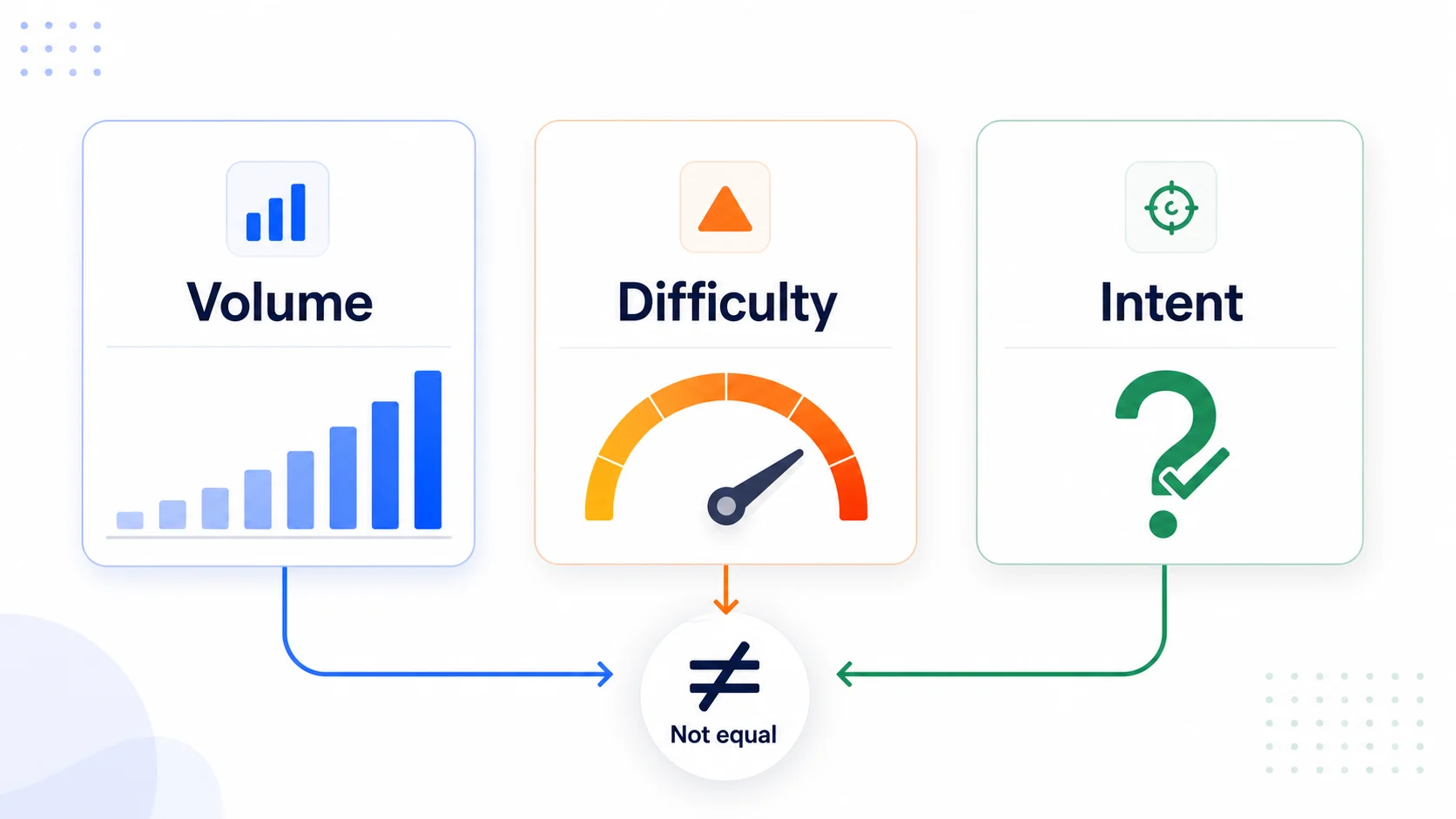
Volume tells you how much visible demand exists. Difficulty tries to estimate the strength of competition. Intent tells you what the user expects to do. All three matter, but they do not deserve equal weight.
If a keyword has high volume but weak intent for your business, it can fill reports without creating meaningful opportunities. If a keyword has low volume but perfectly matches a high-value problem, it may deserve more attention than a large, vague keyword.
Volume creates the ceiling. Difficulty defines the cost. Intent decides whether the traffic is worth having.
When volume lies
Click potential: the missing metric between volume and traffic
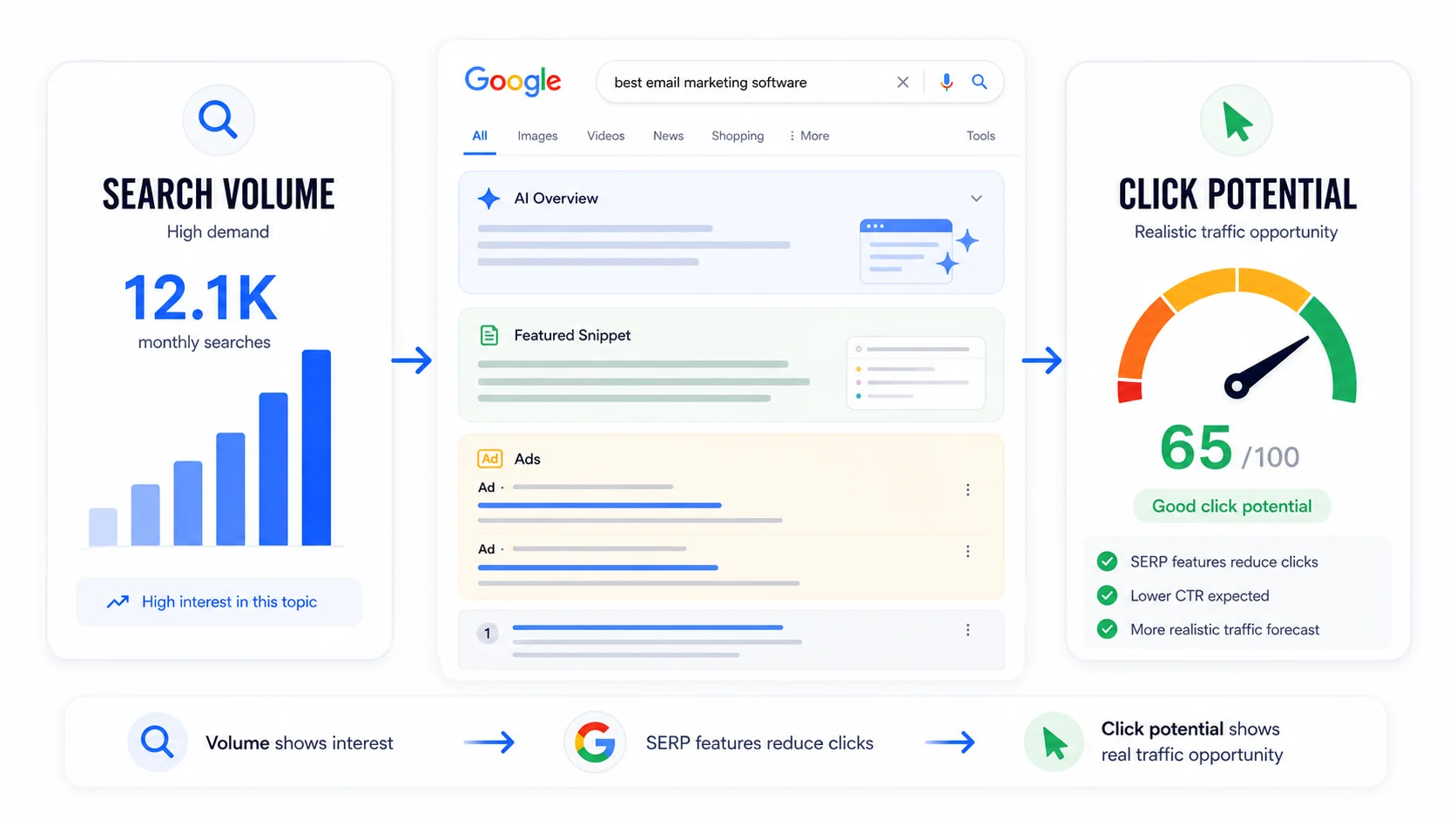
A keyword can have high search volume and still produce very few organic clicks. If the SERP has an AI Overview, featured snippet, ads, carousels, direct answers or a dominant local pack, part of the demand stays inside Google.
That is why click potential should act as a fourth metric. Do not only ask “how many searches does this keyword have?” Ask: how much organic space remains, is the answer solved without a click, does the user need to compare more, and does the winning format invite page visits?
If volume is high but click potential is low, lower the priority unless the keyword has brand, authority or indirect conversion value.
Volume is often the most seductive metric. It is also the most dangerous when used alone. A keyword with 10,000 searches can be worse than one with 100 if the user is not looking for what you sell, if the SERP answers the question directly or if the ranking format does not match your page.
Volume also does not measure precision. Many small keywords reveal very specific problems. In B2B, SaaS, professional services and specialized ecommerce, those searches can be more valuable than huge awareness keywords.
When difficulty lies
Difficulty is an estimate, not a verdict. It is usually based on visible authority, links or competition signals. But a difficult keyword can still be attackable if the SERP is poorly served, if intent is fragmented or if you can create a much more useful page.
The opposite is also true: a low-difficulty keyword can be a trap if it has unclear intent, does not fit your architecture or Google already solves the answer directly in the SERP.
Choose the goal before choosing the keyword
Not every keyword should compete for the same outcome. If your goal is ad-supported traffic, volume matters more. If you sell services, SaaS or ecommerce, intent and proximity to conversion matter more. If you are building topical authority, you may accept informational keywords that do not convert directly.
| Goal | Prioritize | Avoid |
|---|---|---|
| Traffic | Volume, click potential and evergreen topics | Keywords with no-click SERPs or overly broad intent |
| Leads / revenue | Commercial intent, clear problem and transactional pages | Informational articles that never connect to an offer |
| Topical authority | Complete clusters, internal links and real user questions | Publishing isolated pieces with no architecture |
| Learning | Keywords testable as sections, FAQs or page improvements | Creating new URLs before validating demand |
Intent should be the main filter
Intent is the signal that connects SEO with usefulness. Before prioritizing a keyword, ask what the user wants to do: learn, compare, buy, solve a problem, find a brand, locate a business or validate a decision.
If you cannot create a page that satisfies that intent better than the current results, the keyword should not be a priority even if its metrics look attractive.
The practical prioritization matrix
Four keyword priority types
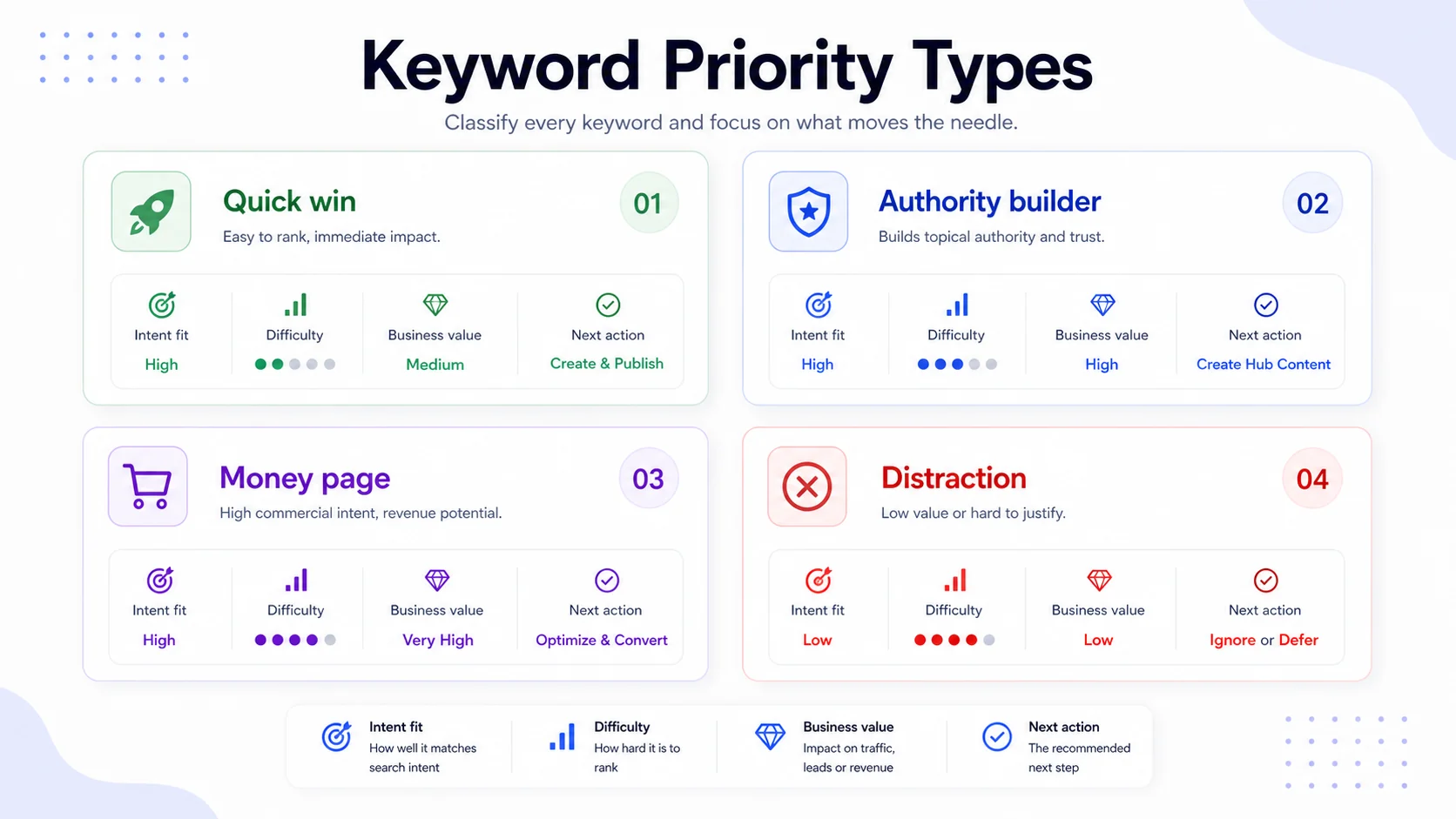
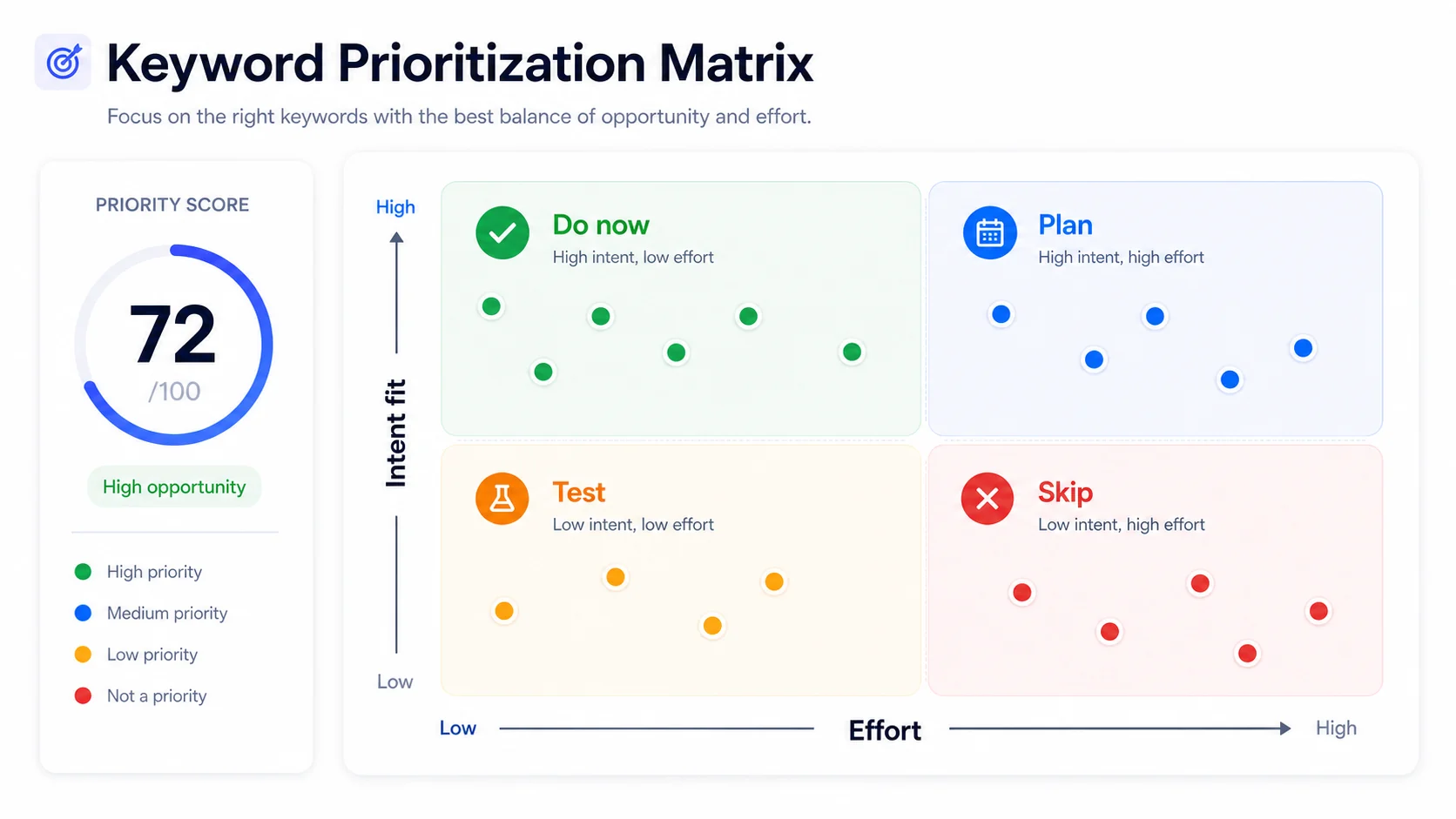
High intent, clear value, realistic SERP format and reasonable effort.
Good intent, but not enough demand or evidence yet to justify a standalone URL.
Good opportunity, but you need authority, internal links, supporting content or a better offer.
Attractive volume, but weak intent, low value or a SERP you cannot realistically match.
How to score a keyword without fooling yourself
A useful formula should not give equal weight to everything. For a small business, business value and intent fit usually matter more than volume. For a new site, difficulty and realistic capability matter more. For an authoritative site, the bottleneck may be choosing topics that convert.
Common keyword signal conflicts
| Signal | What it looks like | The better decision |
|---|---|---|
| High volume + low intent | Big traffic opportunity | Prioritize only if it supports authority or links to business pages. |
| Low volume + high intent | Small keyword | May be a priority if it is close to conversion or solves a key objection. |
| High difficulty + high value | Too hard | Create a phased strategy: long-tail, support content, internal links and authority. |
| Low difficulty + weak SERP | Easy win | Validate demand and whether the intent deserves its own content. |
| Commercial SERP + informational post | Easy content to write | Create a landing page, comparison or service page, not a generic article. |
More concrete prioritization examples
| Sample keyword | Signals | Decision |
|---|---|---|
| “free SEO tools” | High volume, broad intent, strong competition | Plan or use as a comparison only if you can add real experience. |
| “SEO software for franchises” | Low volume, specific intent, high commercial value | Prioritize as a money page or section inside a vertical landing page. |
| “what is keyword difficulty” | Informational, useful for cluster, indirect conversion | Use as an authority builder linked to keyword research pages. |
| “best cheap SEO agency” | Commercial intent, but questionable customer fit | Postpone if it attracts low-quality leads or weak margins. |
Use the SERP as the referee, not decoration
The SERP tells you what Google believes the intent means. If you see comparisons, do not publish a simple definition. If you see product pages, do not answer with an informational guide. If you see local results, do not expect to win with a blog post alone.
You should also look at who ranks. Competing against forums, old posts and weak pages is different from competing against strong brands, marketplaces, editorial publishers and pages with real experience.
Validate priority with Search Console
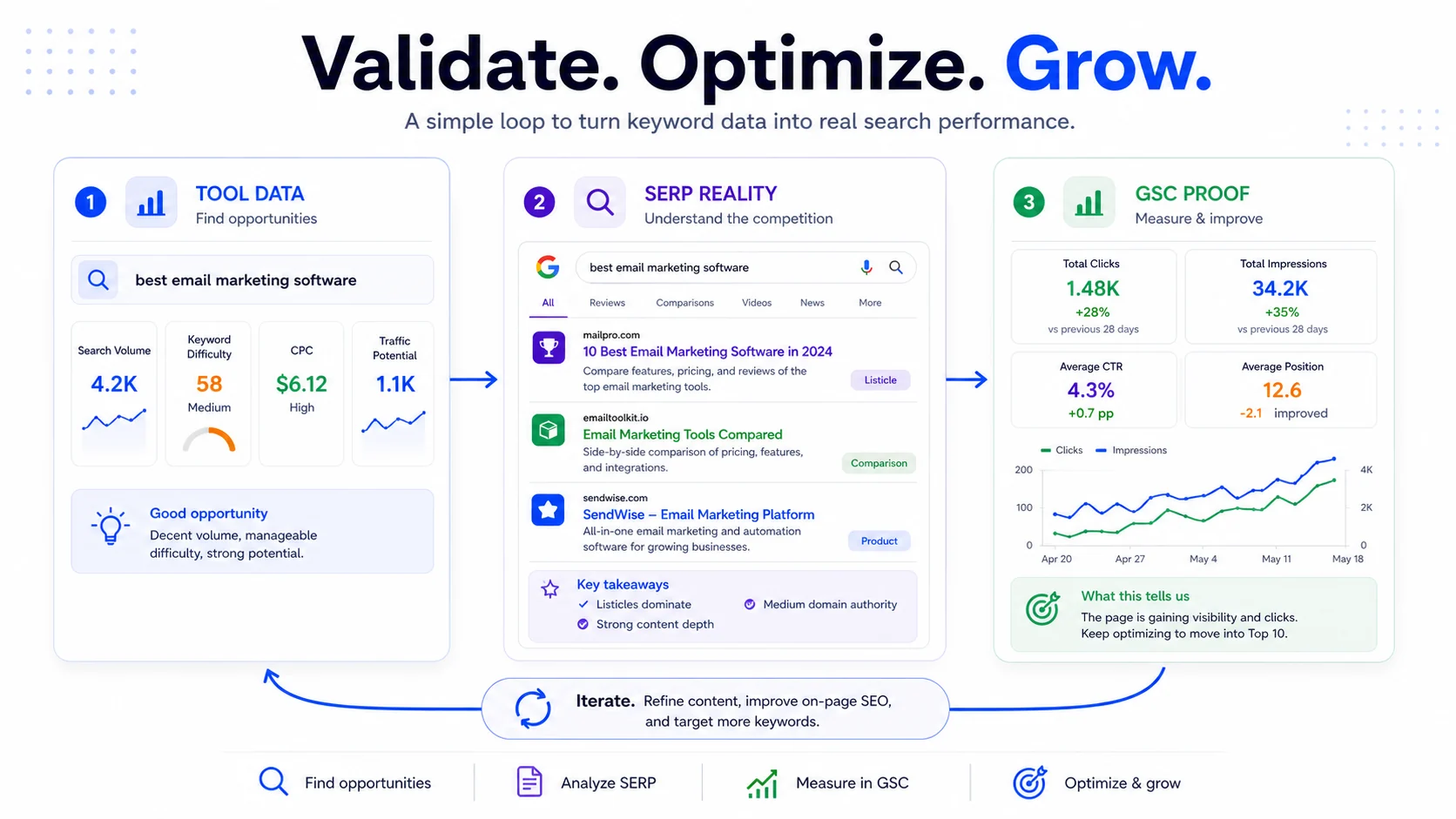
After publishing or improving a page, validation should come from query groups, not one exact keyword. Look for new impressions, whether Google consolidates the right URL, whether CTR improves and whether the traffic makes sense for the business.
If a section starts receiving many queries of its own, it may deserve a page. If a new page does not gain signals, it may need stronger internal authority, a better format or a more specific intent.
Real demand signals that SEO tools do not show
Tools are the starting point, not the final judge. A low-volume keyword should move up your priority list if it repeatedly appears in sales calls, customer emails, support tickets, YouTube comments, Reddit threads, competitor comparisons or questions from your sales team.
This kind of signal is especially useful in B2B, SaaS and high-value services, where demand often appears in specific language that tools do not always group well.
If a keyword appears in sales, support and Search Console, treat it as a real opportunity even when estimated volume is low.
Turn this into a repeatable process
Create a sheet or system with columns for volume, difficulty, intent, business value, SERP format, owning URL, current status and decision. The final column should not be “publish yes/no.” Use: do now, test as a section, plan, consolidate or skip.
To complete the workflow, connect this guide with types of keywords in SEO, when a keyword deserves its own page or just a section, keyword mapping SEO and Search Console as a decision system.
Sources and references
This guide is grounded in Google’s principles for helpful content, the Google Search Console Performance Report, Ahrefs on keyword research, Ahrefs SEO statistics, Backlinko CTR data, Semrush on keyword difficulty, Semrush on zero-click search and Mangools on search intent.
Conclusion
When volume, difficulty and intent disagree, do not look for one winning metric. Look for a better decision. The right keyword is not always the biggest or easiest one. It is the one you can satisfy, measure and connect to a real outcome.