
Not every type of keyword does the same job. Some keywords attract traffic. Others capture demand. Others build topical authority. And some only create noise if you turn them into standalone pages.
That is why classifying keywords should not be an academic exercise. The classification only matters if it changes an SEO decision: what to create, what to improve, what to merge, how to link and what to measure.
The target keyword for this article, types of keywords in SEO, has an educational SERP, moderate difficulty and People Also Ask plus AI Overview visibility. That fits a practical guide, but the goal here is not to repeat the classic list. The goal is to turn keyword types into a decision system.
Tool: SEO keyword classifierIdentify keyword type, priority and the best editorial action.Open tool
Keyword inputs
The classic classification: informational, navigational, commercial and transactional
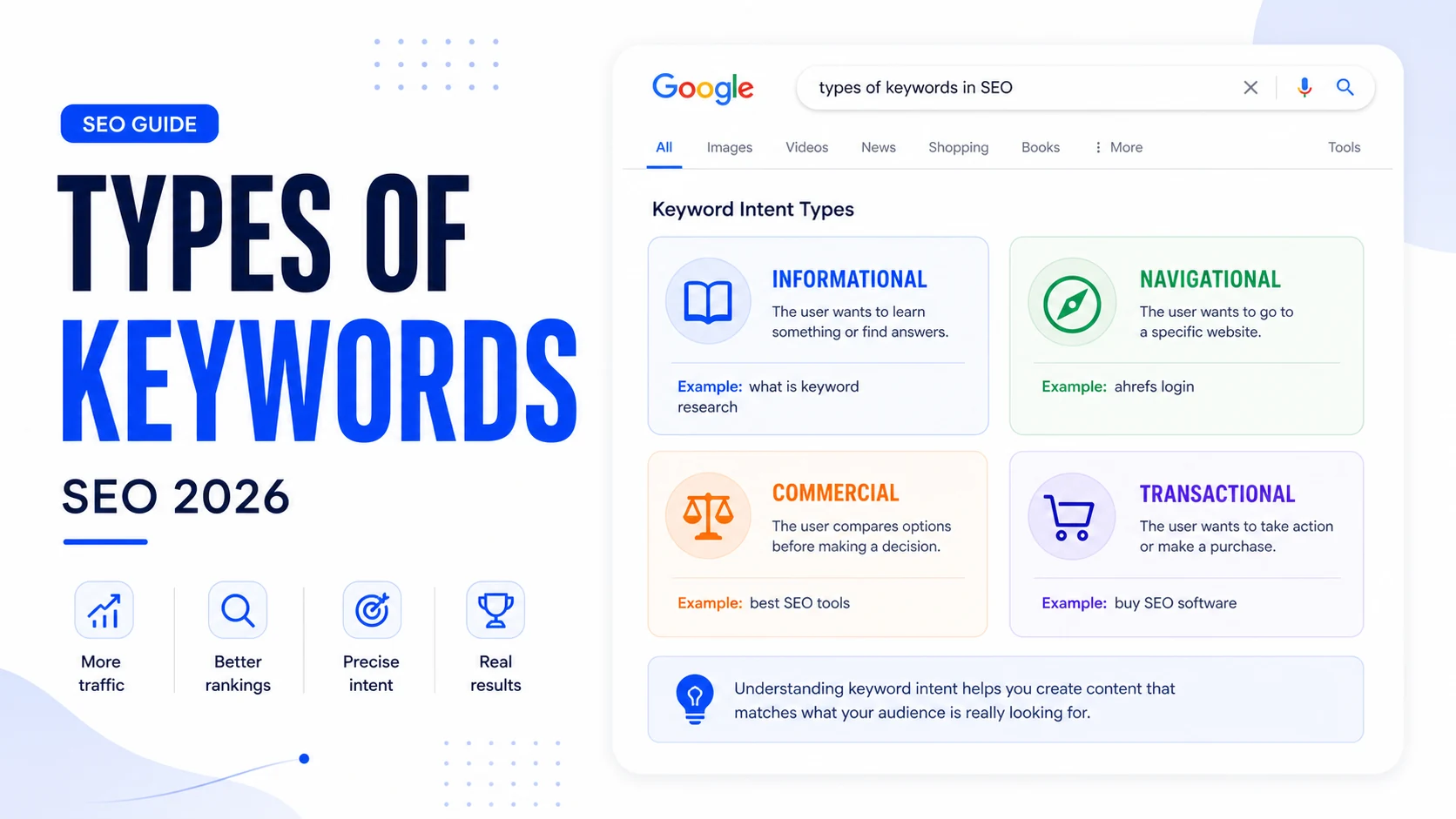
The most useful place to start is search intent. Semrush, Mangools and most SEO tools use this logic because it summarizes the searcher’s state of mind: they want to learn, reach a site, compare or act.
But this classification should not stop at labels. An informational keyword does not need the same page as a commercial keyword. A transactional keyword should not be buried inside a blog post. And a navigational keyword rarely deserves aggressive acquisition work unless you are managing brand, alternatives or comparisons.
Informational keywords
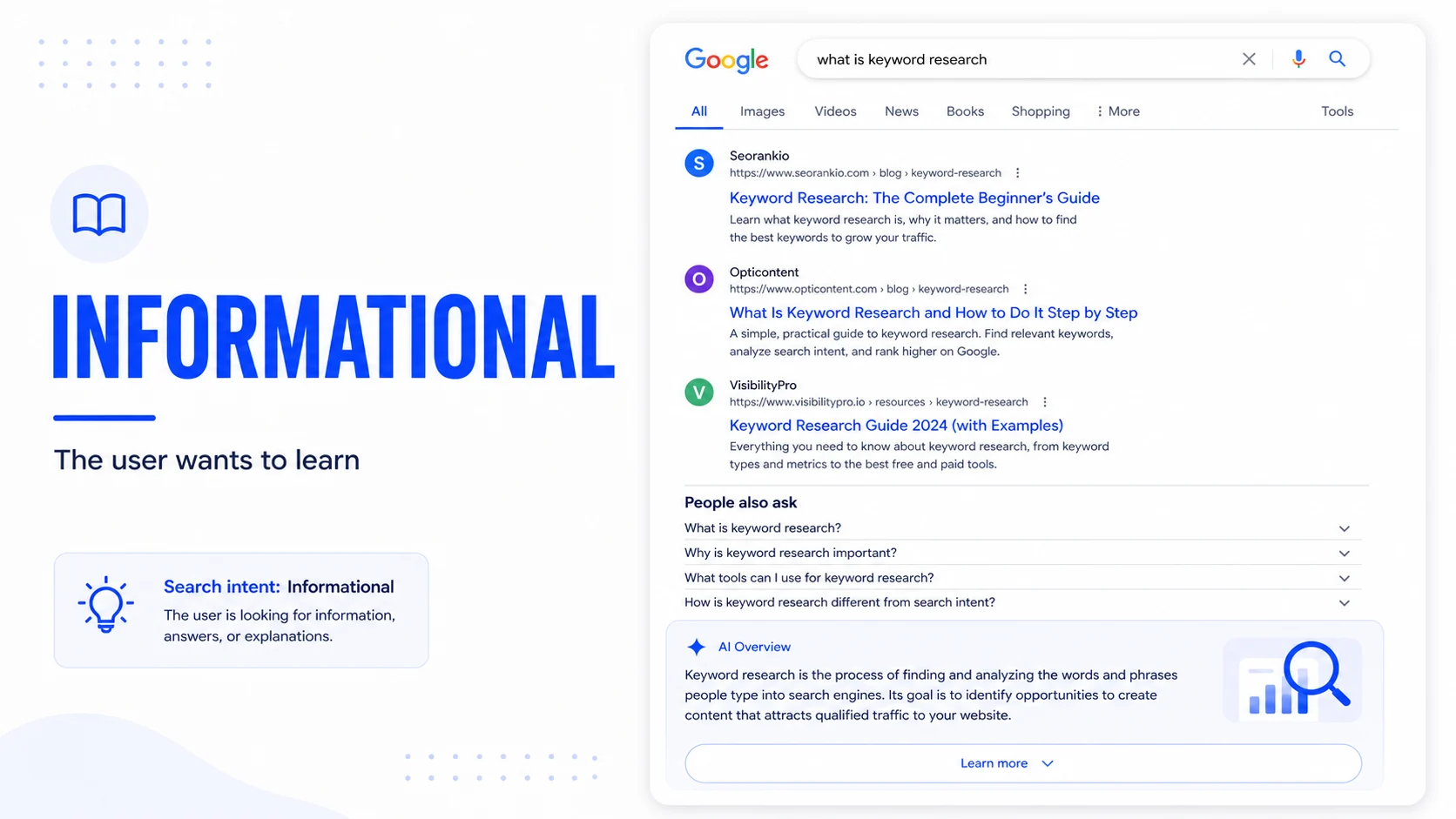
An informational keyword appears when the user wants to understand something. Examples: “what is keyword research,” “how technical SEO works” or “types of keywords.” These keywords are useful for early demand, topical authority and internal linking.
The mistake is measuring them only by direct leads. Many informational keywords will not convert on the first visit, but they can help Google understand your topical coverage and help users find the next step.
Create a standalone page when the topic needs depth, examples, structure and can become a linkable resource. If it can be answered in three paragraphs, it probably belongs as a section.
Navigational keywords
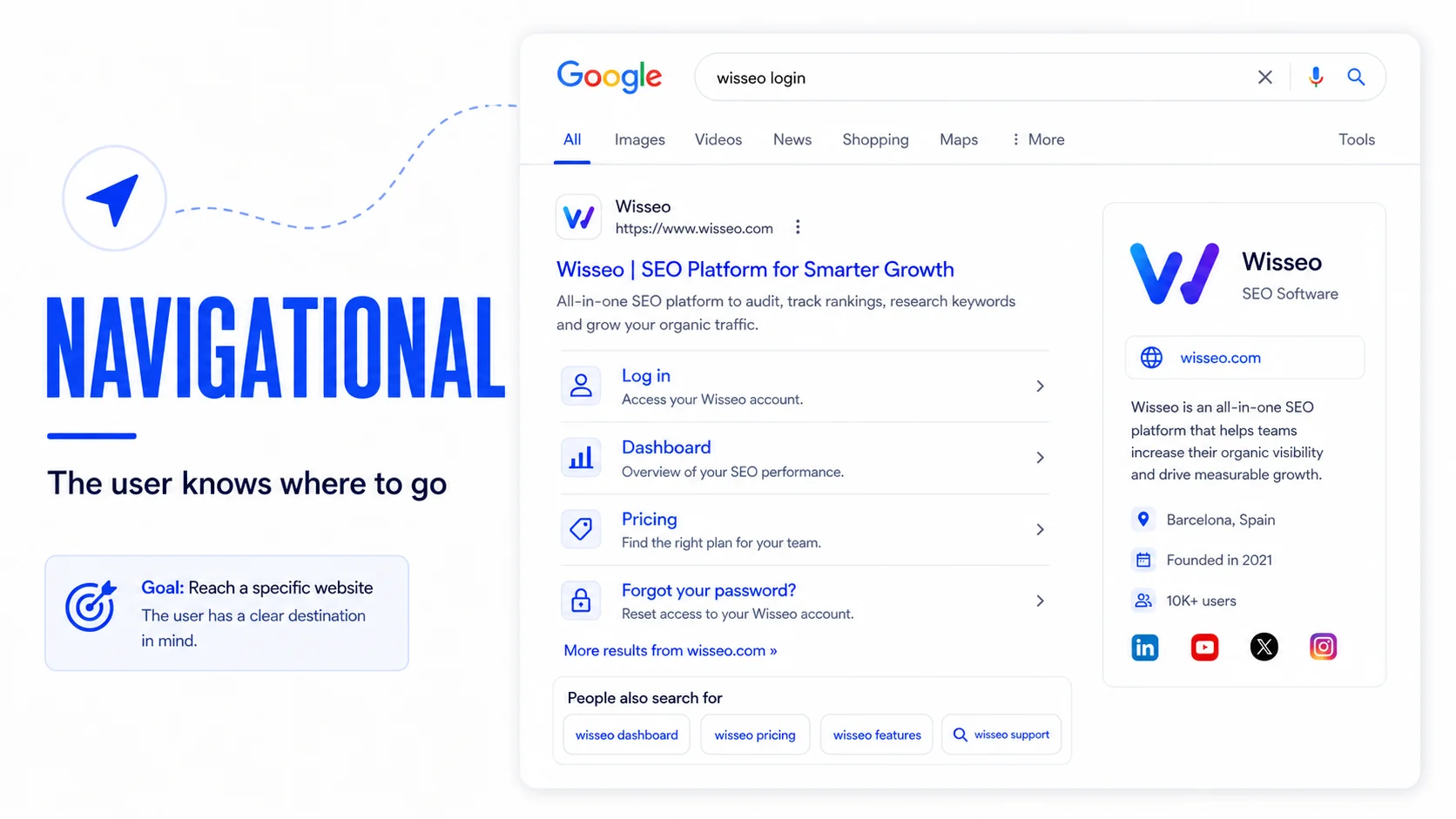
A navigational keyword appears when the user already knows where they want to go. Examples: “Google Search Console login,” “Ahrefs pricing” or “Wisseo keyword research.” In general, these are not the best opportunity for acquiring new cold traffic from other brands.
Still, they matter for your own brand. If someone searches for your name, tool, pricing or key pages, the SERP should be clean, clear and controlled. Here SEO looks more like reputation and brand experience than cold acquisition.
Commercial keywords
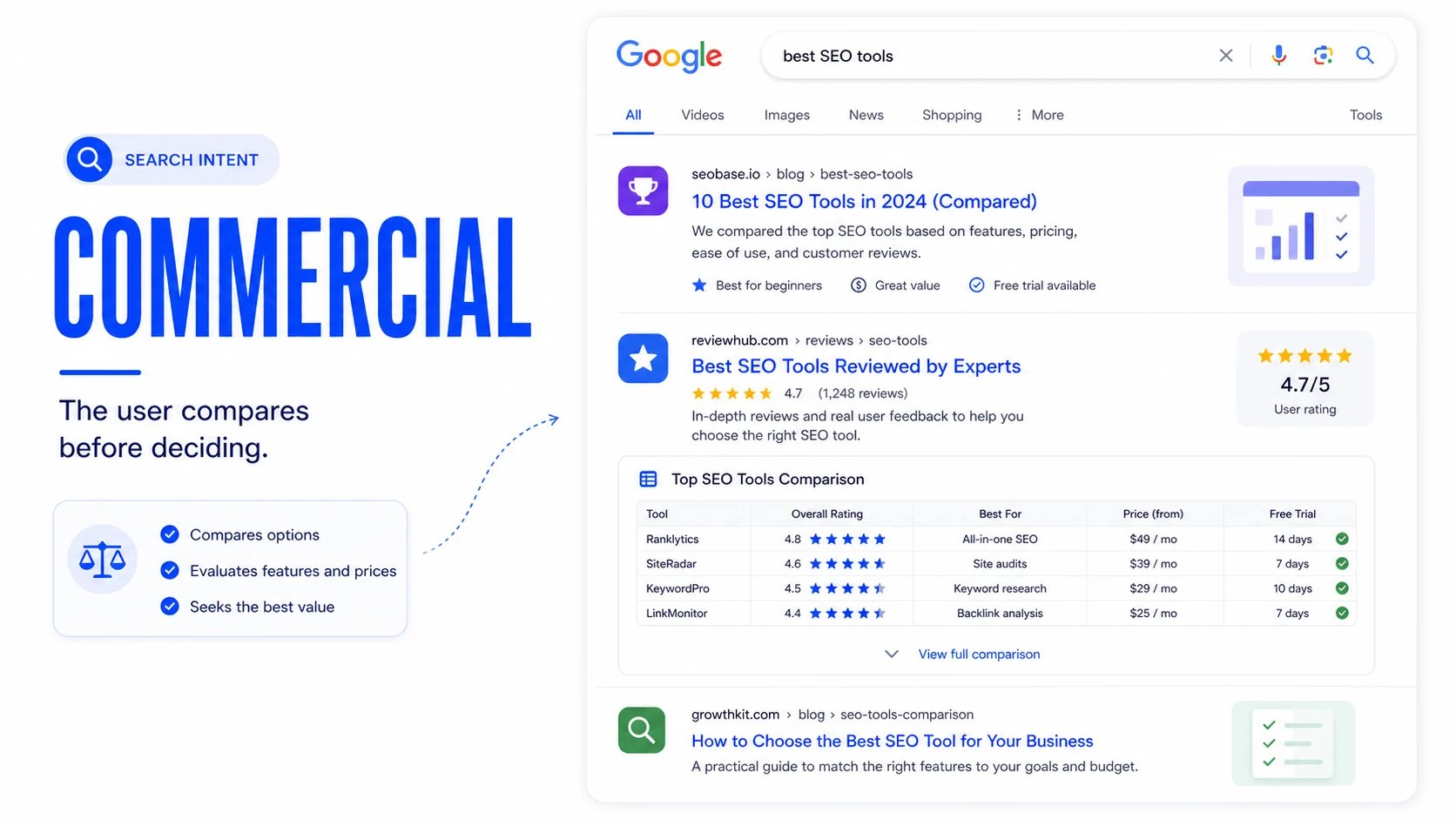
Commercial keywords live in the comparison phase. Examples: “best SEO tools,” “Semrush vs Ahrefs,” “HubSpot alternatives” or “best CRM for freelancers.” The user is not buying yet, but they are narrowing options.
This type of keyword often carries more value than pure informational demand because it connects to a decision. It also requires more trust: clear criteria, experience, pros and cons, pricing, use cases and freshness.
Transactional keywords
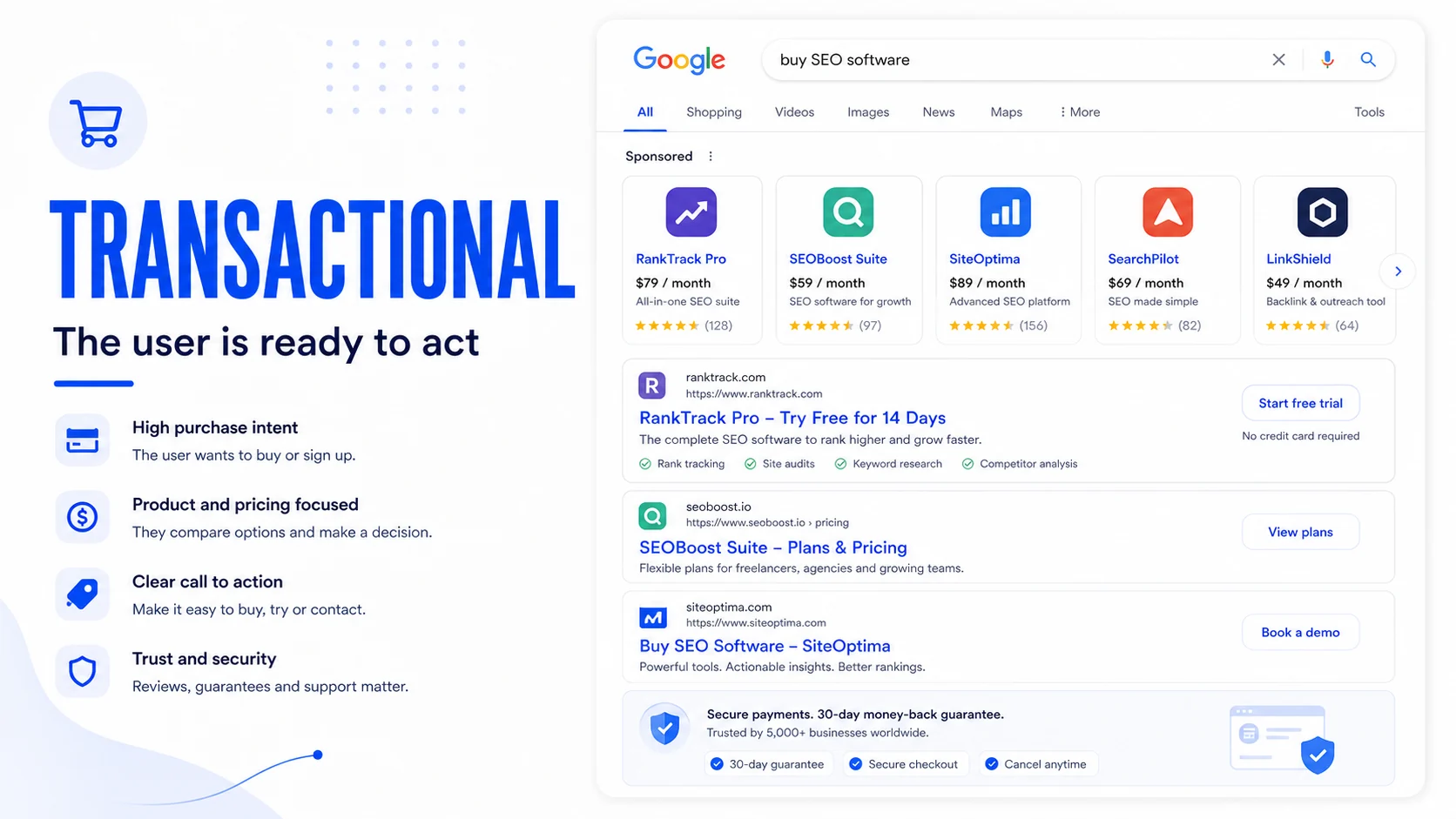
A transactional keyword appears when the user is close to acting. Examples: “buy SEO software,” “SEO agency for ecommerce,” “SEO audit pricing” or “hire SEO consultant.” The page should help the user convert, not just learn.
If Google shows service pages, landing pages, categories or product pages, a purely informational post is usually the wrong response. The page needs value proposition, proof, objections, CTAs and internal architecture around it.
Long-tail keywords
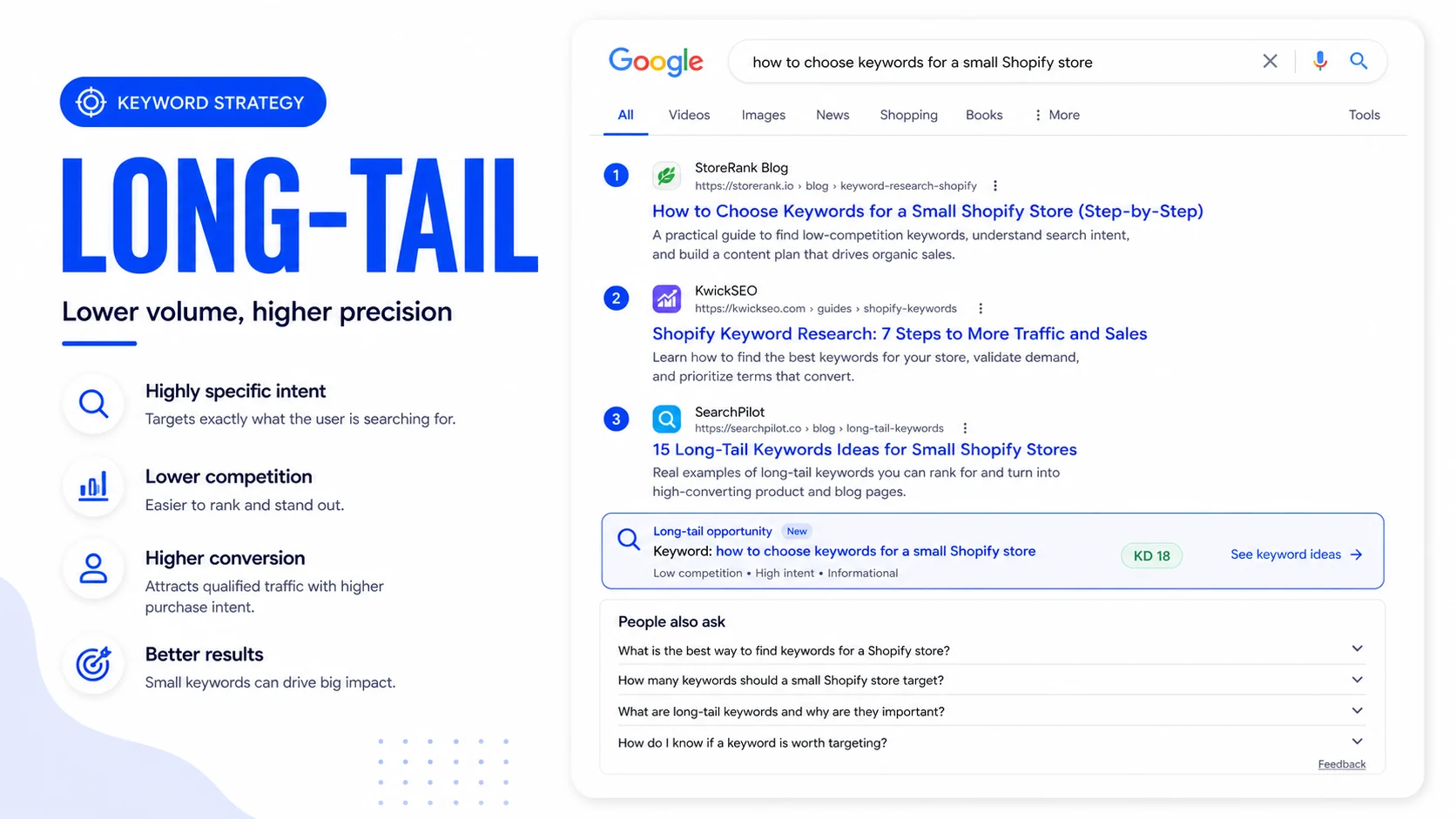
Long-tail keywords are longer and more specific searches. Sometimes SEO tools show little volume, but the query reveals a concrete problem. “How to choose keywords for a small Shopify store” is narrower than “keyword research,” but it is also easier to answer precisely.
Not all long-tail queries deserve standalone pages. Many work better as H2s, FAQs, examples or blocks inside a stronger guide. The question is whether they represent a new intent or just a variation of the same problem.
Local keywords
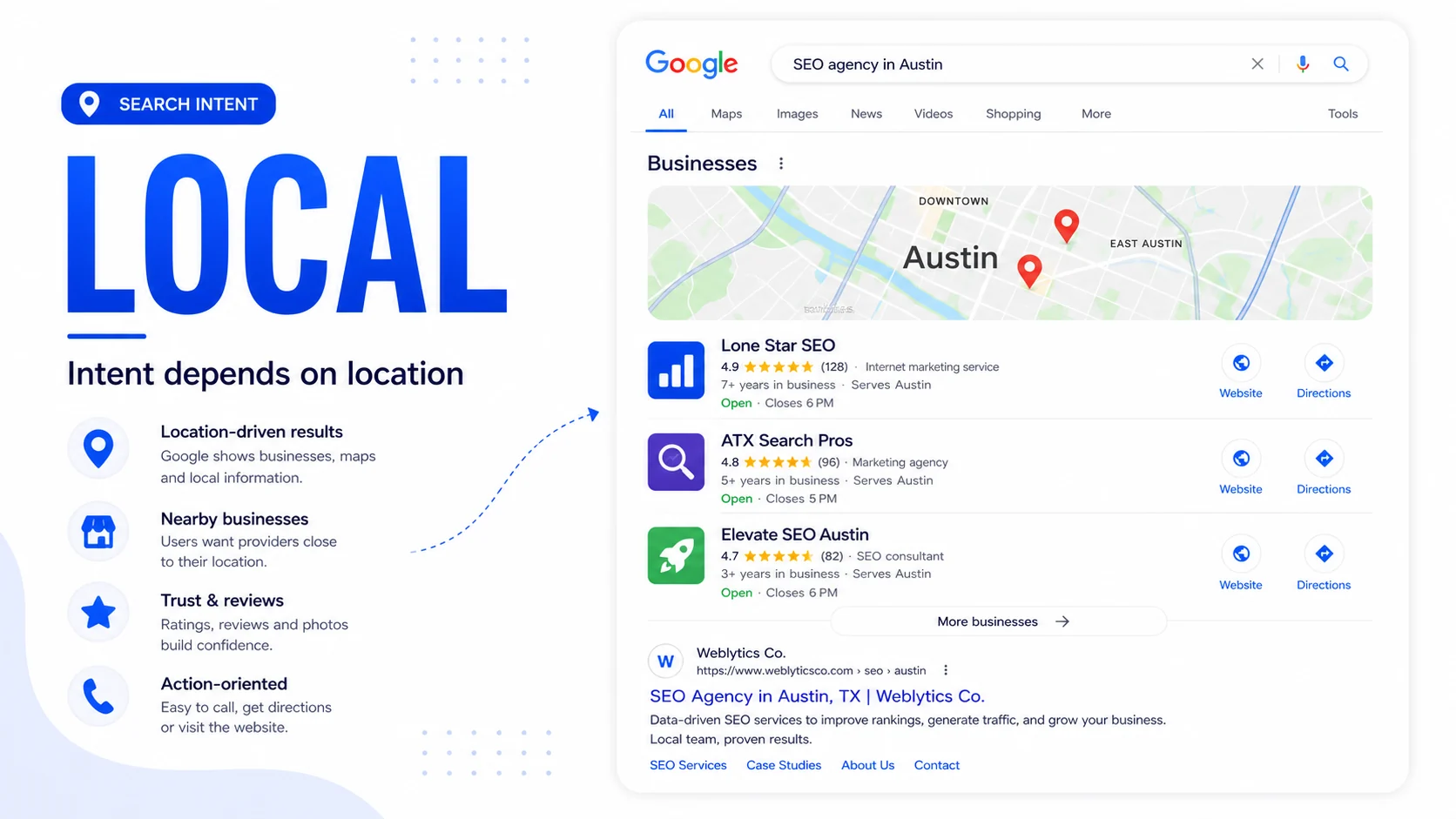
Local keywords mix commercial intent with location. Examples: “SEO agency in New York,” “employment lawyer Austin” or “dentist near me.” The SERP often combines a local pack, reviews, maps, directories and organic pages.
For local businesses, these keywords are not solved with content alone. Google Business Profile, reviews, NAP consistency, location pages, local authority and trust signals also matter.
Other keyword types that actually matter
Practical matrix: keyword type, content and goal
| Type | What to create | SEO goal | Common risk |
|---|---|---|---|
| Informational | Guide, definition, tutorial, glossary | Topical authority and early traffic | Chasing traffic without linking to business pages |
| Navigational | Brand page, login, pricing, help page | Brand control and experience | Competing where the destination is already decided |
| Commercial | Comparison, list, alternatives, use cases | Capture decision-stage demand | Publishing generic lists with no real experience |
| Transactional | Service, category, product, landing page | Conversion and revenue | Answering with a post when the SERP wants a landing page |
| Long-tail | Section, FAQ, example or specific page | Precision and lower competition | Creating too many thin URLs |
| Local | Local page, GBP, service-by-city page | Local visibility and leads | Ignoring reviews and local trust signals |
How to decide what type of page to create
Use it when the intent is distinct, the SERP shows dedicated URLs and there is enough business value or depth.
Use it when the keyword is a useful sub-intent, but not strong enough to support an independent URL.
Use it when several URLs compete for the same intent and Google switches between them.
How to measure whether you chose correctly
Validation is not about one exact keyword. Measure query groups, owning URL, new impressions, CTR, average position, assisted leads and internal links. Search Console is especially useful for seeing whether a page starts capturing related long-tail demand or whether Google is splitting queries between the wrong URLs.
For deeper workflows, connect this guide with when a keyword deserves its own page or just a section, keyword mapping SEO and how to turn Search Console into a decision system.
Sources and references
To prepare this guide, I reviewed the SERP and references from Semrush on keyword types by intent, Ahrefs on types of keywords, Mangools on search intent and Google’s documentation on helpful, people-first content.
Conclusion
The best keyword classification is not the longest one. It is the one that helps you decide. If you know the search intent, the SERP format and the role the keyword plays in your business, you can choose better between creating a page, strengthening an existing URL or simply adding a section.