

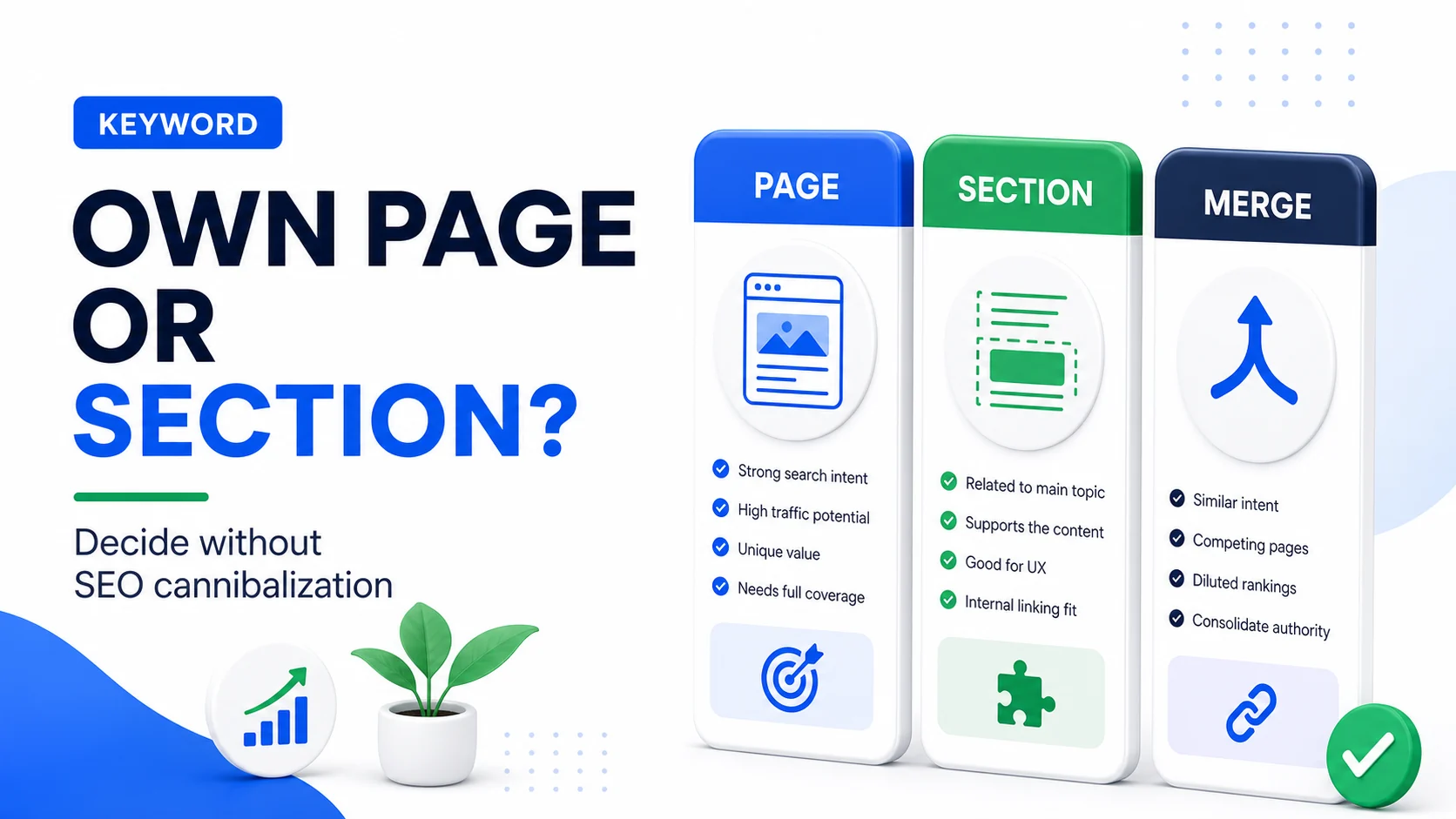
One of the most underrated SEO decisions is whether a keyword deserves its own page or should live as a section inside an existing page. It sounds like a small architecture choice, but it affects rankings, cannibalization, internal authority, maintenance and conversion.
The common mistake is treating every keyword as if it needs a URL. If a tool shows search volume, someone creates a page. If a phrase appears in Search Console, someone wants to publish an article. That is how sites end up with hundreds of weak, overlapping pages that are hard to maintain.
The right question is not “does this keyword have searches?”. The better question is: does this keyword represent a different enough intent to deserve its own search experience?
Decision tool: own page or sectionScore a keyword and decide whether it deserves a standalone URL, a section inside an existing page, or just a brief mention.Open tool
Keyword inputs
Recommendation
Create a strong section
Add the keyword as an H2 inside a broader page, with a complete answer and clear internal links.
A standalone URL may split signals if another page already covers the same intent.
Track impressions, new queries and average position for the main URL across 28 complete days.
This tool prioritizes editorial decisions. Always validate the real SERP and business value before creating new URLs.
The base rule: one URL per intent, not one URL per keyword

Google does not rank a page because you repeat an exact keyword combination. It ranks a page because it understands that the URL solves an intent better than the alternatives. Two keywords can look different and still belong to the same intent. The opposite is also true: two keywords can look similar but require separate pages because the user expects a different solution.
That is why “keyword” should not be the unit of architecture. The real unit is the intent group: the set of searches one page can answer without feeling forced, confusing or too shallow.
When a keyword deserves its own page

A keyword deserves its own page when it combines differentiated intent, enough depth and real business value. It does not need thousands of searches. Sometimes a small keyword deserves a URL because it converts well or defines a clear service category.
Example: if you have a page about “SEO services” and find “SEO for dental clinics,” a small section may not be enough. The vertical intent, examples, proof and objections are different. That keyword may deserve its own page if it matters commercially.
When it should only be a section
A keyword should be a section when it helps complete a broader page but does not justify a standalone experience. This is common with subtopics, FAQs, semantic variations and concepts users expect to find inside a larger guide.
For example, “where to place the main keyword” fits naturally inside a guide about how to add keywords to a website. A separate URL could work if the treatment is deep enough, but in most cases it strengthens the main page better as a section.
The section still needs to be real. An H2 with three lines does not turn a page into a complete answer. If the keyword has demand, the section needs clarity, examples, nuance and internal links.
The SERP tells you more than volume
Before deciding, look at what ranks. If the top results are dedicated pages about that exact intent, a section may be too weak. If Google ranks broad guides, category pages or resources that cover multiple subtopics, a section usually makes more sense.
Search volume can mislead you. Some low-volume keywords deserve pages because they have strong commercial intent. Some high-volume keywords do not deserve URLs because they are too broad, ambiguous or dependent on a larger parent intent. For a quick SERP-based check, use the process in how to find an easy keyword without tools.
What ranks in English for this topic
I reviewed the English SERP on June 28, 2026 for queries such as “keyword deserves its own page,” “own page or section SEO,” “one URL per intent SEO,” and “keyword cannibalization.” The pattern is clear: Google tends to surface content about search intent, keyword mapping, clustering and cannibalization, but fewer results turn that into a practical architecture decision.
Patterns visible in the English SERP
- Guides about cannibalization and page consolidation.
- Articles about keyword mapping and intent-based clustering.
- Resources explaining that one strong page can rank for many keyword variations.
- Advice about architecture, canonicalization and helpful content.
I also reviewed large live sites to see how this decision looks outside SEO theory. These are not perfect templates to copy blindly, because large brands can sustain more URLs than small sites. But they show useful patterns.
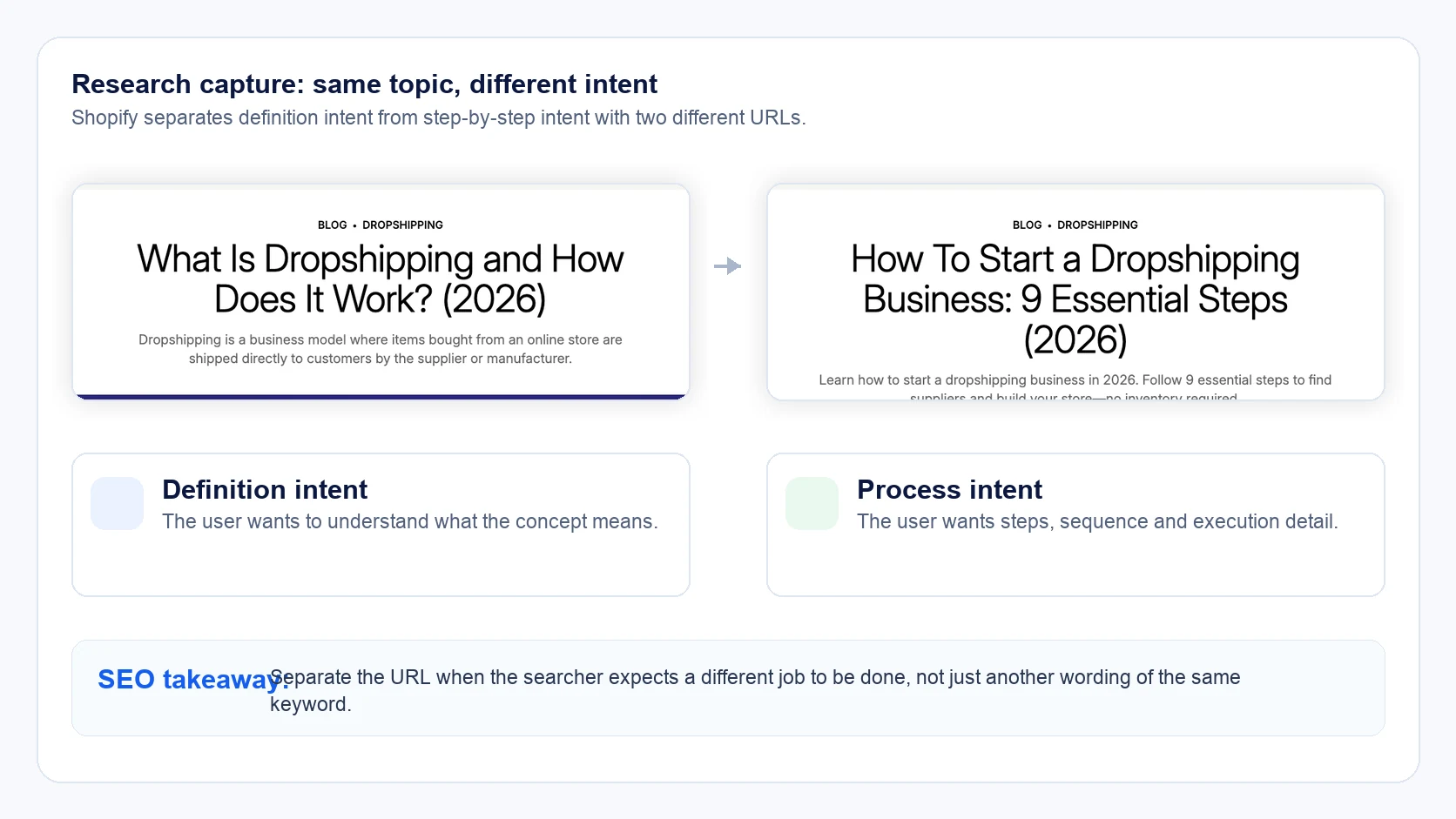
In Shopify’s case, the split makes sense because the searcher’s job changes. One query is definitional: what it is and how it works. The other is procedural: how to start step by step. Both belong to the same topic, but they deserve different experiences.
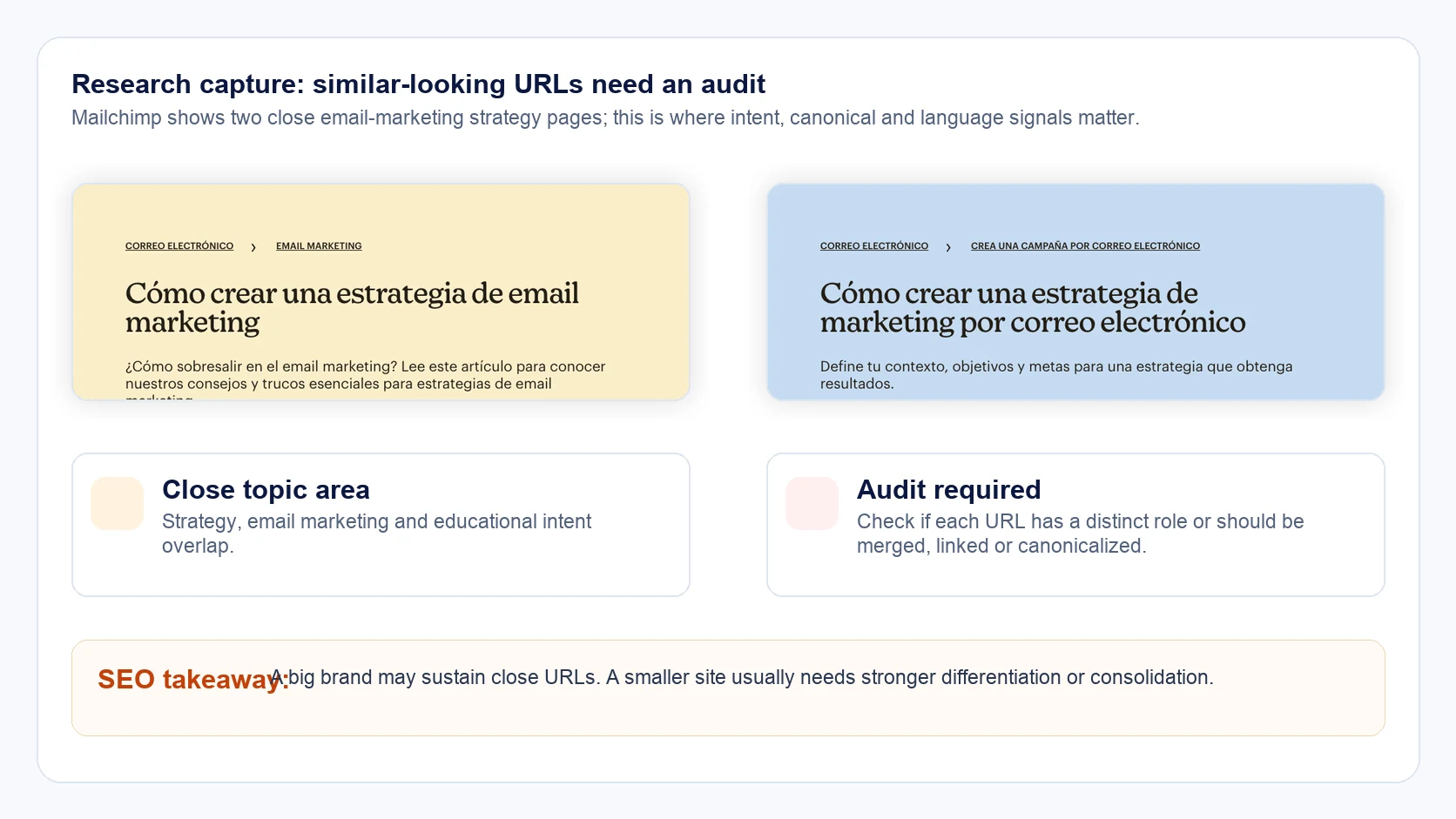
The Mailchimp example is useful for the opposite reason. The two URLs sit in a very close topic area. That does not automatically make them wrong, but it should trigger a core SEO question: does each page have a distinct role, or should one absorb the other?
The decision matrix
Distinct intent, business value and SERP results with dedicated URLs.
A useful subtopic that strengthens an existing URL without splitting signals.
High overlap, cannibalization risk and weak differentiation.
| Signal | Standalone page | Section | Do nothing yet |
|---|---|---|---|
| Intent | Clear and different | Related to an existing page | Ambiguous or too similar |
| SERP | Dedicated URLs dominate | Broad guides dominate | Mixed or weak results |
| Depth | Needs a complete answer | Works as a strong block | Can be answered briefly |
| Business | Can convert or support sales | Supports authority or consideration | No commercial priority |
| Overlap | Low overlap with current URLs | Partial overlap | High overlap and high risk |
The risk of creating too many pages

Creating new pages feels like an easy way to “cover more keywords,” but it also increases SEO debt. Every URL needs content, internal links, maintenance, updates, performance data and a clear reason to exist.
When you publish multiple pages for nearly identical intents, you can create cannibalization. It is not always catastrophic, but it can make Google alternate URLs, split signals and complicate reporting. Instead of one strong page, you get three medium-strength pages competing with each other.
If a keyword does not deserve its own page, that does not mean you should ignore it. It means you should put it in the right place inside the architecture.
How to use Search Console to decide
Search Console is useful when a page starts getting impressions for queries it does not fully answer. If one URL appears for many variations of a secondary intent, you have three options: improve the section, create a new page, or merge the intent into a better URL.
The most useful signal is not one isolated keyword. It is a query group that repeats, has impressions, fits the business and reveals an intent your page only partially serves. That is where a new page may exist. For a deeper workflow, see how to turn Search Console into a decision system.
Internal links to validate the decision
The decision does not end when you publish. A standalone page needs internal links that explain its role. A section needs links to the exact block or to the page that expands the topic. Use this mini-architecture:
SERP validationCheck whether the intent is actually worth competing for.
GSC dataDecide with query groups, not intuition.
Ranking signalsPrioritize relevance, content, authority and UX.
What to do if you are not sure
If you are unsure, start with a strong section inside the existing page. It is cheaper, reduces cannibalization risk and lets you validate whether Google starts associating that URL with new queries.
If the section later gains impressions, earns internal links, grows in depth and starts demanding its own experience, you can split it into a standalone URL. That evolution is usually safer than creating twenty pages from scratch with no prior signal.
Sources and references
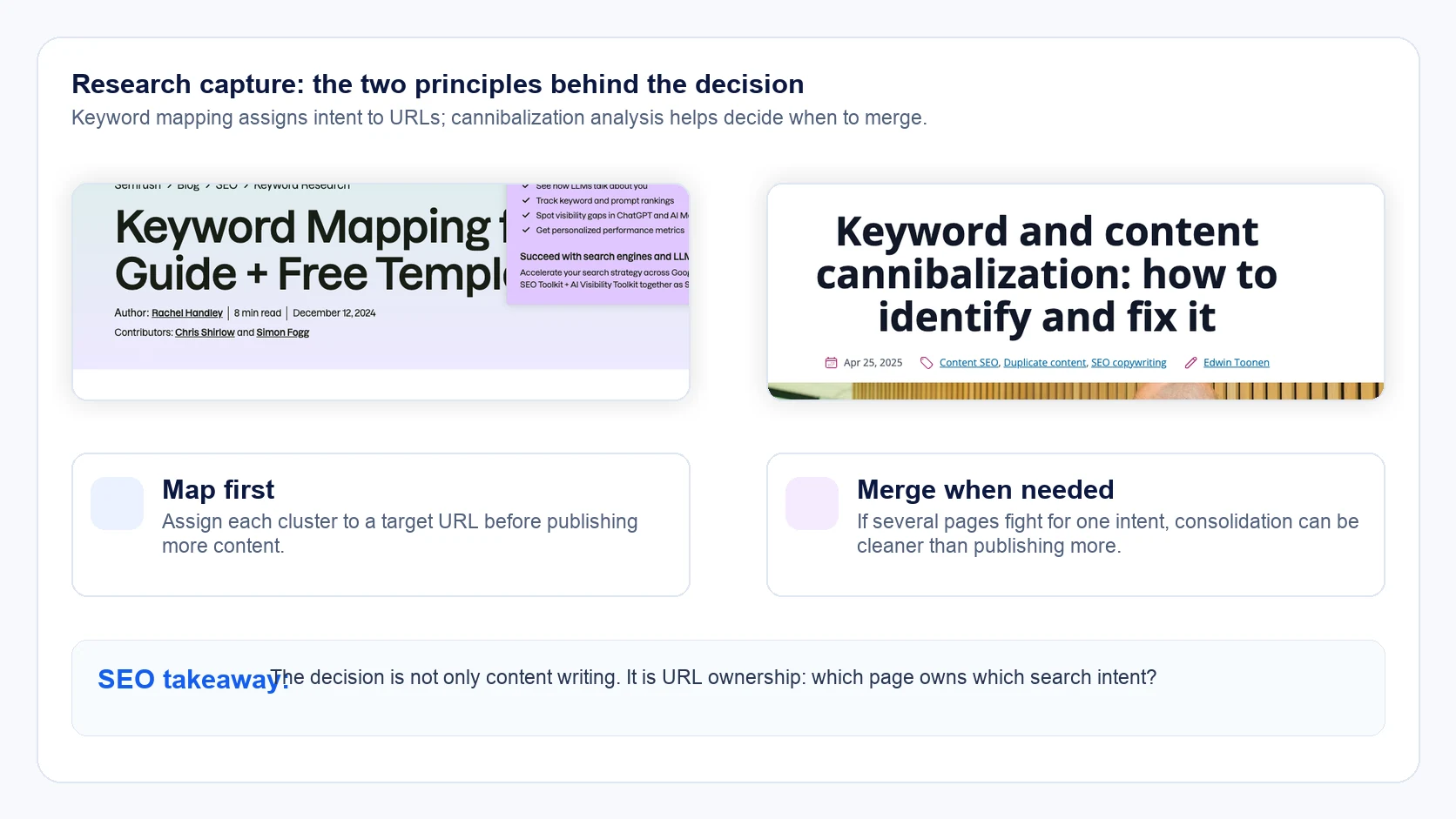
To keep this decision grounded, this article uses external references from Google on helpful, people-first content and consolidating duplicate URLs, Ahrefs on keyword research and keyword cannibalization, Semrush on keyword mapping, and Yoast on content cannibalization.
The final decision
A keyword deserves its own page when the user needs a different experience. It deserves a section when it completes a broader answer. It deserves nothing new when it only adds noise, overlap or thin content.
SEO does not improve because you have more URLs. It improves when every URL has a clear role in the architecture: capture an intent, solve it better than competitors, and move the user toward the next step.